02 · Research & Development
AI Drug Discovery in 2026: What Actually Works for Small Biotechs
How big pharma is investing, where AI is delivering measurable value, where it is not, and a practical playbook for reducing risk and shortening the path from discovery to clinic and commercial launch.
EllyCell, LLC
Biopharmaceutical Consulting, R&D, Licensing and Business Development
McLean, Virginia, USA
Email: info@ellycell.com
Website: https://ellycell.com/
Executive summary
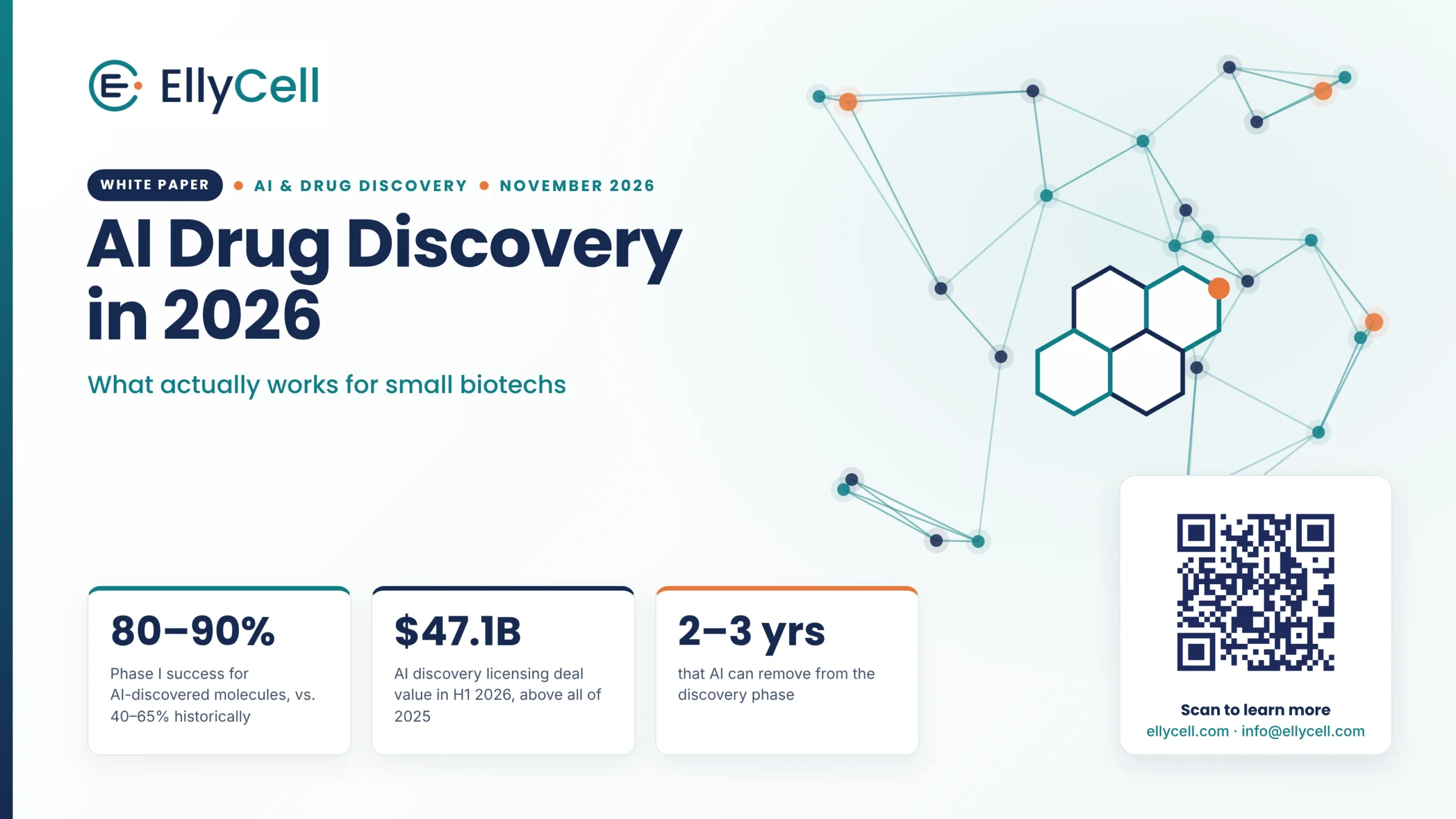
By late 2026, AI drug discovery has moved from promise to a measurable track record, but the record is uneven. AI reliably shortens the chemistry phase of discovery and produces molecules with better drug-like properties. It has not yet shown that it can pick biology that works better in patients. No AI-discovered drug has been approved so far, although the first approval decisions are now within sight.
173+
AI-derived programs in clinical development (early 2026)
~$60B
invested in AI drug discovery since 2019
$47.1B
AI discovery licensing deal value, H1 2026
0
FDA-approved AI-discovered drugs (Nov 2026)
Key takeaways for small biotech leaders
AI works best as a speed and quality tool in discovery. Insilico reports 12 to 18 months from project start to preclinical candidate, with only 60 to 200 molecules made per program, versus a typical 2.5 to 4 years.
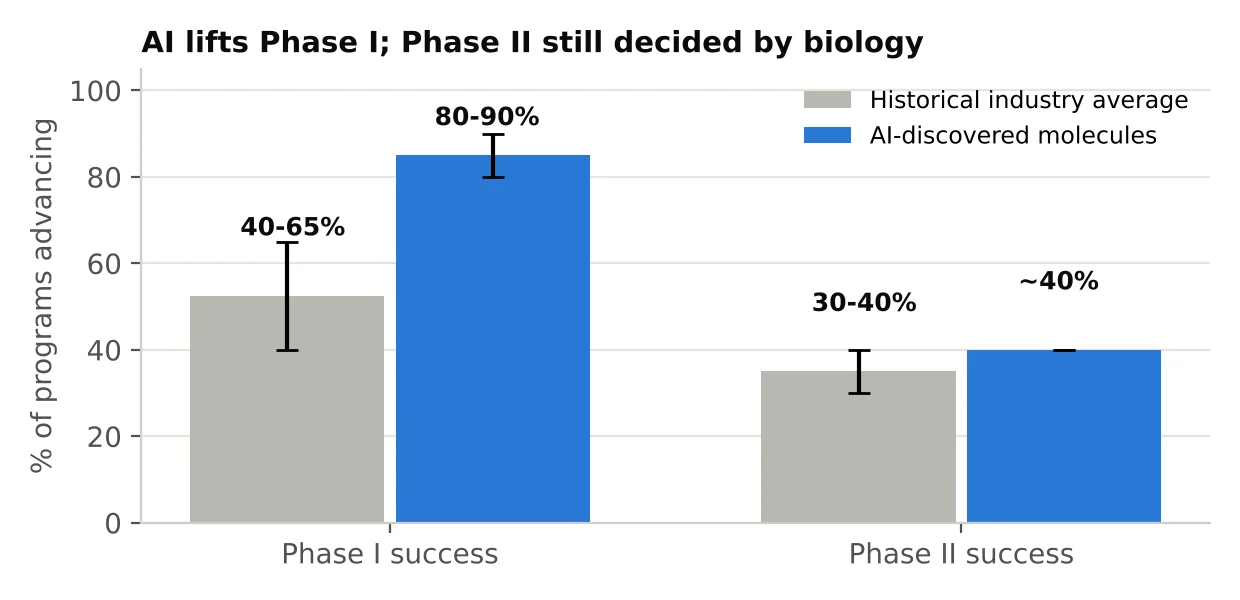
Phase I looks better; Phase II does not (yet). AI-discovered molecules passed Phase I 80 to 90% of the time, versus a 40 to 65% historical average. In Phase II, success was about 40%, in line with the industry.
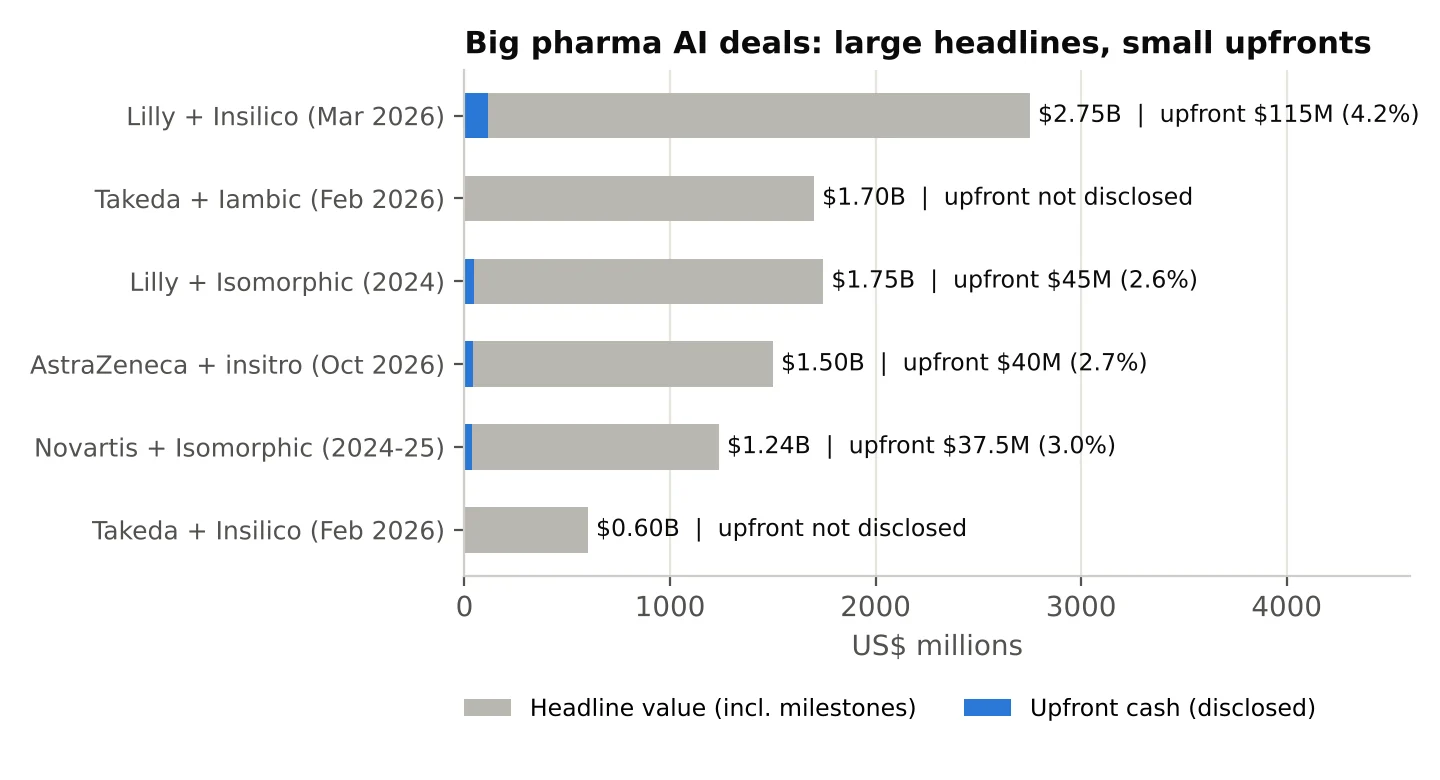
Big pharma pays for options, not certainty. Headline AI deals of $1.5B to $2.75B typically carry upfront cash of only about 2.5 to 4%. The rest is milestones.
The winning small-biotech model in 2026 is an asset company that uses AI, not a platform company that sells AI. Validated assets with clean data packages earn the large upfronts.
Time savings after the clinic come from execution: early CMC planning, AI-assisted trial design (for example, digital twins that shrink control arms), and early regulator engagement.
Where AI drug discovery stands in 2026
Three 2026 milestones mark the field’s transition from early-stage hype to late-stage evidence:
First AI-designed molecule under FDA review. Takeda’s zasocitinib, an oral TYK2 inhibitor designed by Nimbus Therapeutics using computational and AI methods, had its New Drug Application accepted under Priority Review in September 2026. The FDA’s target action date is in the first quarter of 2027. Both Phase 3 psoriasis trials met all primary and 44 ranked secondary endpoints.
First fully AI-originated drug in Phase 3. Insilico Medicine started a Phase 3 trial of rentosertib in idiopathic pulmonary fibrosis (IPF) in July 2026. Both its target (TNIK) and its molecule came from Insilico’s AI platform, and its Phase 2a results were published in Nature Medicine.
Record capital for AI-first companies. Isomorphic Labs (the Google DeepMind spinout) raised a $2.1B Series B in May 2026 and is targeting its first human trials by the end of 2026.
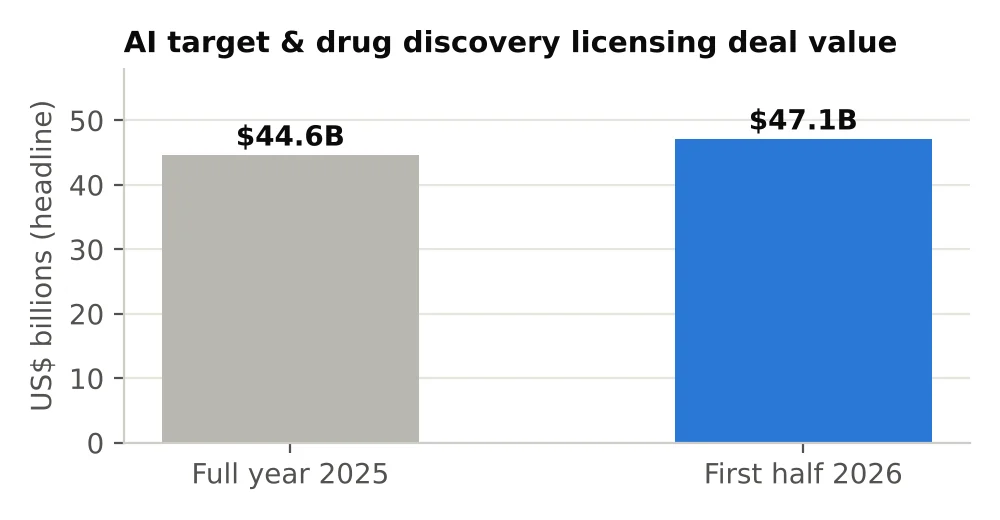
Deal activity has grown alongside the science. AI-based target and drug discovery licensing deals reached $47.1B in headline value in the first half of 2026, already above the $44.6B recorded for all of 2025 (DealForma, via EMARKETER). Big pharma is under pressure to refill pipelines: an estimated $300B of prescription drug revenue faces patent expiration by 2030.
What actually works, and what does not
The clearest dataset comes from a Boston Consulting Group analysis published in Drug Discovery Today. By December 2023, 24 AI-discovered molecules had completed Phase I and 21 succeeded. Of 10 that completed Phase II, 4 succeeded. The sample is small, but the pattern is consistent with later experience: AI is good at designing molecules that are safe and behave well in the body, but efficacy still depends on whether the biological hypothesis is right.
Maturity by use case
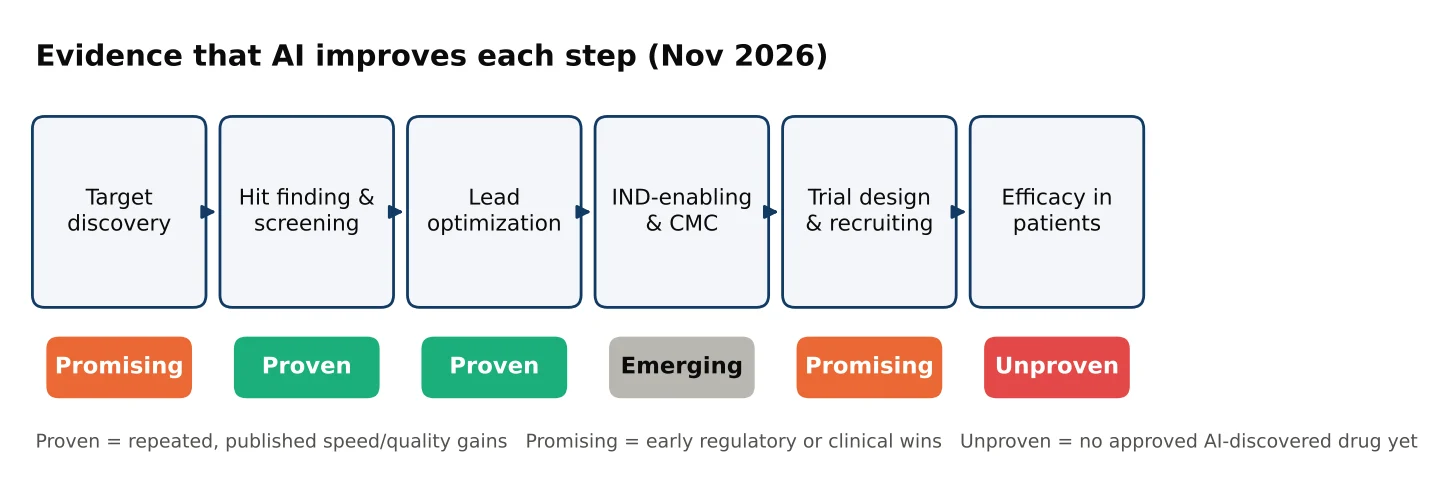
| AI use case | Maturity (2026) | What it delivers | Access for a small biotech |
| Structure prediction & virtual screening | Proven | Faster hit finding; fewer compounds to buy or make | Low cost: open models (Boltz-2, OpenFold) under permissive licenses |
| Generative chemistry & lead optimization | Proven | Candidate in 12 to 18 months with 60 to 200 molecules synthesized (Insilico) | Medium: vendor platforms or AI-enabled CROs |
| ADMET & toxicity prediction | Proven to promising | Fewer Phase I failures; cleaner safety profiles | Low to medium: commercial and open tools |
| Target discovery from multi-omics | Promising | Novel targets; still the riskiest step | High: needs proprietary or licensed patient data |
| Biologics / de novo antibody design | Promising | New binders, faster antibody discovery | Medium to high: partner with Chai, Generate and similar |
| Clinical trial design & recruitment | Promising | Smaller control arms; faster enrollment | Medium: service providers (for example, Unlearn) |
| Predicting efficacy in patients | Unproven | Not yet demonstrated at scale | N/A |
Lessons from the field
In silico Medicine (success story, still in progress). Rentosertib went from AI-identified target to Phase I in about 18 months. In Phase 2a, the highest dose improved lung function (FVC) by an average of 98.4 mL over 12 weeks, while placebo patients declined by 62.3 mL. Insilico has nominated 30+ preclinical candidates since 2021 and turned its platform into revenue through partnering, including a deal with Lilly worth up to $2.75B.
Nimbus Therapeutics (the best small-biotech exit). Nimbus used computational design to make a highly selective TYK2 inhibitor and sold it to Takeda in 2022 for $4B upfront (up to $6B total). Takeda projects peak sales of $3B to $6B if approved across indications. The lesson: a differentiated, data-backed asset in a validated pathway earns a premium.
Recursion (cautionary tale). Despite one of the largest AI platforms and its 2024 merger with Exscientia, Recursion ended or paused several programs in 2025 after mid-stage data failed to confirm efficacy (for example, REC-994 in cerebral cavernous malformation), cut its pipeline from 11 programs to about 7, and reduced its workforce by roughly 20%. The lesson: scale and data volume do not replace sound biology and disciplined indication choice.
How big pharma is investing in AI drug discovery
Large pharmaceutical companies use five main investment models. Most now combine several, and many work with competing AI vendors at the same time to compare them.
| Investment model | How it works | 2025-2026 examples |
| 1. Milestone-heavy discovery collaborations | Small upfront; pharma picks targets; AI company designs candidates; pharma runs the clinic | Lilly + Insilico (up to $2.75B; $115M upfront); AstraZeneca + insitro (up to $1.5B; $40M upfront); Takeda + Iambic (up to $1.7B); Takeda + Insilico (up to $600M) |
| 2. Platform / model licensing | Pharma licenses AI models or software to use in-house, often fine-tuned on its own data | Pfizer + Chai Discovery (Jun 2026, early access to Chai-3); Pfizer + Boltz (Jan 2026) |
| 3. Multi-program research alliances | Long-term alliances that expand as results come in | Novartis + Isomorphic (expanded from 3 to 6 programs); J&J + Isomorphic (Jan 2026; small molecules, antibodies, peptides, molecular glues) |
| 4. Acquisitions of assets and AI teams | Buy de-risked AI-designed assets, or buy AI companies to build internal capability | Takeda buys Nimbus’s TYK2 asset ($4B upfront); AstraZeneca acquires Modella AI (Jan 2026) |
| 5. Infrastructure & enterprise AI | Compute, foundation models and company-wide AI partnerships | Lilly + NVIDIA $1B co-innovation lab (Jan 2026); Novo Nordisk + OpenAI (Apr 2026) |
What the deal structures tell small biotechs
Pharma is buying options. Upfront cash is typically 2.5% to 4% of headline value. Plan your finances around the upfront and near-term milestones, not the headline.
Pharma keeps the clinic. In almost every deal, the large partner controls clinical development, regulatory filings and commercialization. The AI partner earns milestones and single-digit to low-double-digit royalties.
Validated assets earn far more than platforms. Nimbus’s $4B upfront for one clinical asset dwarfs the upfronts in any platform deal shown above.
Repeat partners are a signal. Novartis doubling its Isomorphic programs and insitro adding AstraZeneca after Gilead, BMS and Lilly show that land-and-expand is how AI companies win.
Pros and cons for small biotechs
| Advantages | Disadvantages and risks |
| Faster discovery: 12 to 18 months to a preclinical candidate is now achievable | No AI-discovered drug approved yet; investors still discount ‘AI’ as a label |
| Lower discovery cost: fewer molecules synthesized and fewer assay rounds | Phase II success is no better than industry average so far; biology risk remains |
| Better Phase I odds: 80 to 90% Phase I success in early data | Data quality and access: models are only as good as the data behind them |
| Open models (Boltz-2 under MIT license) put advanced tools within reach of small teams | Platform builds are expensive; burn rate can outrun clinical proof (Recursion’s 2025 cuts) |
| Stronger partnering story when AI is backed by experimental validation | IP questions: AI cannot be named as an inventor; human contribution must be documented |
| Regulators are building a path: FDA’s 7-step credibility framework; joint FDA-EMA Good AI Practice principles (Jan 2026) | Regulatory expectations for AI used in submissions are still being finalized |
Reducing risk
Most AI programs fail for the same reasons traditional programs fail: the wrong target, the wrong patients or an unworkable development plan. The checklist below addresses those risks directly.
| Risk | Mitigation |
| Biology / target risk | Prefer targets with human genetic or clinical validation; use AI to find a differentiated molecule against a validated mechanism (the Nimbus model) before betting on a novel AI target |
| Translational risk | Define biomarkers and patient selection early; test in patient-derived models; design Phase 1b/2a to read out efficacy signals, not only safety |
| Model / data risk | Validate AI predictions experimentally at every step; benchmark more than one tool; record each model’s context of use as the FDA framework expects |
| CMC / manufacturing risk | Check synthetic route, scalability, salt and formulation before candidate nomination; lock a CDMO plan by IND-enabling |
| Financing risk | Stage-gate spending; fund to a value-inflection readout; pursue non-dilutive grants and partner milestones |
| IP risk | Document human inventive contribution; file composition-of-matter early; run freedom-to-operate on AI-generated scaffolds |
| Partnering risk | Build a buyer-ready data room early; map likely partners by indication and modality; align the package with each buyer’s strategy |
Shortening time from discovery to clinic and launch
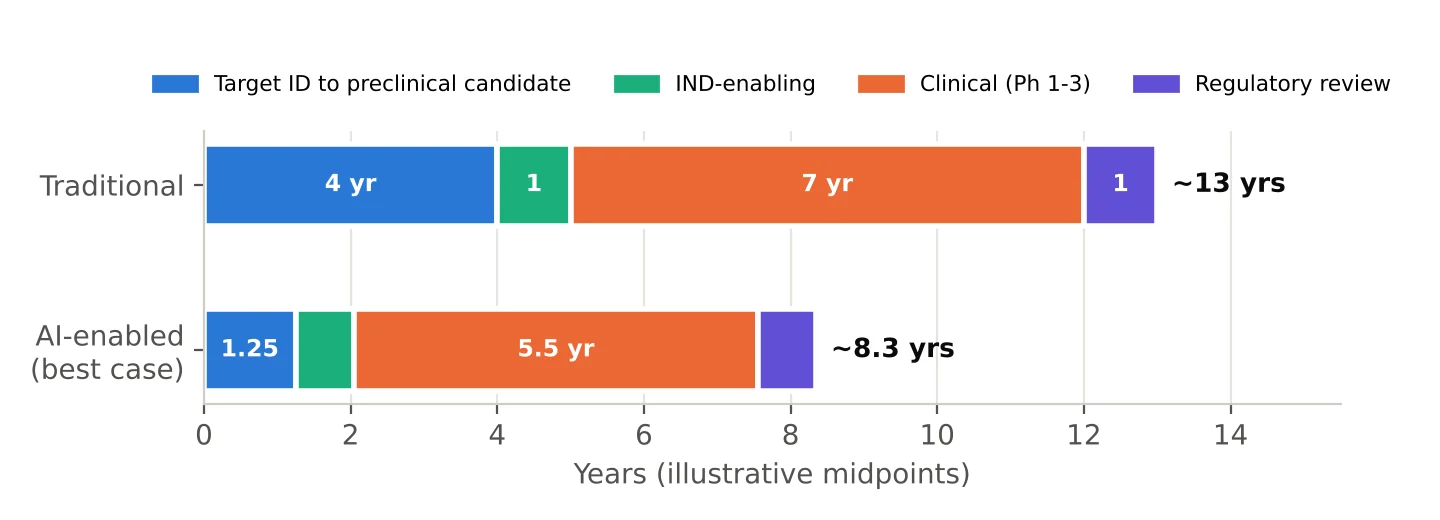
AI can remove roughly 2 to 3 years from discovery. Further gains come from running the later stages in parallel and executing them well. The figure below is illustrative and uses midpoints of published ranges; actual timelines vary widely by indication and modality.
| Stage | Typical time | Levers that cut time |
| Target to preclinical candidate | 2.5 to 4+ years | Generative chemistry; open structure and affinity models; automated design-make-test cycles (12 to 18 months achievable) |
| IND-enabling | ~12 months | Start CMC route scouting and GLP tox planning before candidate nomination; use AI toxicity prediction to choose backup compounds |
| Phase 1 to 3 | 6 to 8 years | AI-assisted site selection and recruitment; digital-twin control arms (Unlearn reports 30 to 35% smaller control arms, EMA-qualified method); adaptive designs; biomarker enrichment |
| Regulatory review | ~10 to 12 months | Priority Review / Breakthrough / Fast Track where eligible; early Type B/C meetings; AI credibility documentation prepared in advance |
| Commercial launch | Ongoing | Partner early with a company that has commercial reach; plan market access and manufacturing scale-up during Phase 3 |
A 12-month starter playbook
- Months 0 to 2: Choose the indication and target based on validation strength and unmet need. Run a competitive landscape. Choose the AI approach (in-house open models, a vendor or an AI CRO).
- Months 2 to 8: Run design-make-test cycles with clear go/no-go criteria. Check synthetic feasibility and early ADMET in parallel.
- Months 8 to 12: Nominate a candidate with a backup. Draft the IND-enabling and CMC plan. Build the data room and partner map. Begin non-confidential outreach.
How EllyCell can support you
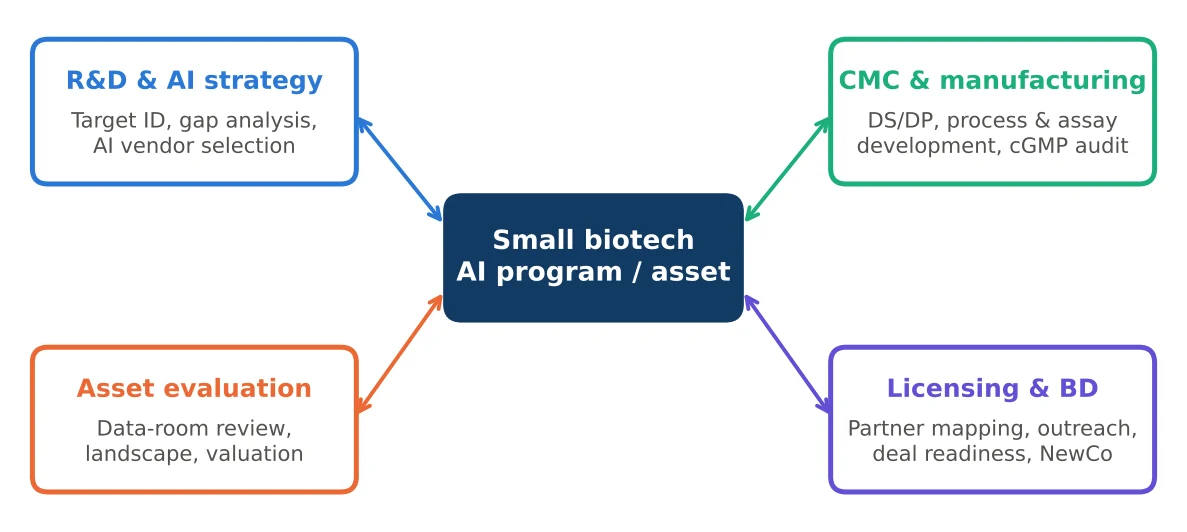
EllyCell helps small and mid-size biotechs turn AI-generated science into investable, partner-ready programs. Our team brings hands-on experience from preclinical work through Phase 1/2 clinical development, CMC and manufacturing, and licensing, with team members in the United States, Belgium, France and China.
| Your need | How EllyCell helps |
| Choosing where AI fits | AI strategy and vendor selection; target identification and gap analysis; partnering plan by indication |
| Making AI molecules developable | Drug substance and drug product manufacturing support, process development, assay development and qualification, CMC strategy |
| Quality and compliance | cGMP / GLP audits, CAPA, process characterization and PPQ support |
| Proving value to investors | Asset valuation; preclinical and clinical data review with indication-specific MD clinicians; data-room assessment; investment-package readiness |
| Finding the right partner | Landscape and competitor analysis; pharma partner mapping; in- and out-licensing and BD representation; NewCo structuring with investors |
| Visibility | Conference coverage and media through EllyCell’s LinkedIn and YouTube channels (50,000+ followers) |
Start with a no-obligation asset review
Share a non-confidential summary of your program or platform.
We will assess development readiness, the AI value story and likely partner fit.
You receive a short readiness memo with prioritized next steps.
EllyCell, LLC, McLean, Virginia, USA https://ellycell.com, info@ellycell.com
References
Takeda: FDA accepts zasocitinib NDA under Priority Review (Sep 14, 2026)
Insilico Medicine: Phase III trial of rentosertib initiated (Jul 7, 2026)
IntuitionLabs: AI-Discovered Drugs in Clinical Trials 2026
EMARKETER: AstraZeneca strikes $1.5B deal as pharma pours billions into AI drug discovery
AstraZeneca: collaboration with insitro (Oct 15, 2026)
PharmExec: Eli Lilly and Insilico $2.75B agreement (Mar 30, 2026)
BioSpectrum Asia: Takeda and Iambic $1.7B deal (Feb 11, 2026)
WebProNews: Takeda’s $600M Insilico deal
GEN: Pharma bets big on AI platforms (Lilly-NVIDIA, J&J-Isomorphic)
Pharmaceutical Technology: Pfizer and Chai Discovery licensing (Jun 5, 2026)
BioPharm International: Isomorphic Labs raises $2.1B (May 13, 2026)
Philipp Dubach: Isomorphic deal structures (upfront vs. milestones)
DCAT Value Chain Insights: Novo Nordisk and OpenAI (Apr 2026)
HealthManagement.org: BCG analysis of AI-discovered molecules (Drug Discovery Today)
Insilico: Chemistry42 / preclinical candidate benchmarks
BioPharmaTrend: Insilico preclinical benchmarks and Phase 2a data
Fierce Biotech: Takeda zasocitinib Phase 3 success
GEN: Recursion halts four pipeline programs
GEN: Recursion data update and workforce reduction
MIT Jameel Clinic: Boltz-2 open-source binding affinity model
PQE Group: The FDA guide to AI in drug development