02 · Research & Development
Sequencing, Transcriptomics and Bioinformatics
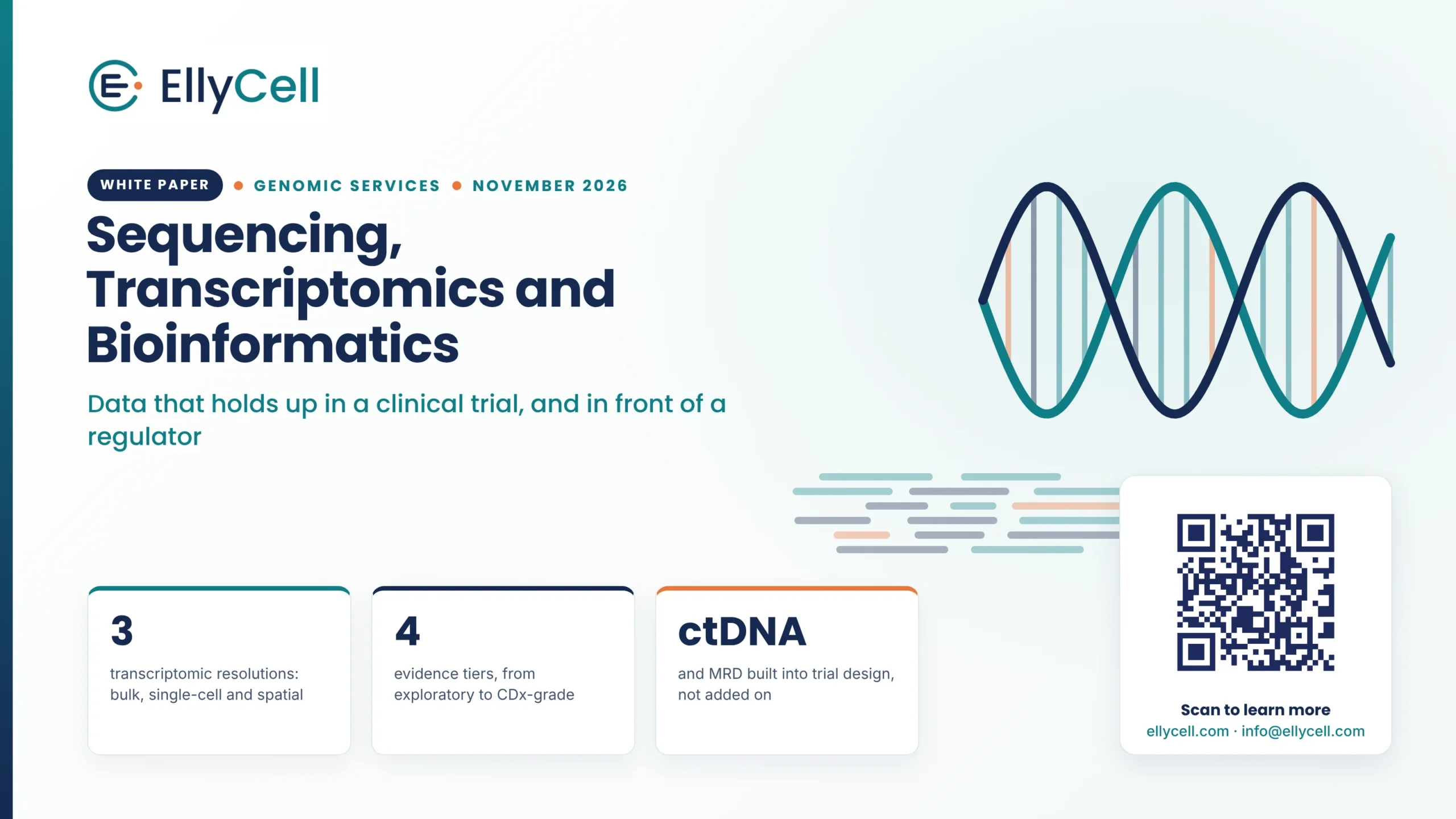
Data that holds up in a clinical trial, and in front of a regulator
Sequencing is cheap. Sequencing that a sponsor can put in a protocol, defend at a pre-IND meeting and carry into a registrational trial is not. This paper sets out how EllyCell designs, runs and documents NGS, transcriptomics and bioinformatics work for clinical programs.
EllyCell, LLC
Biopharmaceutical Consulting, R&D, Licensing and Business Development
McLean, Virginia, USA
Email: info@ellycell.com
Website: https://ellycell.com/
Executive summary
Most sponsors do not have a sequencing problem. They have a decision problem that sequencing is being asked to solve, and the two are often mismatched: a discovery-grade RNA-seq dataset is asked to support a patient-selection claim, or a vendor’s variant report arrives with no pipeline version attached and cannot be reproduced two years later when a reviewer asks.
EllyCell works backwards from the decision. We define what the data has to prove, choose the lowest-burden assay that proves it, specify and oversee the lab, lock the analysis, and write the package that a regulator or a partner’s diligence team will actually read.
End to end
design, vendor oversight, analysis and reporting in one scope
Fit for purpose
exploratory, qualified, validated or CDx-grade, chosen deliberately
Reproducible
versioned pipelines, fixed reference build, full audit trail
Trial-tested
experience across oncology, CNS and rare-disease programs
Key messages
Pick the modality from the question, not the catalogue. Bulk RNA-seq, single-cell, spatial and targeted DNA panels answer different questions, and the expensive one is not always the right one.
The bioinformatics is the assay. Under CLIA and CAP, the informatics pipeline is validated as part of the test, not treated as downstream convenience [5, 7, 8].
Serial sampling beats a single timepoint. ctDNA read at several timepoints predicts relapse far better than one measurement, and that is now how trials are designing around it [1, 4].
Decide the evidence tier before the first sample ships. Retrofitting validation onto an exploratory dataset is the most expensive mistake in this field.
Where sequencing earns its place
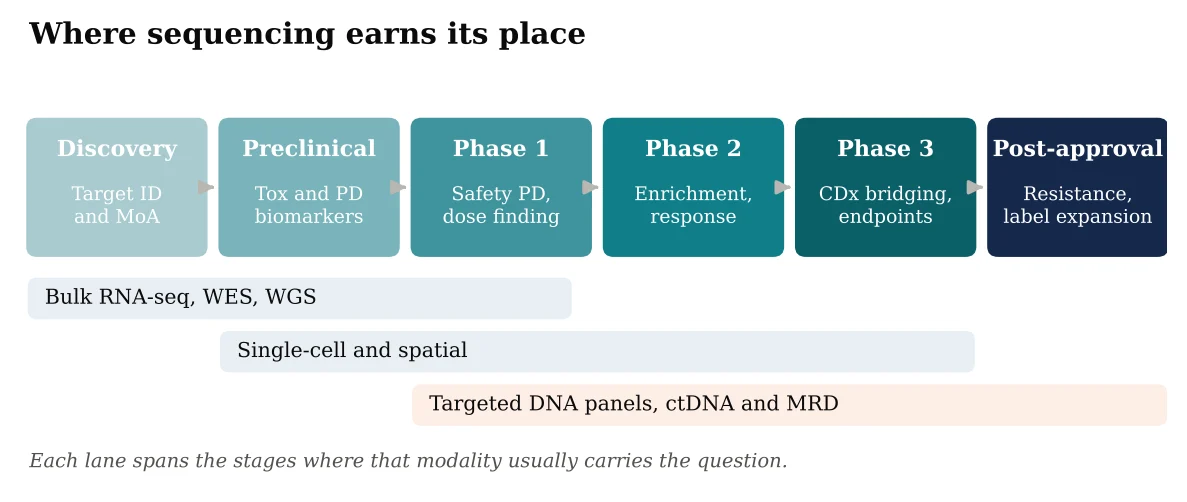
A sequencing plan should map onto the program, not sit beside it. Different stages ask different questions, and the modality that answers one is often wasted on another.
| Stage | The question | What usually answers it |
| Discovery | Is the target expressed where we think, and in whom? | Bulk RNA-seq across tissue panels and public cohorts; single-cell to resolve which cell type carries the target |
| Preclinical | Does the mechanism engage, and is there an off-target signal? | RNA-seq pharmacodynamic signatures in model systems; WES or WGS for insertion-site and integrity work |
| Phase 1 | Is the drug doing anything at these doses? | Paired pre- and on-treatment biopsies, bulk or single-cell; early ctDNA dynamics |
| Phase 2 | Who responds, and can we enrich for them? | Targeted DNA panels for selection; transcriptomic signatures; spatial work on responders against non-responders |
| Phase 3 | Can the selection marker be delivered as a test? | A locked, analytically validated assay; a bridging study to the clinical-trial assay; a companion-diagnostic pathway |
| Post-approval | Why are patients progressing? | Longitudinal ctDNA for resistance mutations; label-expansion biomarker work |
The most common mis-step
An exploratory signature found in 40 Phase 2 patients is written into the Phase 3 eligibility criteria without an assay that can be run prospectively at a central lab. The signature may be real; the test does not exist yet, and building it takes longer than the trial can wait.
The NGS service catalogue
What we scope, specify and oversee. In most engagements the sequencing itself is run at a CLIA-certified or CAP-accredited partner laboratory; EllyCell writes the specification, selects and qualifies the lab, and owns the analysis and the documentation.
| Assay | What it delivers | Typical use in a trial |
| Targeted DNA panels | SNVs, indels, CNVs and fusions across a defined gene set, at high depth | Patient selection, eligibility screening, resistance mutations |
| Whole-exome sequencing | Coding variants genome-wide, tumor mutational burden, MSI | Mechanism of response, hypothesis generation, TMB as a stratification factor |
| Whole-genome sequencing | Structural variants, non-coding events, vector-integration sites | Cell and gene therapy integration-site analysis, rare-disease diagnosis |
| ctDNA and liquid biopsy | Low-frequency variants from plasma, tumor-informed or tumor-naive | Non-invasive enrollment where tissue is unavailable, response monitoring |
| MRD assays | Ultra-deep detection of residual disease below imaging sensitivity | Recurrence risk, escalation and de-escalation designs, surrogate endpoints |
| Immune repertoire | TCR and BCR clonality and diversity | Immuno-oncology pharmacodynamics, cell-therapy persistence |
| Methylation and epigenomics | Methylation profiles, cell-of-origin classification | Early detection, tumor classification, CNS tumor typing |
| Microbiome sequencing | 16S or shotgun metagenomics | Response-modifier hypotheses, gut-brain and immuno-oncology work |
| Pharmacogenomics | Star-allele and diplotype calls for genes such as CYP2D6, CYP2C19 and HLA, with long-read sequencing where structural variation or hybrid alleles matter | Exposure-response and safety-signal analyses, pharmacogenomic labeling language, in every therapeutic area |
| Gene-editing and vector analytics | On- and off-target editing (GUIDE-seq, CHANGE-seq, amplicon and long-read sequencing for large deletions), AAV genome integrity, integration-site profiling | CMC and nonclinical safety packages for cell and gene therapies, aligned with FDA’s genome-editing guidance [13] |
Sample realities we plan around
| Issue | How it is handled |
| FFPE degradation | DNA and RNA quality thresholds set in the lab manual up front, with a defined path for blocks that fail; RNA assays chosen for compatibility with fragmented input |
| Low tumor content | Minimum tumor cellularity agreed with the pathology reviewer, and macrodissection specified where it will change the answer |
| Plasma volume and handling | Streck or equivalent tube specification, time-to-processing limits and shipping conditions written into the site manual, because pre-analytical drift is the main source of ctDNA false negatives |
| Multi-site variability | One central lab wherever feasible; where several labs are unavoidable, a cross-lab concordance study before enrollment opens, as the NCI-MATCH network did across four CLIA laboratories [5] |
| Clonal hematopoiesis | Variants from expanding blood-cell clones are a common source of false-positive ctDNA calls [14]; tumor-naive assays are specified with paired white-blood-cell sequencing or a documented CHIP filter |
| Germline findings | Tumor sequencing reveals germline variants. Consent language, germline filtering and a policy for returning medically actionable findings, referenced to the ACMG secondary-findings list [15], are agreed before the first sample |
Choosing a sequencing platform
We are platform-neutral: we do not resell instruments, and we choose the platform from the question, the evidence tier and the laboratory that will run the test. In practice the choice is between short-read sequencing, which carries almost every validated clinical assay today, and long-read sequencing, which answers questions that short reads cannot.
| Platform class | Where it fits | What to watch |
| Short-read sequencing (Illumina; also Element Biosciences, Ultima Genomics, MGI and Complete Genomics) | Targeted panels, WES and WGS, ctDNA and MRD, bulk and single-cell RNA-seq, immune repertoire, bisulfite methylation | The clinical default: most CLIA- and CAP-validated assays and FDA-approved NGS companion diagnostics run on short-read instruments. Short reads cannot resolve long repeats, complex structural variants or full-length isoforms |
| PacBio HiFi long-read sequencing | Structural variants and repeat expansions, haplotype phasing, full-length isoforms, difficult pharmacogenes such as CYP2D6 and HLA, AAV and lentiviral vector integrity, large on-target deletions after genome editing | Higher DNA input and quality requirements, higher cost per sample and few clinical laboratories; today it mostly supports exploratory or qualified work rather than a validated trial assay |
| Oxford Nanopore long-read sequencing | Ultra-long reads, native methylation calling without bisulfite conversion, rapid turnaround, targeted enrichment by adaptive sampling, integration-site and vector work, methylation-based CNS tumor classification | Basecaller models and chemistries change often, and each change is a pipeline change that needs version locking and re-verification; error profiles must be validated by variant class |
| Ion Torrent semiconductor sequencing (Thermo Fisher) | Fast-turnaround targeted panels from low-input FFPE, including FDA-approved companion diagnostics | Higher indel error in homopolymer runs; most relevant when a diagnostic partner’s existing companion diagnostic runs on it |
A platform change is an assay change. Moving a test between instruments, chemistries or basecaller versions triggers the change control in section 5.1 and, for a validated assay, a concordance study against the previous configuration.
At CDx grade, the diagnostic partner sets the platform. Companion-diagnostic development is tied to the partner’s authorized instrument, so the platform for a registrational trial is settled when the partner is chosen, not after the trial assay is built.
Long reads earn their place outside oncology. Repeat-expansion disorders in CNS programs, structural variants in rare disease, complex pharmacogenes and vector integrity in cell and gene therapy are where long-read data most often changes the answer.
Transcriptomics: three resolutions, three questions
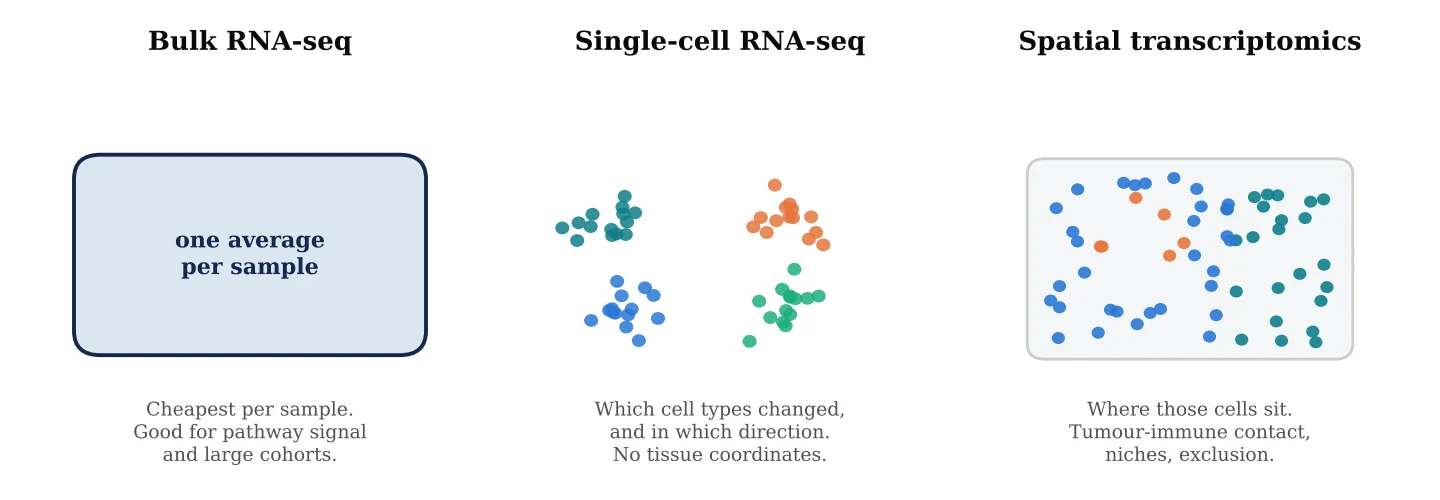
| Bulk RNA-seq | Single-cell RNA-seq | Spatial transcriptomics | |
| Answers | Did the pathway move? | Which cell population moved? | Where in the tissue did it move? |
| Input | Bulk tissue or blood; tolerant of FFPE | Fresh or cryopreserved cells; dissociation-sensitive | FFPE or fresh-frozen sections |
| Cohort size | Hundreds of samples is routine | Tens of samples is typical | Tens of sections is typical |
| Cost per sample | Lowest | High | Highest |
| Main pitfall | Composition shifts masquerade as expression changes | Dissociation bias loses fragile cell types | Segmentation error, which materially changes the result [11] |
The three are complementary rather than competing. A common and cost-controlled design runs bulk RNA-seq across the full cohort, then uses single-cell and spatial work on a nested subset of extreme responders and non-responders to explain what the bulk signal is made of. Published 2026 work in renal cell carcinoma and neuroendocrine tumors used exactly this shape to identify spatially organized multicellular programs associated with checkpoint-inhibitor resistance [2, 3].
Design matters as much as modality. RNA quality thresholds (RIN for fresh tissue, DV200 for FFPE) belong in the lab manual. Samples from each arm and timepoint should be randomized across library batches and sequencing runs, so that batch cannot masquerade as treatment effect. Single-cell comparisons between patients should be made at the patient level, for example by pseudobulk aggregation, rather than by treating each cell as an independent observation. Where isoform structure or fusion partners matter, long-read RNA sequencing reads full-length transcripts that short reads can only infer.
Deconvolution is not a substitute
Computational deconvolution of bulk data against a single-cell reference is useful and cheap, but it is an estimate constrained by the reference. Where the claim depends on a specific cell population, that population should be measured, not inferred.
Bioinformatics: a pipeline you can defend
For a clinical NGS test, the informatics pipeline is part of the assay and is validated as such. CAP inspects it, and reproducibility is a requirement, not a nicety: the same input must return the same output every time [7, 8].
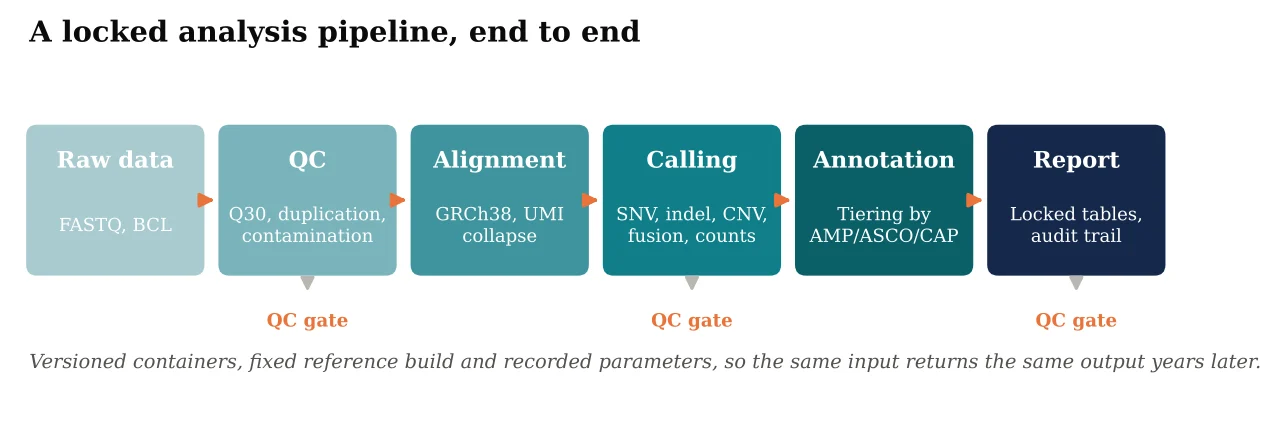
What we lock before the first sample is analyzed
| Element | Specification |
| Reference build | GRCh38 for new work, recorded explicitly; coordinates differ between builds and a mismatch produces wrong clinical conclusions [8] |
| Software versions | Every tool pinned and containerized, with the container digest recorded in the run record |
| Parameters | All thresholds, filters and caller settings fixed in a version-controlled configuration file, not entered at the command line |
| QC acceptance criteria | Coverage depth and uniformity, Q30 fraction, duplication rate, contamination estimate and on-target rate, each with a pass threshold and a defined action on failure |
| Variant tiering rules | AMP, ASCO and CAP tiering applied by documented rule, with the knowledge-based version recorded |
| Change control | Any pipeline change triggers re-validation and a version lock, as the NCI-MATCH assay did on every versioning event [6] |
| Sequencing platform | Instrument model, chemistry and kit versions, and basecaller or demultiplexing software recorded per run; a change to any of them is handled under change control (section 3.2) |
Analysis deliverables
| Deliverable | Contents |
| Bioinformatics analysis plan | Written before unblinding: endpoints, variant definitions, handling of missing and failed samples, multiplicity |
| QC report | Per-sample and per-run metrics against pre-set thresholds, with every exclusion justified |
| Results package | Annotated variant tables, expression matrices, differential analyses, figures and the code that produced them |
| Validation report | Sensitivity, specificity, precision, reproducibility and limit of detection by variant class, against reference materials such as NIST Genome in a Bottle [8] |
| Data and records | Raw and processed data archived to a defined retention schedule, with audit trails suitable for 21 CFR Part 11 expectations [9] |
| Submission datasets | Biomarker results mapped to CDISC SDTM, including the Genomics Findings (GF) domain, with define.xml; raw and processed files (FASTQ, CRAM, VCF) in the format agreed with the sponsor and the Agency [16] |
Data governance and algorithms
Genomic data are identifying data. Informed consent should cover the genomic analyses planned, future research use, data sharing and how germline findings will be handled. Storage and transfer have to satisfy HIPAA in the US, GDPR in the EU and national rules elsewhere, including China’s human genetic resources regulations, which restrict the export of samples and data. Cloud environments are specified with access control, encryption and audit logging that meet the same Part 11 expectations as the pipeline itself [9].
Machine-learning signatures are held to the same standard as any other pipeline component: the model is locked, versioned and validated before it touches trial data, with training and test data kept separate and documented. FDA’s draft guidance on artificial intelligence in drug development sets out a risk-based credibility framework for exactly this use [17].
Fit for purpose: exploratory to companion diagnostic
Evidence burden should match the decision. An exploratory biomarker that informs nothing but the next experiment does not need a validation package; a marker that gates enrollment in a registrational trial does and will need to exist as a deliverable test.

| Tier | What it supports | What it requires |
| Exploratory | Hypothesis generation; no decision rests on the result | Sound methods, documented QC, honest reporting of multiplicity |
| Qualified | Internal go or no-go decisions, dose selection, cohort expansion | Fit-for-purpose qualification: precision, reproducibility, and a defined analytical range for the intended use |
| Validated | A pre-specified trial endpoint or a stratification factor | Full analytical validation by variant class, a locked pipeline, a central lab, and pre-specification in the protocol and SAP |
| CDx-grade | A labeled patient-selection claim | An IVD development pathway with a diagnostic partner, bridging from the clinical-trial assay, and a parallel regulatory submission |
The jump from qualified to validated is where programs most often lose time, because it is not only an analytical exercise. It requires a lab that can run the test prospectively at trial volume and turnaround, a specimen pathway that sites can follow, and a protocol that has pre-specified how the result will be used. EllyCell’s companion paper on assay qualification against validation covers the analytical side in more detail.
When the trial assay is itself a device
An assay that selects or assigns patients in a trial is an investigational device. If an erroneous result could expose a patient to significant risk, for example by withholding standard therapy, the assay needs an investigational device exemption under 21 CFR 812 in addition to the IND. FDA offers oncology sponsors a streamlined route to a study-risk determination through the IND [18], and a pre-submission (Q-Sub) is the usual way to settle the question early. We raise it at the pre-IND meeting rather than discover it at IND review.
Two further points shape the plan. In the US, FDA’s 2024 rule bringing laboratory-developed tests under device regulation was vacated by a federal court in March 2025, so CLIA remains the main framework for central-lab LDTs; an LDT that gates enrollment still raises the investigational-device question above. In the EU, the In Vitro Diagnostic Regulation treats a companion diagnostic used in a clinical trial as a device in a performance study, with its own notification or authorization requirements [19]. Multinational trials should plan for it alongside the clinical-trial application.
ctDNA and MRD in trial design
Circulating tumor DNA has moved from a correlative add-on to a design element. FDA has issued guidance on using ctDNA as a biomarker in curative-intent solid-tumor drug development, including escalation designs for ctDNA-MRD-positive patients and de-escalation designs for MRD-negative patients, with explicit expectations on assay sensitivity and negative predictive value [1].
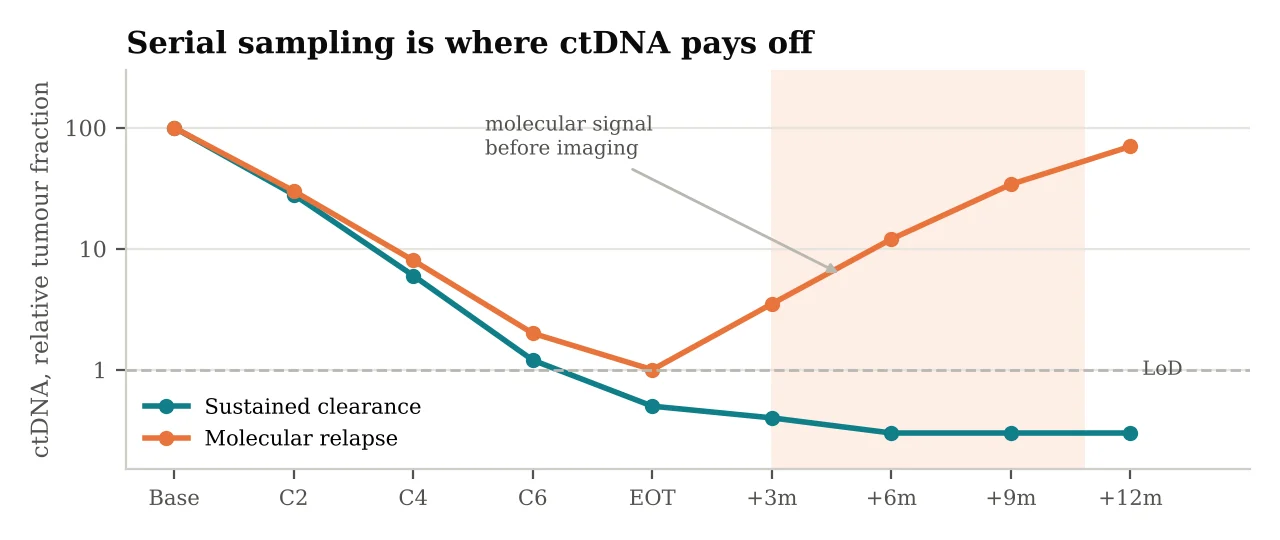
Trials are being built around this. CIRCULATE-US uses ctDNA to stratify escalation against observation in colorectal cancer; MERMAID-1 uses MRD as a recurrence-risk endpoint in non-small-cell lung cancer; COBRA tests whether ctDNA can determine the need for adjuvant chemotherapy; BESPOKE tracks real-world longitudinal MRD. Analyses presented through 2026 found that serial measurements improved relapse prediction substantially over a single timepoint [4].
| Design choice | What it turns on |
| Tumor-informed or tumor-naive | Tumor-informed assays reach lower limits of detection but need archival tissue and a lead time to build the personalized panel; tumor-naive panels are faster to turn around [1] |
| Sampling schedule | Fixed landmark timepoints, serial surveillance, or both. Serial sampling is where the predictive value sits, and it drives both cost and site burden |
| Endpoint role | Exploratory correlative, stratification factor, or a pre-specified surrogate endpoint. Each choice sets the validation burden in section 6 |
| Sensitivity against NPV | De-escalation designs lean on high negative predictive value; escalation designs lean on specificity. The assay should be chosen against the design, not the other way round [1] |
Patterns from clinical programs
Across oncology, CNS and rare-disease work, the same situations recur. These are engagement patterns rather than named studies; specifics stay with our clients.
| Situation | What we do | What changes |
| A signature found in Phase 2 that has no deliverable test | Build the assay specification and bridging plan in parallel with the Phase 3 protocol, and reset the eligibility language to what the test can actually deliver | The program stops waiting on an assay that was never scoped |
| Vendor results that cannot be reproduced | Reconstruct the pipeline, pin versions, re-run from raw data and document the delta | The dataset becomes defensible, or its limits become explicit before a reviewer finds them |
| Sites generating unusable plasma | Rewrite the lab manual, retrain sites on tube type and processing windows, and add an incoming-sample QC gate | ctDNA failure rates fall, and the drop is attributable rather than mysterious |
| An expensive single-cell study with no decision attached | Re-scope to bulk across the full cohort plus a nested single-cell and spatial subset on extremes | Statistical power rises and cost falls, usually at the same time |
| A pre-IND meeting with thin biomarker justification | Write the biomarker section of the briefing package: intended use, analytical status, and what the data can and cannot support | The Agency asks about the plan rather than about the gaps |
| Diligence on an in-licensing candidate | Independent review of the sequencing data behind the asset’s biomarker story, including reanalysis from raw data where it is available | The buyer learns whether the selection hypothesis is supported before the term sheet |
How EllyCell helps
EllyCell is a biopharmaceutical consulting, R&D and licensing firm. Our genomic-services work sits inside the consulting and R&D arms and runs across four steps.
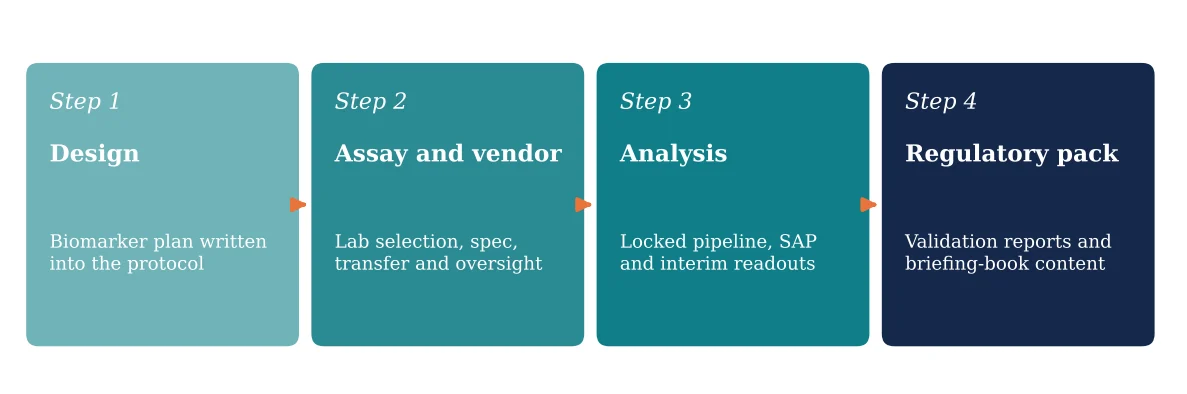
| Service | What you get |
| Biomarker strategy and study design | The biomarker section of the protocol: intended use, sampling schedule, assay tier, analysis plan and the decision each result feeds |
| Assay specification and lab selection | A written assay specification, a shortlist of qualified CLIA or CAP laboratories, scoring against your requirements, and oversight through transfer and go-live |
| Bioinformatics analysis | Locked, versioned pipelines for DNA, RNA, single-cell and spatial data, with QC reporting and a reproducible results package |
| Validation and regulatory documentation | Validation protocols and reports, pipeline validation documentation, and the biomarker content for pre-IND, IND and briefing packages |
| Data review and diligence | Independent reanalysis and assessment of sequencing data behind an asset, for sponsors and for buyers |
| Companion diagnostic planning | Bridging strategy from clinical-trial assay to IVD, and diagnostic-partner selection |
Start a conversation
Send us the question the data has to answer and the stage you are at. We will come back with the modality, the evidence tier and what it takes to get there.
EllyCell, LLC, McLean, Virginia, USA https://ellycell.com, info@ellycell.com
References and further reading
[1] FDA, “Use of Circulating Tumor DNA for Curative-Intent Solid Tumor Drug Development,” guidance for industry. Draft guidance, May 2022.
[2] Yao W, et al. Integrated single-cell and spatial transcriptomics reveals a multicellular program contributing to immunotherapy resistance in clear cell renal cell carcinoma. npj Precision Oncology, 2026.
[3] Single-cell and spatial transcriptomics reframe the immunosuppressive microenvironment of neuroendocrine neoplasms. 2026.
[4] GeneOnline, review of MRD-integrated clinical trials, 2026, covering CIRCULATE-US (NCT05174169), MERMAID-1 (NCT04385368), COBRA (NCT04068103) and BESPOKE (NCT04264702).
[5] Lih CJ, et al. Analytical validation of the next-generation sequencing assay for a nationwide signal-finding clinical trial: the NCI-MATCH trial. Journal of Molecular Diagnostics. 2017;19(2):313–327.
[6] NCI-MATCH (NCT02465060) protocol, laboratory and assay-versioning sections.
[7] Roy S, et al. Standards and guidelines for validating next-generation sequencing bioinformatics pipelines. AMP and CAP joint recommendation. Journal of Molecular Diagnostics, 2018;20(1):4–27.
[8] Gargis AS, et al. Good laboratory practice for clinical next-generation sequencing informatics pipelines. CDC Next-generation Sequencing: Standardization of Clinical Testing workgroup. Nature Biotechnology, 2015;33(7):689–693.
[9] 21 CFR Part 11, electronic records and electronic signatures; ICH E6 (GCP); ISO 15189.
[10] Clinical validation of a 170-gene DNA and RNA panel in the CLIA setting, following AMP and CAP guidelines.
[11] Impact and correction of segmentation errors in spatial transcriptomics. Nature Genetics, 2026.
[12] Pharma Focus America, “From biomarkers to precision trials: the expanding role of NGS in pharma,” 2026.
[13] FDA, “Human Gene Therapy Products Incorporating Human Genome Editing,” guidance for industry, January 2024.
[14] Razavi P, et al. High-intensity sequencing reveals the sources of plasma circulating cell-free DNA variants. Nature Medicine, 2019;25:1928–1937.
[15] Miller DT, et al. ACMG SF v3.2 list for reporting of secondary findings in clinical exome and genome sequencing. Genetics in Medicine, 2023;25:100866.
[16] CDISC, Study Data Tabulation Model Implementation Guide (SDTMIG), Genomics Findings (GF) domain.
[17] FDA, “Considerations for the Use of Artificial Intelligence to Support Regulatory Decision-Making for Drug and Biological Products,” draft guidance for industry, January 2025.
[18] FDA, “Investigational In Vitro Diagnostics in Oncology Trials: Streamlined Submission Process for Study Risk Determination,” guidance for industry, 2019.
[19] Regulation (EU) 2017/746 on in vitro diagnostic medical devices (IVDR), provisions on performance studies.
[20] Tie J, et al. Circulating tumor DNA analysis guiding adjuvant therapy in stage II colon cancer. New England Journal of Medicine, 2022;386:2261–2272.
[21] Kotani D, et al. Molecular residual disease and efficacy of adjuvant chemotherapy in patients with colorectal cancer. Nature Medicine, 2023;29:127–134.