01 · Consulting
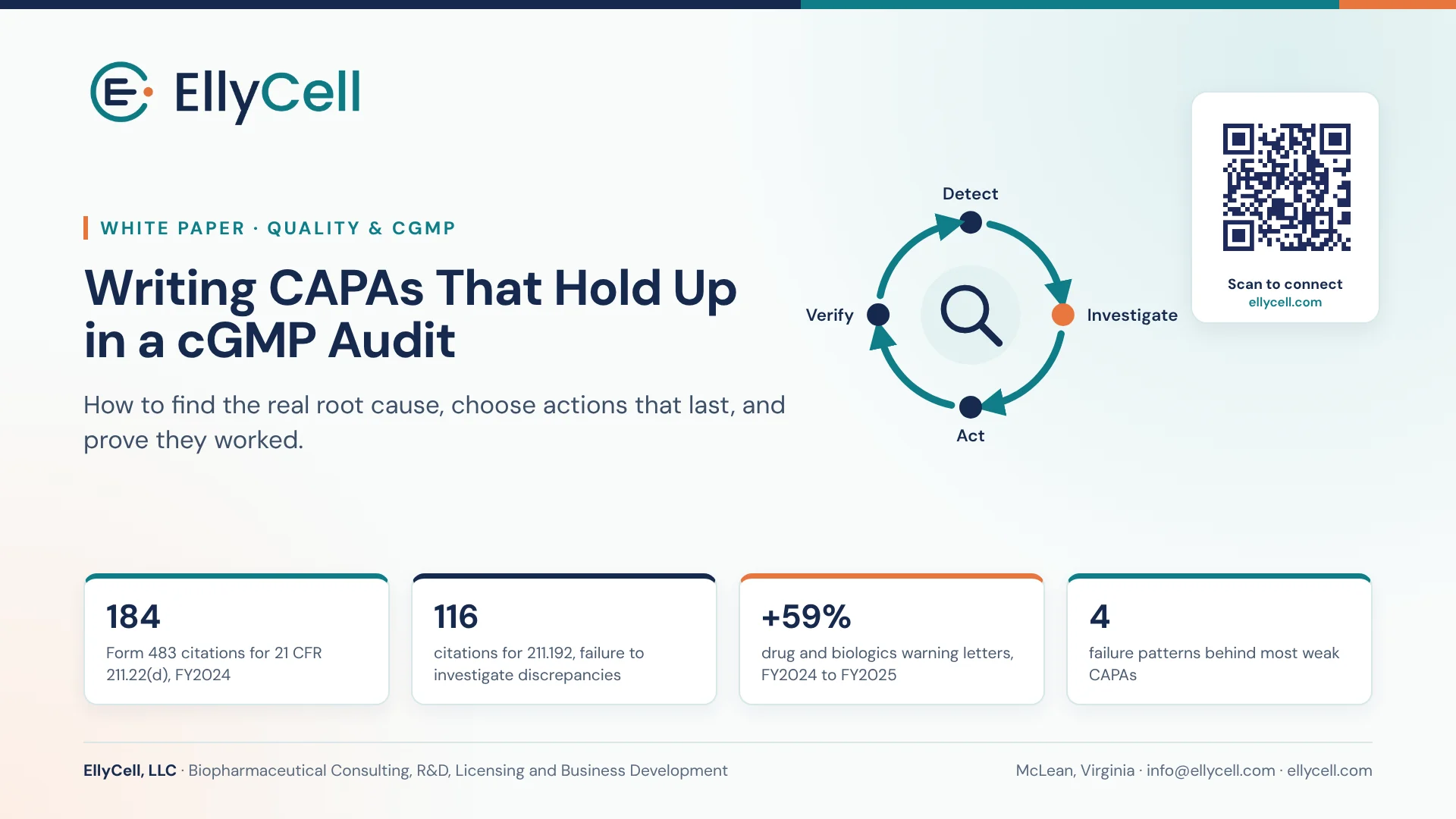
Writing CAPAs That Hold Up in a cGMP Audit
How to find the real root cause, choose actions that last, and prove they worked
Investigators read your CAPA records as evidence of how well your quality system thinks. A strong CAPA tells them the problem is understood and controlled; a weak one invites a closer look at everything else.
EllyCell, LLC
Biopharmaceutical Consulting, R&D, Licensing and Business Development
McLean, Virginia, USA
Email: info@ellycell.com
Website: https://ellycell.com/
Executive summary
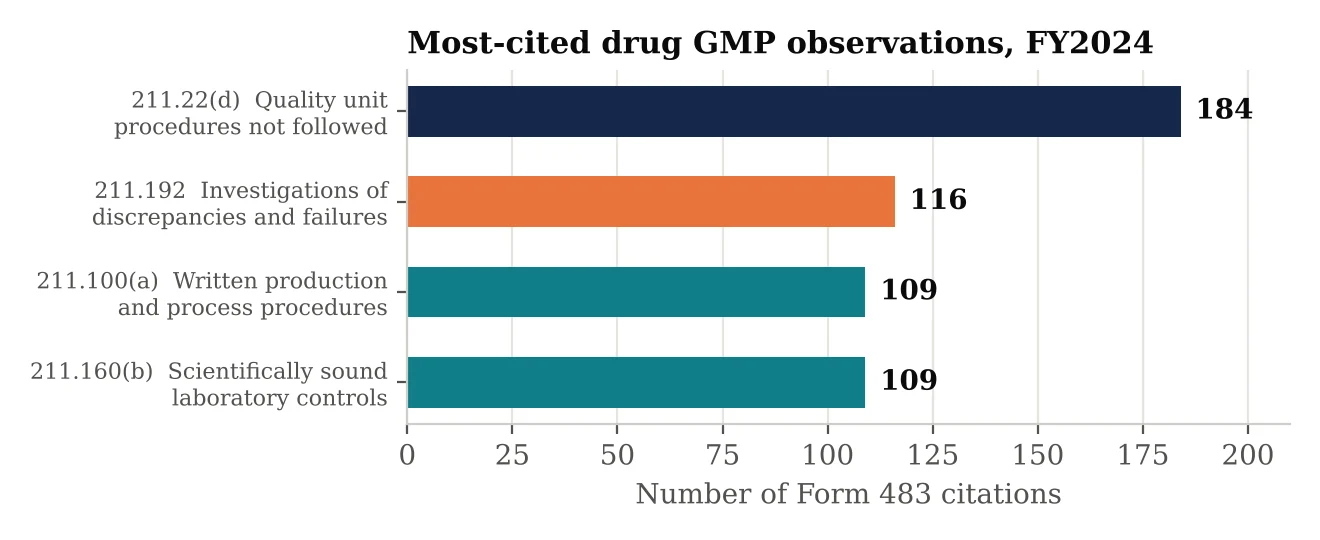
A corrective and preventive action record is the clearest evidence an investigator has of how your quality system reasons. It shows whether you can find a cause, act on it at the right level, and prove the action worked. That is why the most-cited drug GMP observation is not a contamination event or a failed batch, but a quality unit that did not follow its own procedures.
The failures repeat. An investigation stops at human error. The scope covers one batch when five were affected. Retraining is the only action. No one checks whether the fix held. None of these require new technology to correct, but all of them require discipline and a record that shows it.
184
Form 483 citations for 21 CFR 211.22(d), quality unit procedures not followed, FY2024
116
citations for 211.192, failure to investigate discrepancies, second in FY2024
+59%
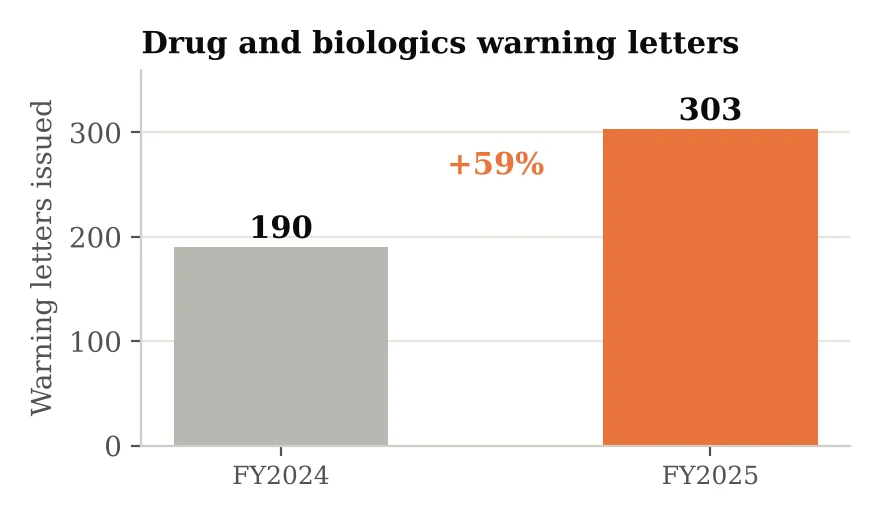
drug and biologics warning letters, FY2024 to FY2025
4
failure patterns behind most weak CAPAs
Key messages
Human error is where an investigation starts, not where it ends. Keep asking why until you reach a cause in the system that you can control.
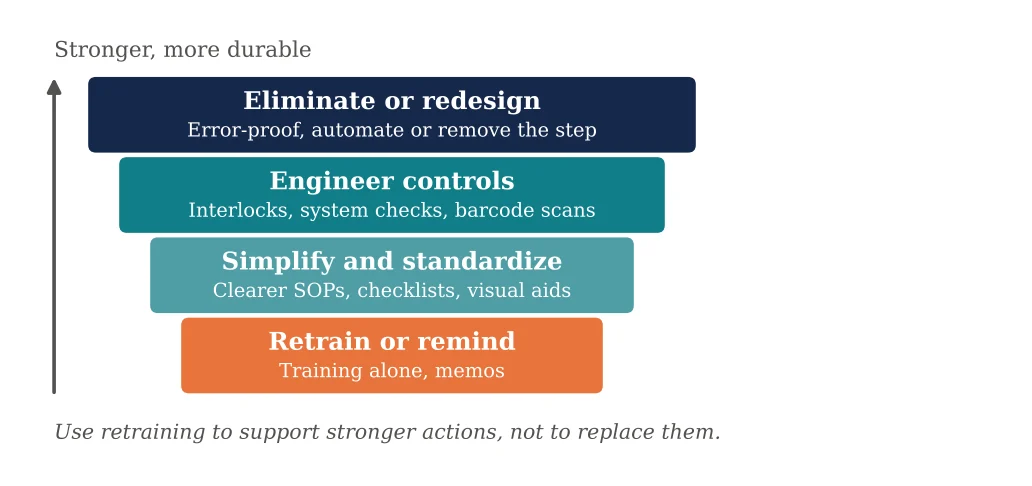
Weak actions produce repeat findings. Retraining alone is the least durable fix. Use it to support stronger actions, not to replace them.
Set the effectiveness check before you close. Define the metric, the success criterion and the time window in advance, and tie them to live trend data.
Scope is where most investigations fall short. Say which other batches, products, lines and sites you considered, and why you included or excluded each.
Why CAPAs fail in audits
The citation data makes the pattern plain. Two of the four most-cited drug GMP observations in FY2024 are about the quality system itself rather than the product: whether procedures were followed, and whether discrepancies were investigated.
The pressure is increasing. Drug and biologics warning letters rose from 190 in FY2024 to 303 in FY2025, an increase of 59 percent.
Four patterns that repeat
| Pattern | What it looks like in the record | What the investigator concludes |
| Symptom, not cause | “Human error”, “sampling error” or “undetermined” closes the file without evidence or scientific rationale | The firm cannot find causes, so other investigations are suspect too |
| Scope too narrow | The investigation stops at one batch; other lots, products, lines or sites are never checked | Affected product may still be in distribution |
| Weak actions | Retraining is the only fix, so the same failure comes back | The system that produced the failure is unchanged |
| No proof it worked | No effectiveness check, the wrong metric, or a CAPA not reopened when trend data says it failed | The firm does not know whether its own fixes work |
The CAPA loop auditors walk through
An investigator follows the same six steps through your record. Three of them are where most findings originate, and they are marked in the figure below.
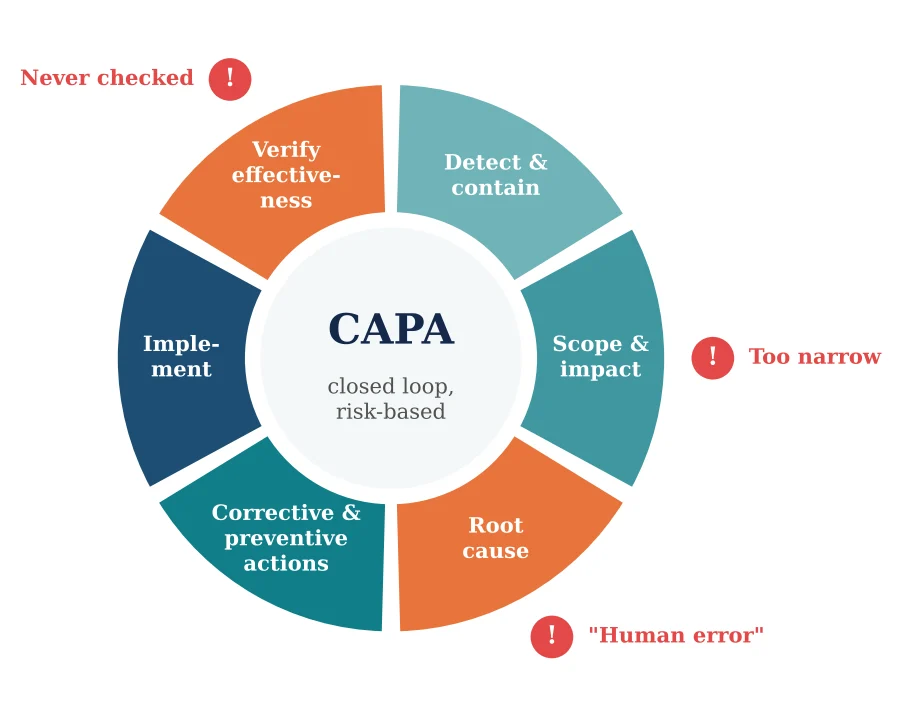
| Step | What the investigator asks |
| 1. Detect and contain | Was the product protected right away? Quarantine, holds and customer notification, dated and documented |
| 2. Scope and impact | Which other batches, products, equipment and sites could be affected, and why were they included or excluded? |
| 3. Root cause | Which method was used (5 Whys, fishbone, fault tree), what evidence supports it, and which alternative causes were ruled out? |
| 4. Corrective and preventive actions | Does each action address the root cause, with an owner, a due date and a link to change control? |
| 5. Implement | Were actions completed on time? Are extensions justified and approved by QA? |
| 6. Verify effectiveness | Is there a measurable success criterion, a time window, and data showing the problem did not recur? |
Get to the real root cause
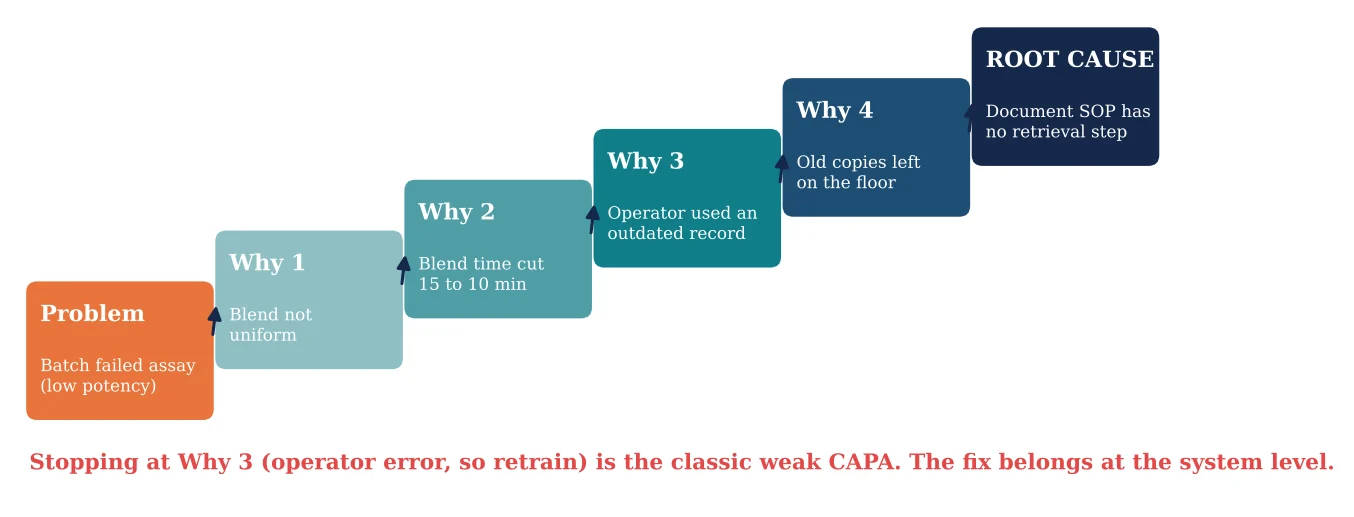
Human error is where an investigation starts, not where it ends. Keep asking why until you reach a cause in the system that you can control and document the evidence behind each step.
Why this matters for the record
Stopping at Why 3 gives you a person to retrain. Continuing to Why 4 and the root cause gives you a procedure to fix, which protects every batch that follows. An investigator can tell the difference in a single page.
Choose actions that last
Not all corrective actions are equal. The further up this hierarchy an action sits, the less it depends on a person remembering to do something.
The audit proof CAPA record contains
| Element | What good looks like |
| Problem statement | Specific: what, where, when, how many, and against which requirement |
| Containment and disposition | Immediate action and product disposition, with dates |
| Scope and impact assessment | Across batches, products, equipment and sites, with inclusions and exclusions justified |
| Root cause analysis | Method used, evidence collected, and the causes ruled out |
| Root cause statement | Names a system cause, not a person |
| Actions | Correction, corrective and preventive actions, each with an owner and a due date |
| Risk and linkage | Risk assessment, with links to change control, deviations and complaints |
| Effectiveness check | Metric, success criterion and time window, all set in advance |
| QA approval | At opening, at closure, and again after the effectiveness check |
Before and after: rewriting a weak CAPA
The same event can produce a record that invites a Form 483 or one that closes the question. The difference is rarely more work; it is work aimed at the right level.
| Element | Weak (invites a 483) | Strong (holds up) |
| Root cause | Operator error. | The document-control SOP has no step to retrieve superseded batch records from the floor, so an outdated copy was used. |
| Scope | Batch 24-117 only. | All batches made on the line since the record was revised (6 batches), plus 2 other products whose records are stored the same way. |
| Corrective action | Retrain the operator. | Recall and destroy superseded copies; add a retrieval and reconciliation step to the SOP; issue records from the electronic system only. |
| Preventive action | None. | Quarterly audit of floor documents on all lines; barcode check of record version at batch start. |
| Effectiveness check | Training record signed. | Zero use of superseded records across 3 months of floor audits and 20 consecutive batches; blend uniformity within specification. |
Case examples from recent waring letters
| Case | What happened | The lesson |
| “Undetermined” is not an answer Jabil Inc., drug manufacturing, August 2026 | After mold was found in product, FDA called the firm’s “undetermined” root-cause finding inadequate. The investigation had not evaluated plausible causes, such as introduction during filling, and lacked adequate CAPA. | If you cannot prove a single cause, show that every plausible cause was evaluated and controlled, with scientific justification. |
| A CAPA that was never reopened Medical device manufacturer, March 2026 | Complaint rates exceeded the firm’s own threshold in the first, second and third quarters of 2025, yet the CAPA was not routed back or supplemented until after the inspection. | Tie effectiveness checks to live trend data, and reopen the CAPA automatically when a threshold is crossed. |
| The wrong effectiveness test Beta Bionics, medical device, January 2026 | The CAPA effectiveness check tested employees rather than actual device users, and the trending method diluted complaint rates. | Verify effectiveness where the failure happens, with the people and conditions that produced it. |
Measure CAPA health before an investigator does
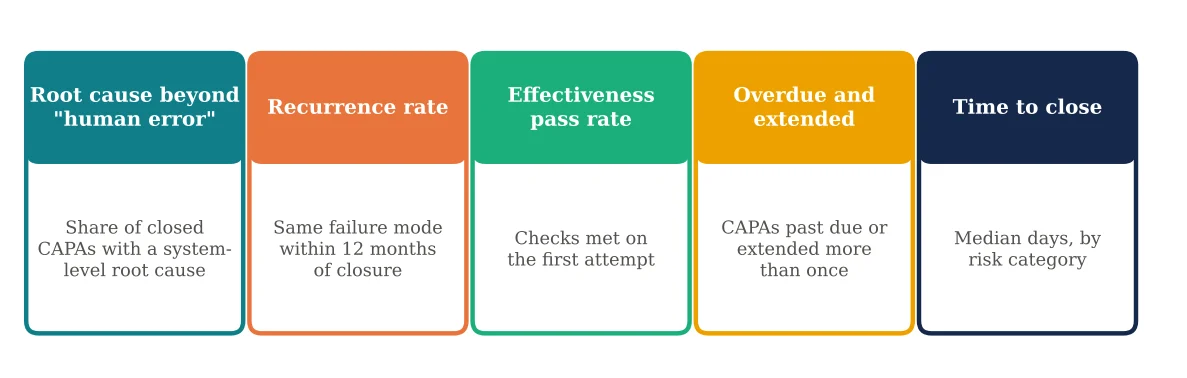
These five metrics show whether your CAPA system is working before anyone else has to tell you. Trend them monthly at management review.
What a rising trend is telling you
A rising recurrence rate or a high share of “human error” root causes is an early warning that CAPAs will not hold up. Both are visible to you months before they are visible to an investigator.
How EllyCell can help you
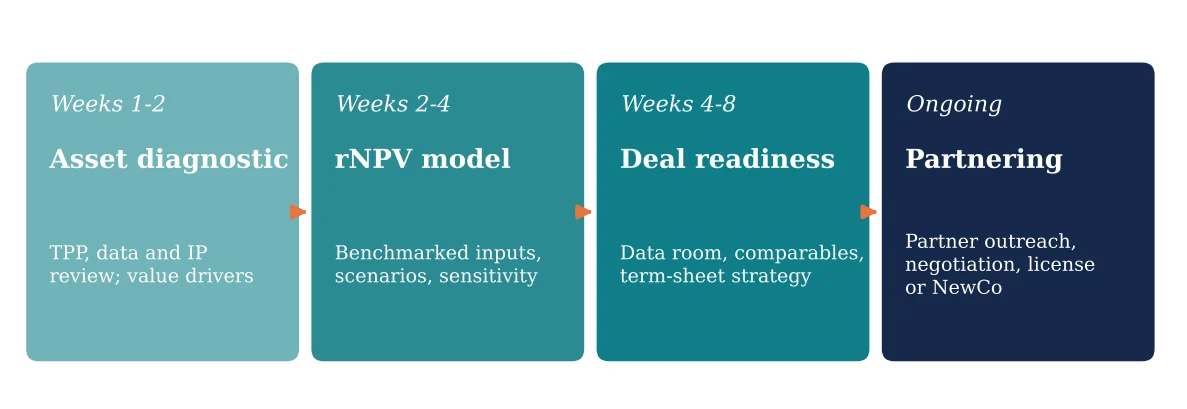
EllyCell’s GMP manufacturing and quality experts work alongside your QA team, at your site or remotely, for biologics, cell and gene therapy, and small-molecule programs, including oversight of CDMOs.
| Service | What you get |
| CAPA and investigation health check | Independent review of a sample of deviations, OOS investigations and CAPAs, scored against audit criteria, with a prioritized fix list |
| Root-cause facilitation | Hands-on root-cause analysis for critical deviations and recurring failures, using structured tools and evidence |
| 483 and warning letter response | Remediation plans, CAPA rewrites and response drafting that address the root cause, scope and effectiveness FDA asks for |
| Training and templates | Practical root-cause and CAPA-writing workshops, SOP and template updates, and CAPA metrics for management review |
Is your next inspection on the calendar?
Ask EllyCell for a CAPA health check. We will review a sample of your records and show you what an investigator would see.
EllyCell, LLC, McLean, Virginia, USA https://ellycell.com, info@ellycell.com