01 · Consulting
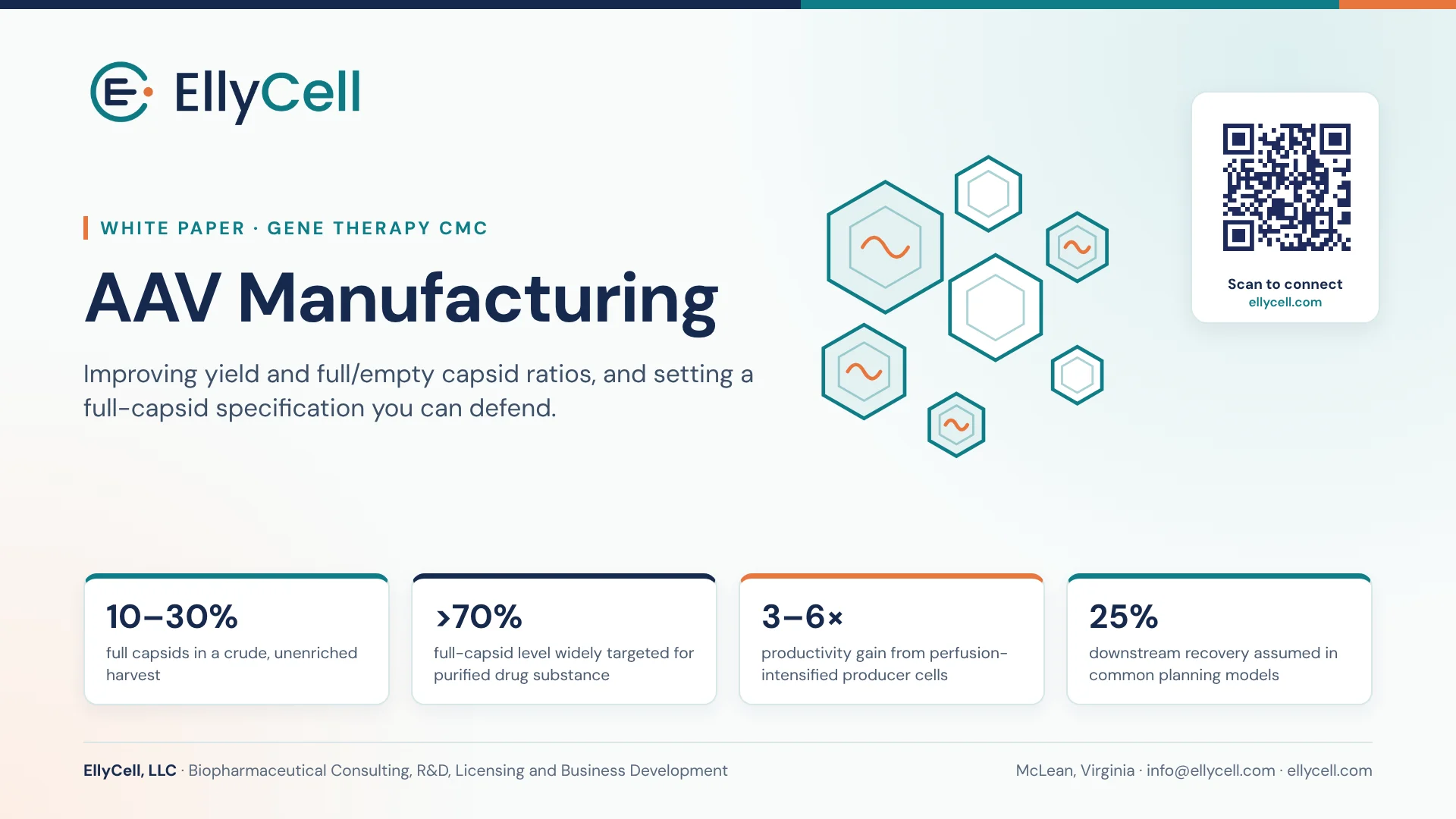
AAV Manufacturing
Improving yield and full/empty capsid ratios
Where vector is actually lost, which levers recover it, and how to set a full-capsid specification you can defend to a regulator.
EllyCell, LLC
Biopharmaceutical Consulting, R&D, Licensing and Business Development
McLean, Virginia, USA
Email: info@ellycell.com
Website: https://ellycell.com/
Executive summary
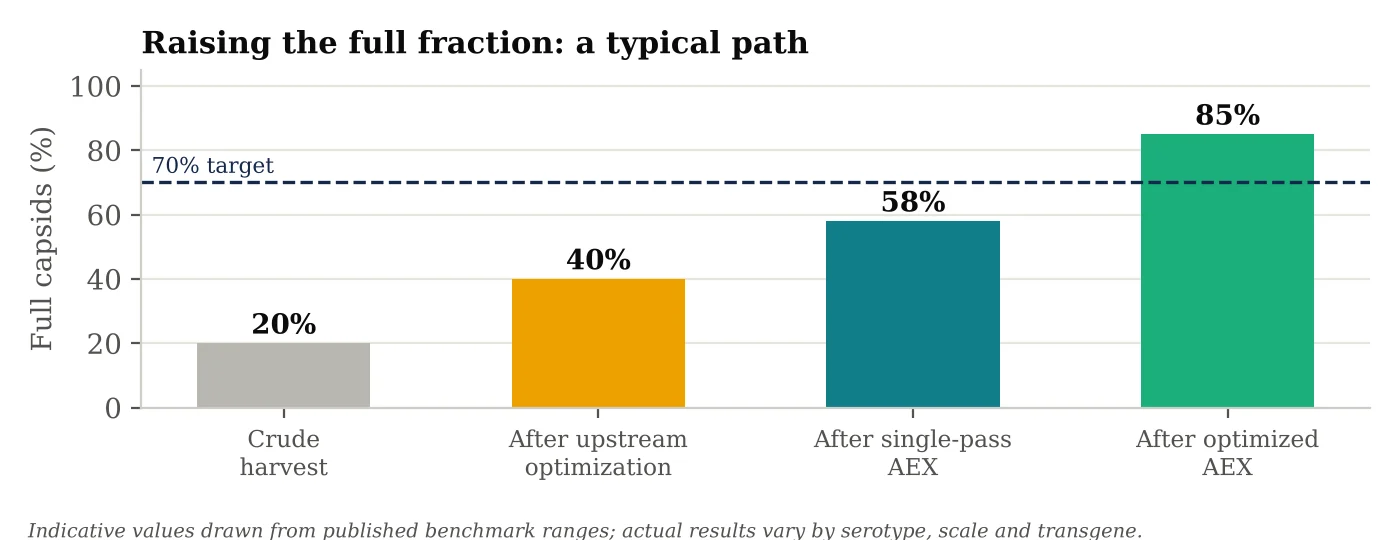
Most AAV programs lose more vector to empty capsids and purification losses than to anything else in the plant. A crude harvest is typically only 10 to 30 percent full, and the separation steps that fix that give back 30 to 55 percent of the vector you already paid to make. The programs that reach an affordable cost per dose do two things at once: they raise volumetric titer, and they make more of that titer full in the first place, so downstream has less to throw away.
10-30%
full capsids in a crude, unenriched harvest
Over 70%
full-capsid level widely used as a target for purified drug substance
3-6x
volumetric productivity gain from perfusion-intensified producer cells
25%
overall downstream recovery assumed in common planning models
Key messages
Upstream levers compound; downstream levers subtract. A plasmid-ratio design of experiments that doubles genome titer and lowers empty formation improves every step that follows. A second anion-exchange pass improves purity by discarding product.
No separation method gives both purity and recovery. Cesium chloride approaches 95 percent full but often returns under half the vector; optimized chromatography reaches 80 to 87 percent full at roughly two-thirds recovery.
Your specification is yours to set and defend. FDA publishes no numeric threshold, so the analytics behind your number carry real regulatory weight.
Decide the platform early. A platform change mid-program is a comparability exercise, not a process tweak.
Why full/empty matters more than it used to
Empty capsids are a product-related impurity, not an inert passenger. They add to the antigenic load at the same dose, which matters most for systemic, high-dose indications where a patient can receive 10^15 vector genomes.
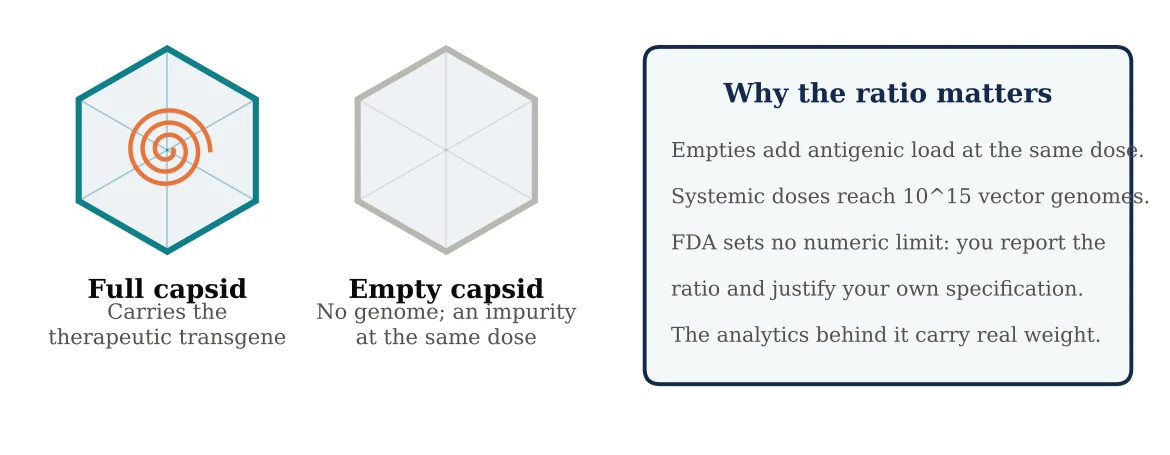
FDA does not set a numeric threshold. Its guidance asks sponsors to report the full-to-empty ratio and to justify their own limit as a critical quality attribute. A widely circulated proposed draft guidance argues that purified product should be at least 70 percent full, while BioPhorum, speaking for 34 manufacturers, has rejected a blanket specification as premature. The practical consequence is that your specification is yours to set and to defend with data, so the analytics behind it carry real regulatory weight. [8, 11, 12]
Where the yield actually goes
Platform sets the ceiling
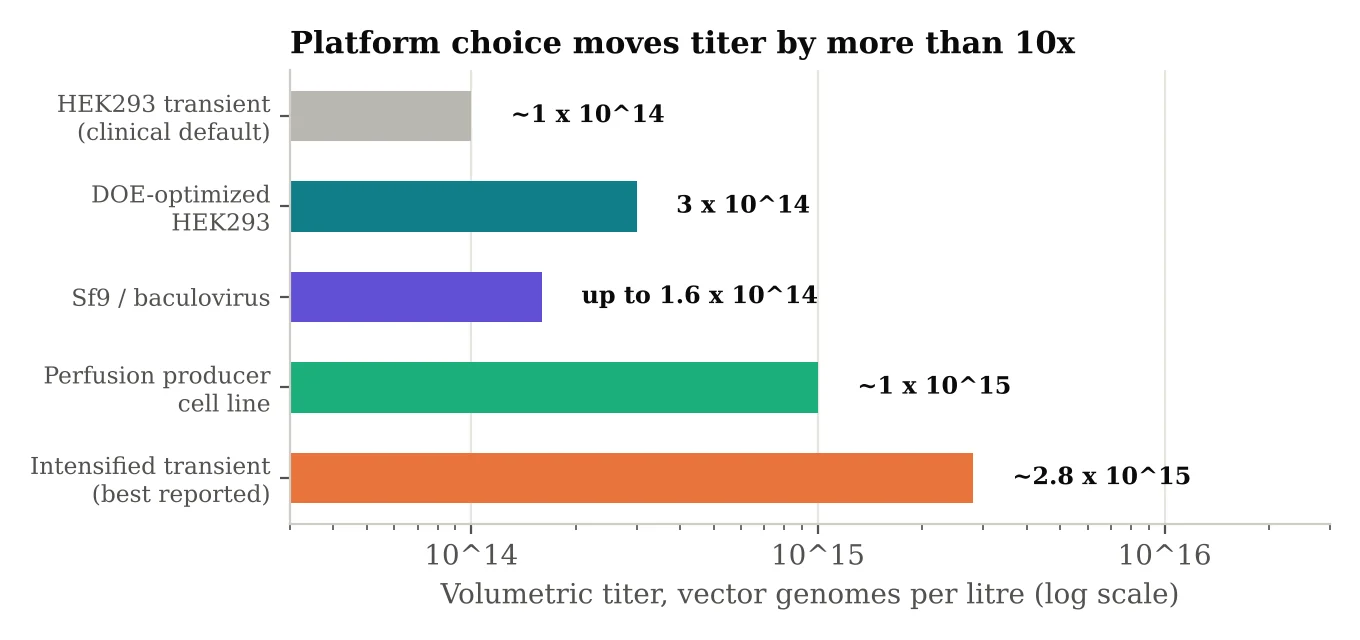
Platform choice moves volumetric titer by more than an order of magnitude. Transient transfection in HEK293 remains the clinical default at roughly 10^14 vector genomes per liter, while design-of-experiments-optimized processes reach 3 x 10^14, perfusion-intensified producer cells approach 10^15, and the best reported intensified transient runs reach the low 10^15 range.
Separation forces a trade
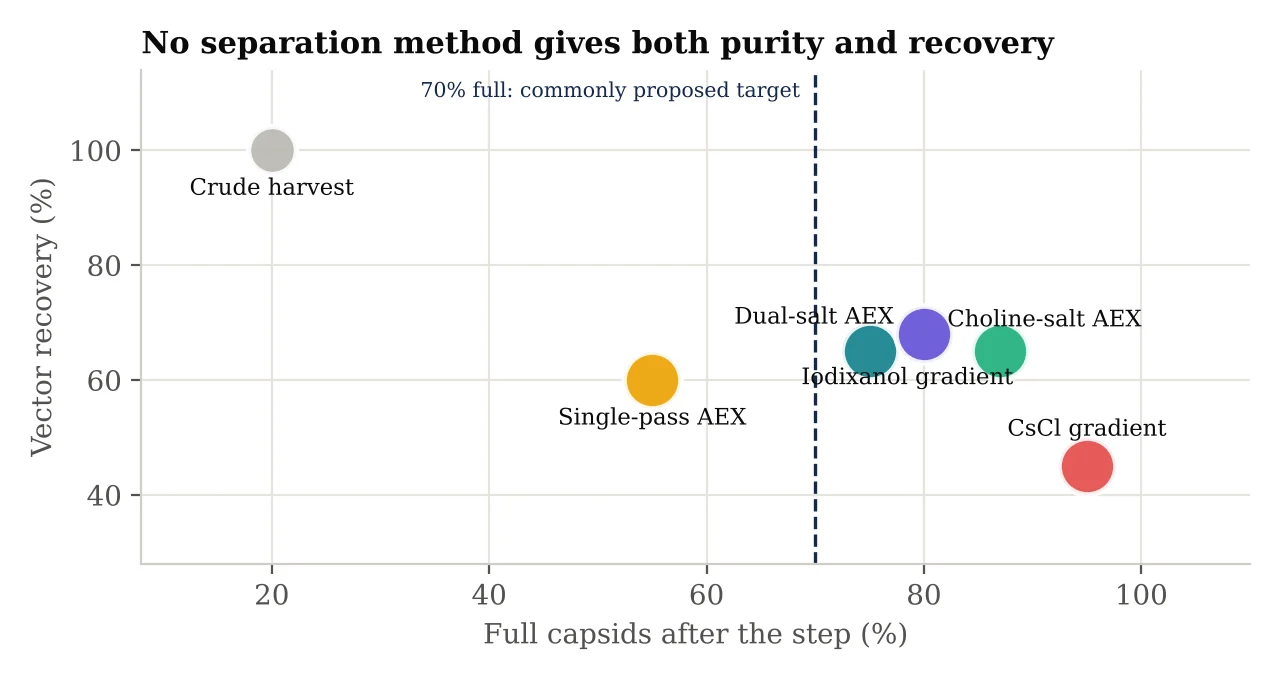
No separation method gives both high purity and high recovery. Cesium chloride approaches 95 percent full but often returns under half the vector and does not scale well. Anion exchange scales cleanly, but a single pass typically lands near 50 to 60 percent full. The optimized chromatographic methods that reach 80 to 87 percent full do so with roughly two-thirds recovery.
The accumulative loss
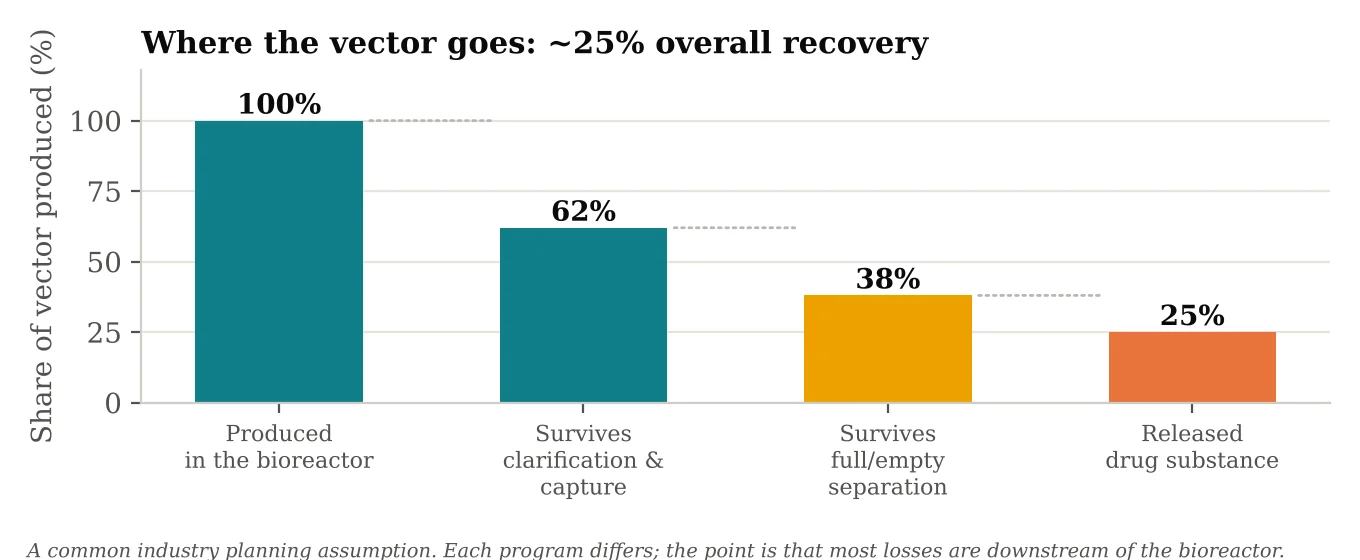
Taken together, the losses are substantial. A common industry planning model assumes about 25 percent overall downstream recovery, which means three quarters of what the bioreactor produced never reaches a patient.
The levers, and where they sit in the process
| Lever | Where | Reported effect | Effort |
| Plasmid ratio (DOE) | Upstream | Reported to roughly double genome titer and cut empty capsid formation | Low |
| Transfection reagent plus enhancer | Upstream | Higher output and better full/empty; less plasmid per litre | Low |
| Cell density and perfusion | Upstream | 3 to 6 times volumetric productivity; avoids the cell-density effect | Medium |
| Harvest timing | Upstream | Percent full keeps rising for about two days after transfection while total capsid stays flat | Low |
| Producer cell line | Upstream | Removes plasmid cost and batch variability; one report of up to 10 times more full particles in perfusion | High |
| AEX salt chemistry | Downstream | Choline or dual-salt elution reaches 75 to 87 percent full | Medium |
| Two-pass AEX | Downstream | Higher full enrichment across serotypes at production scale, at a recovery cost | Medium |
| Gradient ultracentrifugation | Downstream | 90 to 99 percent full, but recovery is often under 50 percent and scale is limited | Medium |
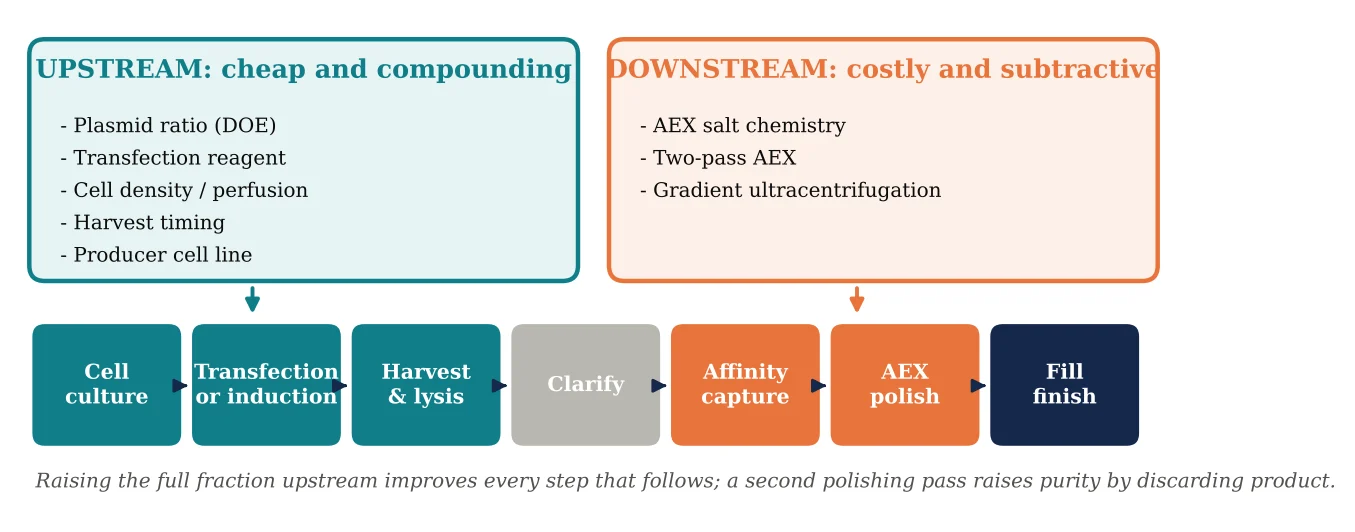
The pattern worth internalizing upstream levers are cheap and compound, downstream levers are expensive and subtractive. A plasmid-ratio design of experiments that doubles genome titer and lowers empty formation improves every step that follows it; a second anion-exchange pass improves purity by discarding product. [1, 7, 9]
Choosing a production platform
| Platform | Strengths | Trade-offs | Reported titer (vg/L) |
| HEK293 transient triple transfection | Most clinical experience; fastest to the clinic; any serotype | Plasmid cost and supply; batch-to-batch variability; scale-up limits | About 1 x 10^14 routine; up to 5 x 10^15 reported |
| Sf9 / baculovirus | Scales past 250 to 1,000 L; lower cost of goods; familiar equipment | Longer development; fewer experienced CDMOs; capsid VP ratios and post-translational modifications differ from human cells | 3.5 x 10^13 to 1.6 x 10^14; 6 to 10 times HEK reported by some sponsors |
| Stable producer or packaging cell line | No transfection reagent or GMP plasmid; consistent batches; pairs well with perfusion | 12 to 18 months of cell-line development; clone screening; serotype lock-in | About 1 x 10^15 with perfusion (3 to 6 times batch) |
A platform change is a comparability exercise
Capsid post-translational modifications, VP ratios and partial-capsid profiles can differ between human and insect systems, and one published comparison found different in vivo liver transduction between platforms for the same serotype. Decide early, or budget for the bridging work. [3, 4, 5]
Measuring what you are improving
Every claim above is only as good as the assay behind it. The common vg/vp quotient, built from separate qPCR and ELISA runs, compounds two methods’ error and cannot see partial capsids. A NIST-coordinated study found labs still differ in how they treat partials, with one convention counting a partial as 0.75 of a full capsid. Pick an orthogonal pair early and keep it stable: a specification set on a shifting assay is not defensible. [11]
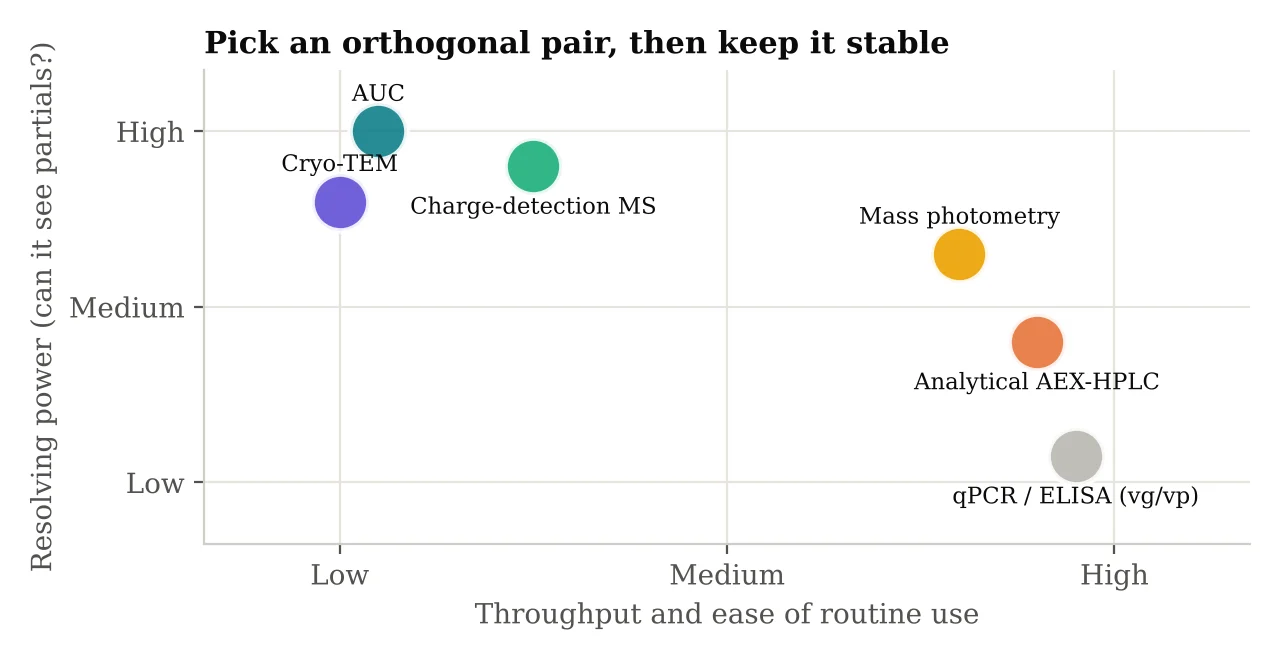
| Method | What it reports | Strengths | Limits |
| Analytical ultracentrifugation (AUC) | Full, partial, empty | Gold standard; about 2 percent CV; resolves partials | Low throughput; large sample |
| Cryo-TEM | Full vs. empty, morphology | Direct visual count; orthogonal | Slow; operator-dependent |
| Mass photometry | Empty, partial, full, overfilled | Minutes per sample; tiny volumes | Less resolving power than AUC |
| Charge-detection MS | Full, intermediate, empty | High resolution of content distribution | Specialist instrument |
| Analytical AEX-HPLC | Empty vs. full | Fast, QC-friendly, scalable to release | Method must be built per serotype |
| qPCR divided by ELISA (vg/vp) | Ratio only | Cheap and familiar | Two assays, compounded error; no partials |
What to do first
- Measure honestly. Get an AUC or mass photometry read on harvest and on purified material before changing anything, so you know whether your problem is production or separation.
- Fix upstream before downstream. Run a plasmid-ratio and reagent design of experiments, then revisit harvest timing. These are the cheapest percentage points of full capsid you will ever buy.
- Intensify only once the ratio is right. Perfusion and high cell density multiply whatever you are already making, including the empties.
- Design the AEX step for your serotype. Salt chemistry and gradient shape, not resin brand, drive the separation.
- Set the specification with the regulator in mind. Justify your percent full with clinical dose, route and batch data rather than pointing at an industry number.
How EllyCell can help you
EllyCell works with gene therapy developers and their CDMOs on the manufacturing questions that decide whether a program is affordable at commercial dose. We are vendor-neutral: we sell no resin, reagents or capacity, so the recommendation is the one the data supports.
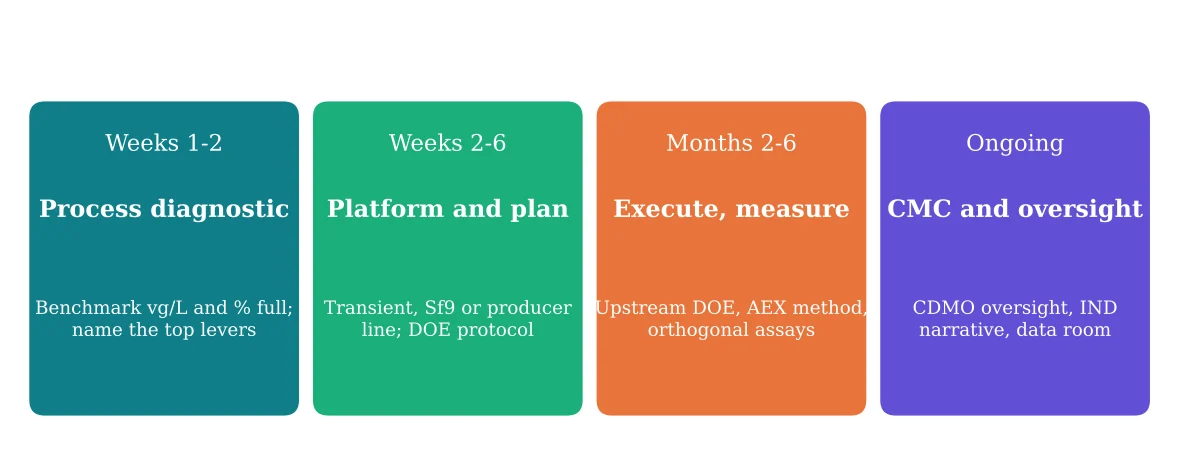
| EllyCell service | What you get |
| Process diagnostic | Where your vg/L and percent full sit against published benchmarks, and which two or three levers are worth pulling first |
| Platform decision | Transient vs. Sf9 vs. producer cell line, modeled against your dose, indication and timeline, including comparability risk |
| Upstream optimization plan | DOE design for plasmid ratio, reagent, cell density, feed and harvest window, written as a protocol your team or CDMO can run |
| Downstream and analytics | AEX method strategy for full/empty, orthogonal assay selection, and a specification you can defend to a regulator |
| CDMO selection and oversight | Scoring, technical diligence, tech-transfer packages, and person-in-plant style oversight of campaigns |
| CMC narrative | The manufacturing and comparability story for an IND, a partnering data room, or a diligence response |
Start a conversation
Engagements run from a two-week process diagnostic to ongoing CMC support through an IND or a partnering process.
EllyCell, LLC, McLean, Virginia, USA https://ellycell.com, info@ellycell.com
References
[1] Advancing AAV vector manufacturing: challenges, innovations, and future directions. Frontiers in Molecular Medicine, 2025.
[2] Advancing AAV production with high-throughput screening and transcriptomics. Cell & Gene Therapy Insights, 2024 (3 x 10^14 vg/L and 25 percent recovery planning assumptions).
[3] Status and future of recombinant AAV vector manufacturing. PMC13636615, 2026.
[4] Advances in recombinant AAV production for gene therapy. American Pharmaceutical Review, 2026.
[5] Daniels G. et al., HEK293 vs. Sf9 comparability. CASSS CGTP Summit, 2023; Tenaya Therapeutics, ASGCT 2023 manufacturing poster.
[6] Xue W. et al., AAV perfusion enhanced expression (APEX). Mol Ther Methods Clin Dev, 2024.
[7] ASGCT 2026 oral session summary: AAV cell line development and engineering. Molecular Therapy, 2026.
[8] Dark Horse Consulting, proposed draft FDA guidance on empty-capsid testing; BioPhorum, Control of empty, full and partially filled capsids, 2024.
[9] AEX enrichment of full capsids: Subramanian et al., Biotechnol Prog 2025; Hejmowski et al., Biotechnol J 2022; choline-based AEX 2025; affinity plus IEX for AAV9, Biomedicines 13(2):361, 2025.
[10] Strobel B. et al., CsCl vs. iodixanol purification of rAAV. Hum Gene Ther Methods, 2015.
[11] Lehman S.E. et al., Interlaboratory measurement of AAV full and empty capsids. Hum Gene Ther, 2024 (NIST); FDA, CMC information for human gene therapy INDs, Jan 2020; Cytiva, Understanding AAV vector impurities, 2025; rAAV production cost analysis, Gene Therapy (Nature), 2026.