01 · Consulting
Assay Qualification vs. Validation
What is needed at each phase of development
The expensive mistake is not under-validating at Phase 1. It is discovering at Phase 3 that pivotal material was released on a method nobody can defend.
EllyCell, LLC
Biopharmaceutical Consulting, R&D, Licensing and Business Development
McLean, Virginia, USA
Email: info@ellycell.com
Website: https://ellycell.com/
Executive summary
Qualification and validation are not two grades of the same exercise. Qualification asks whether a method is good enough to make decisions now. Validation proves, against a pre-approved protocol, that it is fit for a stated purpose. Regulators expect qualification in early development and full validation by the pivotal trial.
The cost of getting this wrong is asymmetric. Over-validating at Phase 1 wastes money on a method that will change. Under-validating at Phase 3 puts a pivotal dataset at risk, because you cannot validate retrospectively after the data is generated.
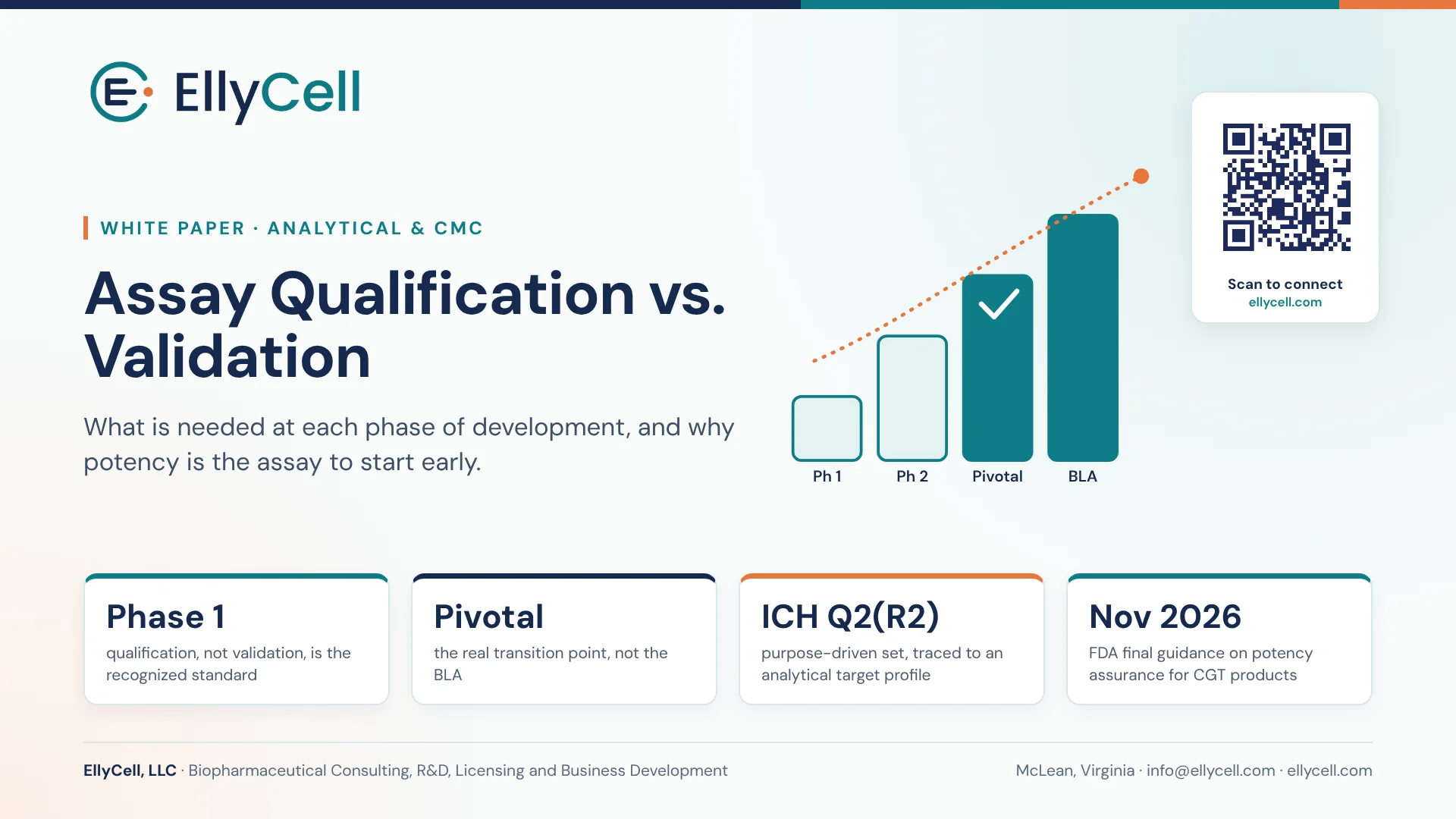
Phase 1
qualification, not validation, is the recognized standard
Pivotal
the real transition point, not the BLA
ICH Q2(R2)
purpose-driven set, traced to an analytical target profile
2 Nov 2026
FDA final guidance on potency assurance for CGT products
Key messages
The transition point is the pivotal trial. Methods used to release material for a pivotal study should already be validated.
Say plainly what is qualified. Sponsors are expected to state in Module 3 which methods are qualified rather than validated, and when validation will follow.
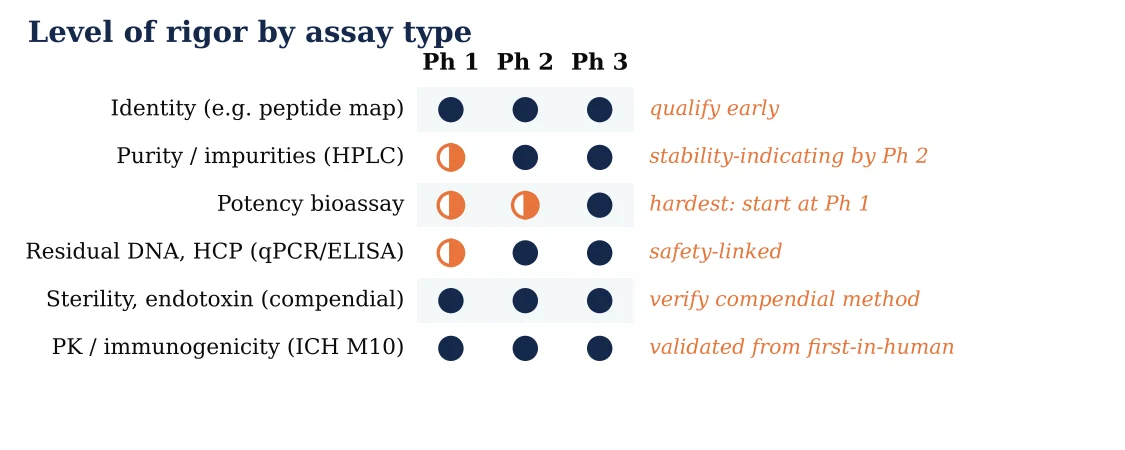
Rigor is not uniform across the panel. Bioanalytical methods supporting PK and immunogenicity follow ICH M10 and are validated from first-in-human, whatever the CMC phase.
Potency is the one to start early. The bioassay takes longest to build and is tied directly to dose and patient safety. A potency strategy is expected at IND even when a validated assay is years away.
Two different exercises
The distinction matters because it decides what a reviewer will accept. One is an internal judgment that a method is good enough for now. The other is a formal demonstration against criteria fixed in advance.
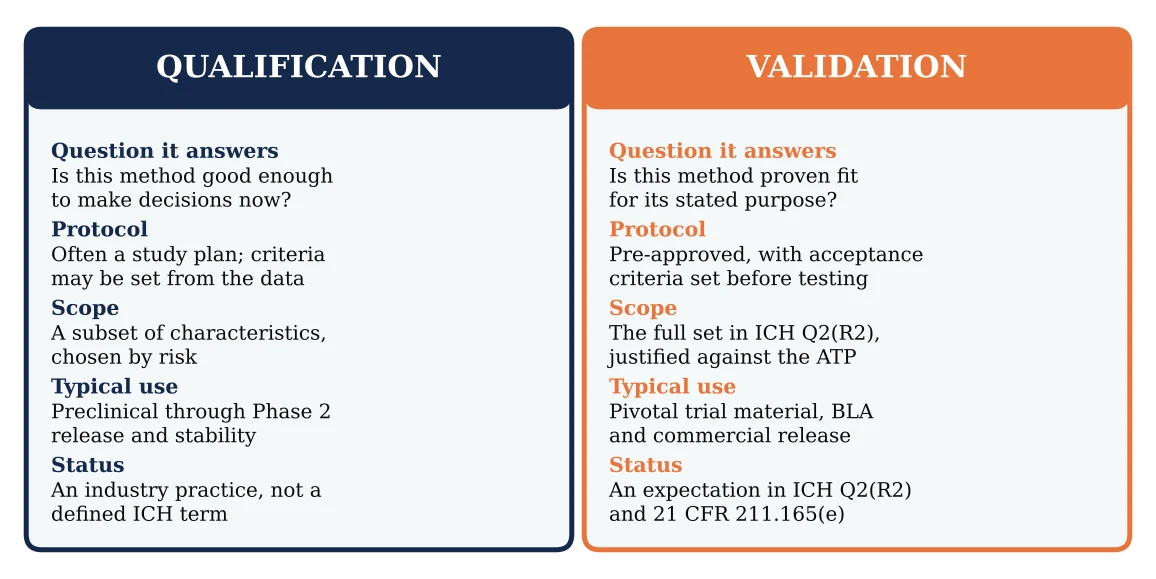
Note the difference in status. Qualification is an industry practice rather than a defined ICH term, which is why the burden falls on you to describe what you did and why it was sufficient. Validation is an expectation written into ICH Q2(R2) and 21 CFR 211.165(e).
The phase roadmap
Expectations tighten in steps rather than all at once. The figure below shows what the data must show at each phase, and where it appears in the filing.
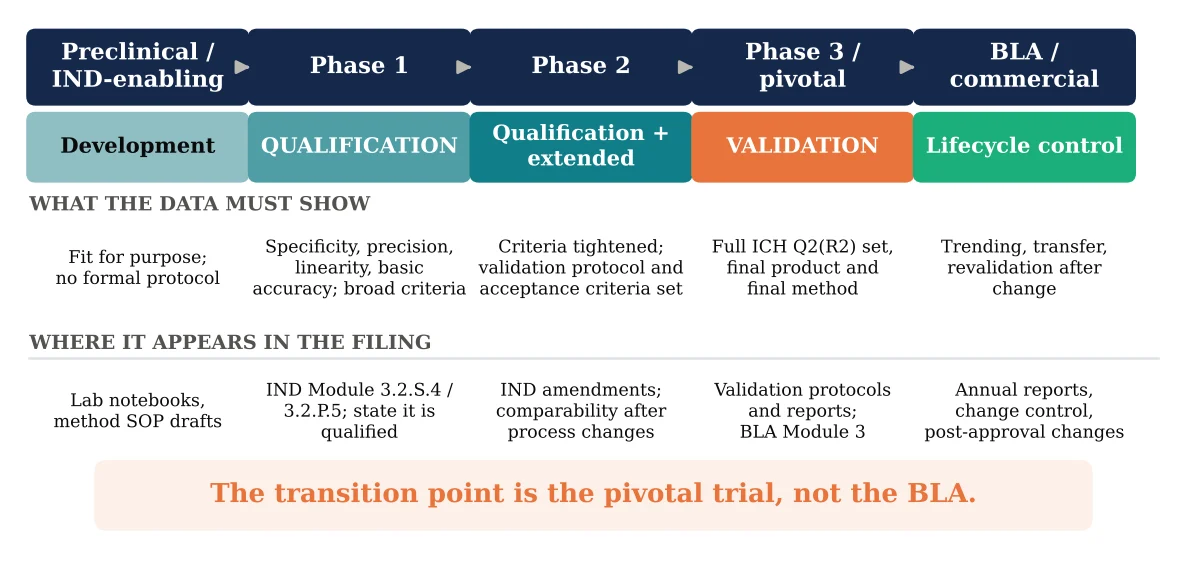
Phase 1 does not require fully validated analytical methods; qualification showing the method is suitable for its intended use is the recognized standard, and sponsors are expected to say plainly in Module 3 which methods are qualified rather than validated and when validation will follow. By Phase 2 the criteria tighten, and the validation protocol should exist. For Phase 3, full validation is strongly recommended, preferably on the final to-be-marketed formulation, and it is required at BLA. [1, 2, 3]
Why the pivotal trial is the real deadline
Methods used to release material for a pivotal study should already be validated. You cannot validate retrospectively after the data is generated, so a late validation means bridging studies, re-testing, or a dataset a reviewer will question.
What rigor is needed, and where
ICH Q2(R2) replaced the fixed checklist with a purpose-driven set. Validation now has to trace to a written analytical target profile from ICH Q14, so the question is no longer which boxes to tick but which characteristics the stated purpose requires.
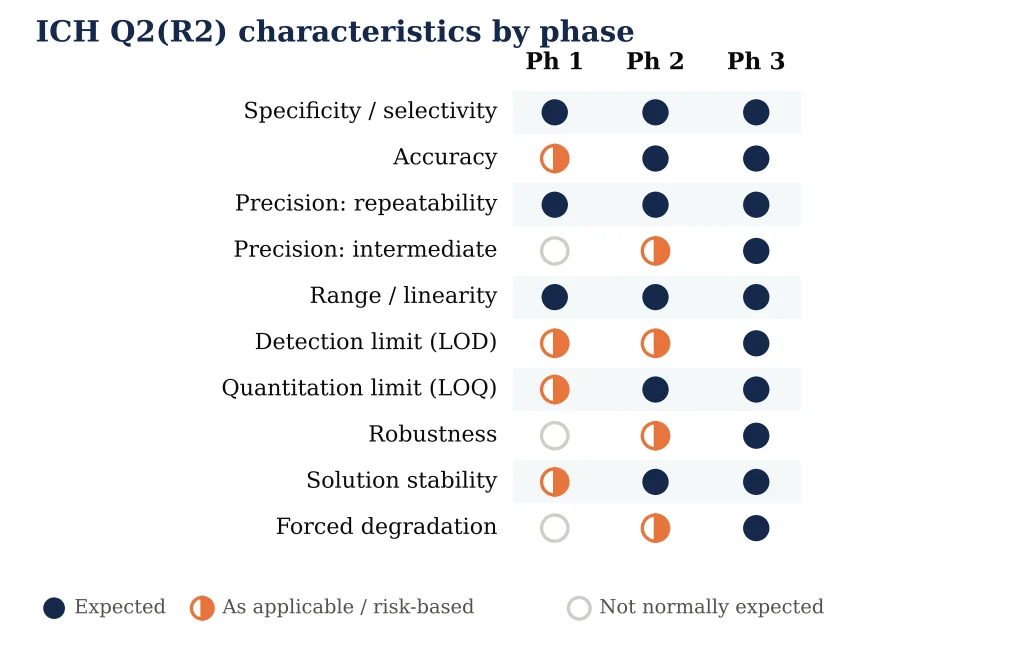
Rigor is also not uniform across the panel. Bioanalytical methods supporting PK and immunogenicity follow ICH M10 and are validated from first-in-human, independent of the product’s CMC phase. Compendial methods are verified rather than validated, but they are not exempt. [1, 6, 7]
Potency: the one to start early
Potency is where phase-appropriate thinking most often breaks down, because the bioassay takes longest to build and is directly tied to dose and patient safety.
FDA’s position hardened this month. On 2 November 2026 the agency issued final guidance, Potency Assurance for Cellular and Gene Therapy Products, replacing the 2011 potency testing guidance. It asks sponsors to build potency assurance across the lifecycle through process design, process and material control, in-process testing and release assays, rather than relying on a single end-of-line test, and to progressively strengthen that strategy as product knowledge grows. [4, 5]
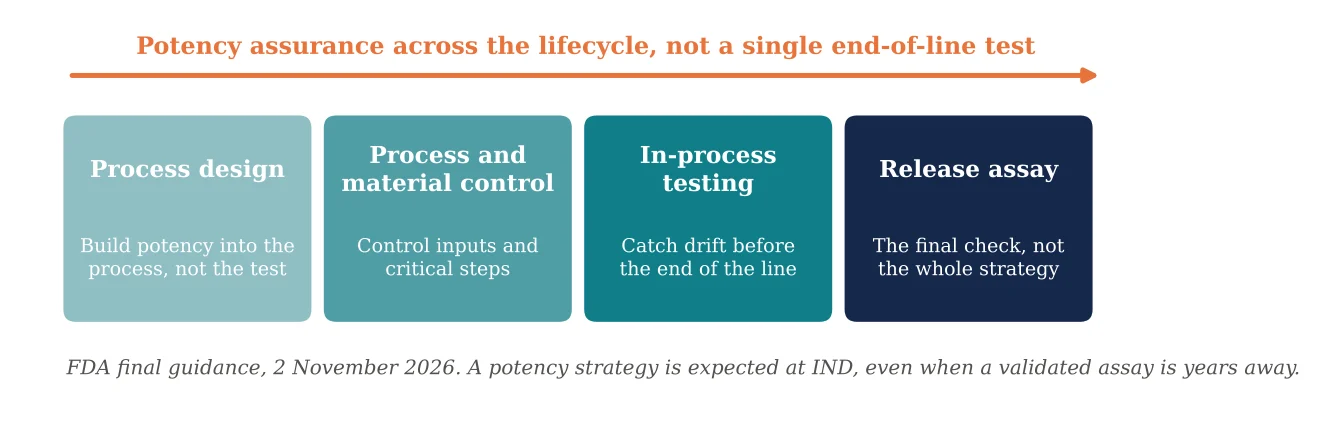
The practical reading for a CGT program: a potency strategy is expected at IND even when a validated assay is years away. What a reviewer wants to see early is the logic, not the final method.
Deciding the level for a given method
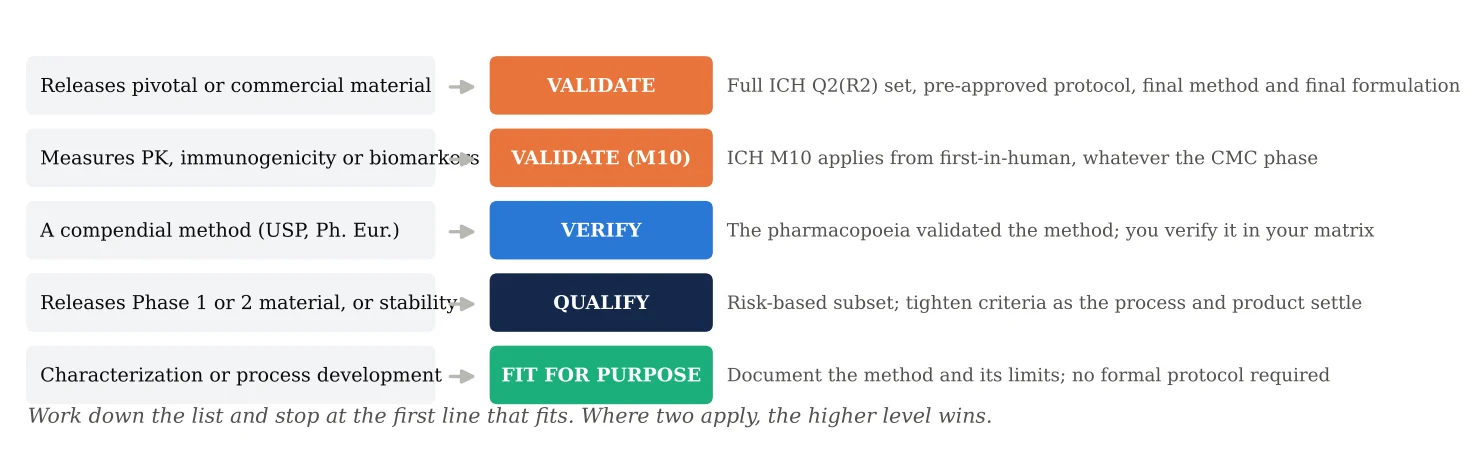
| Level | What it means in practice |
| Validate | Full ICH Q2(R2) set against a pre-approved protocol, on the final method and final formulation |
| Validate (ICH M10) | The bioanalytical standard, which applies from first-in-human whatever the CMC phase |
| Verify | A documented check that a compendial method performs in your matrix; the pharmacopoeia validated the method, not your sample |
| Qualify | A risk-based subset of characteristics, with criteria tightened as the process and product settle |
| Fit for purpose | The method and its limits documented; no formal protocol required |
Common pitfalls
| Validating too late | A pivotal batch is released on a qualified method, and the data has to be bridged or the batch re-tested | Lock the method and validate before the first pivotal GMP release |
| No acceptance criteria up front | Criteria written after seeing the results; an inspector reads this as fitting the limits to the data | Approve the protocol with numeric criteria before any run |
| Potency left to last | The bioassay is the slowest method to develop and the most often cited in CMC holds | Start the potency strategy at IND and build the matrix as knowledge grows |
| Compendial assumed exempt | USP methods still need verification in your matrix; the pharmacopoeia validated the method, not your sample | Run a documented verification for each product matrix |
| Change without revalidation | A reagent lot, column or instrument changes and nothing is re-assessed | Define in advance which changes trigger partial revalidation or transfer |
How EllyCell can support you
EllyCell helps biotech teams decide how much analytical rigor a given stage actually needs, then produces the documents that stand up to a reviewer or a partner’s diligence. We work alongside your CRO or CDMO rather than replacing them.
| EllyCell support | What you get |
| Phase-gap assessment | A method-by-method read of where each assay sits today against what your next filing requires, with the gaps ranked |
| Validation master plan | One document mapping every assay to its phase, owner, protocol and target date, suitable to show a partner or a reviewer |
| Protocol and report authoring | ICH Q2(R2)-aligned protocols with pre-set acceptance criteria traced to an analytical target profile, and the reports to match |
| Potency strategy | Assay selection against mechanism of action, and a phase-appropriate plan built around the FDA potency assurance framework |
| CRO and CDMO oversight | Scoring labs, writing the transfer and co-validation protocols, and reviewing the data packages you receive |
| Filing and diligence support | The Module 3 analytical narrative for an IND or BLA, and responses when a reviewer or a potential partner questions method rigor |
Start a conversation
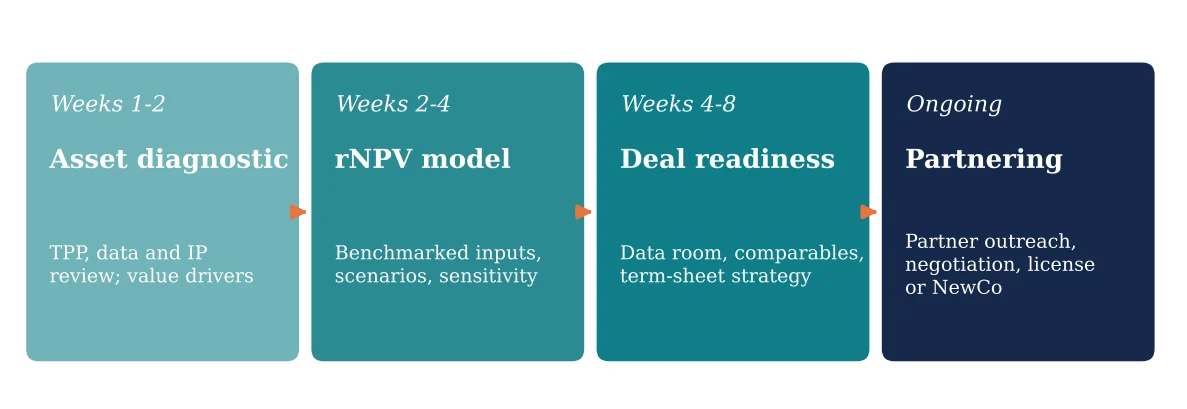
Engagements run from a two-week process diagnostic to ongoing CMC support through an IND or a partnering process.
EllyCell, LLC, McLean, Virginia, USA https://ellycell.com, info@ellycell.com
References
[1] ICH Q2(R2), Validation of Analytical Procedures, and ICH Q14, Analytical Procedure Development, adopted at Step 4 on 1 November 2023; FDA announced both as final guidances on 7 March 2024; EMA adoption 14 December 2023, effective 14 June 2024.
[2] FDA, Analytical Procedures and Methods Validation for Drugs and Biologics, 2015; FDA, CMC information for Phase 1 investigational drugs; 21 CFR 211.165(e).
[3] NIH SEED, Regulatory Knowledge Guide for Biological Products: phase-appropriate qualification and validation expectations.
[4] FDA, Potency Assurance for Cellular and Gene Therapy Products, final guidance issued 2 November 2026 (91 FR 69259), replacing the January 2011 potency testing guidance; draft issued December 2023.
[5] Boone L. (FDA/CBER), Regulatory considerations of bioassay lifecycle management for biologics, CASSS Bioassays, 2024.
[6] ICH M10, Bioanalytical Method Validation and Study Sample Analysis, Step 4, 24 May 2022, including partial and cross validation.
[7] USP General Chapters <1032>, <1033> and <1034> on design, validation and analysis of biological assays; <1225> and <1226> on validation and verification of compendial procedures.
[8] ISPE PQLI, Readiness for implementation of ICH Q2(R2) and Q14: industry survey results, Pharmaceutical Engineering, 2025.