01 · Consulting
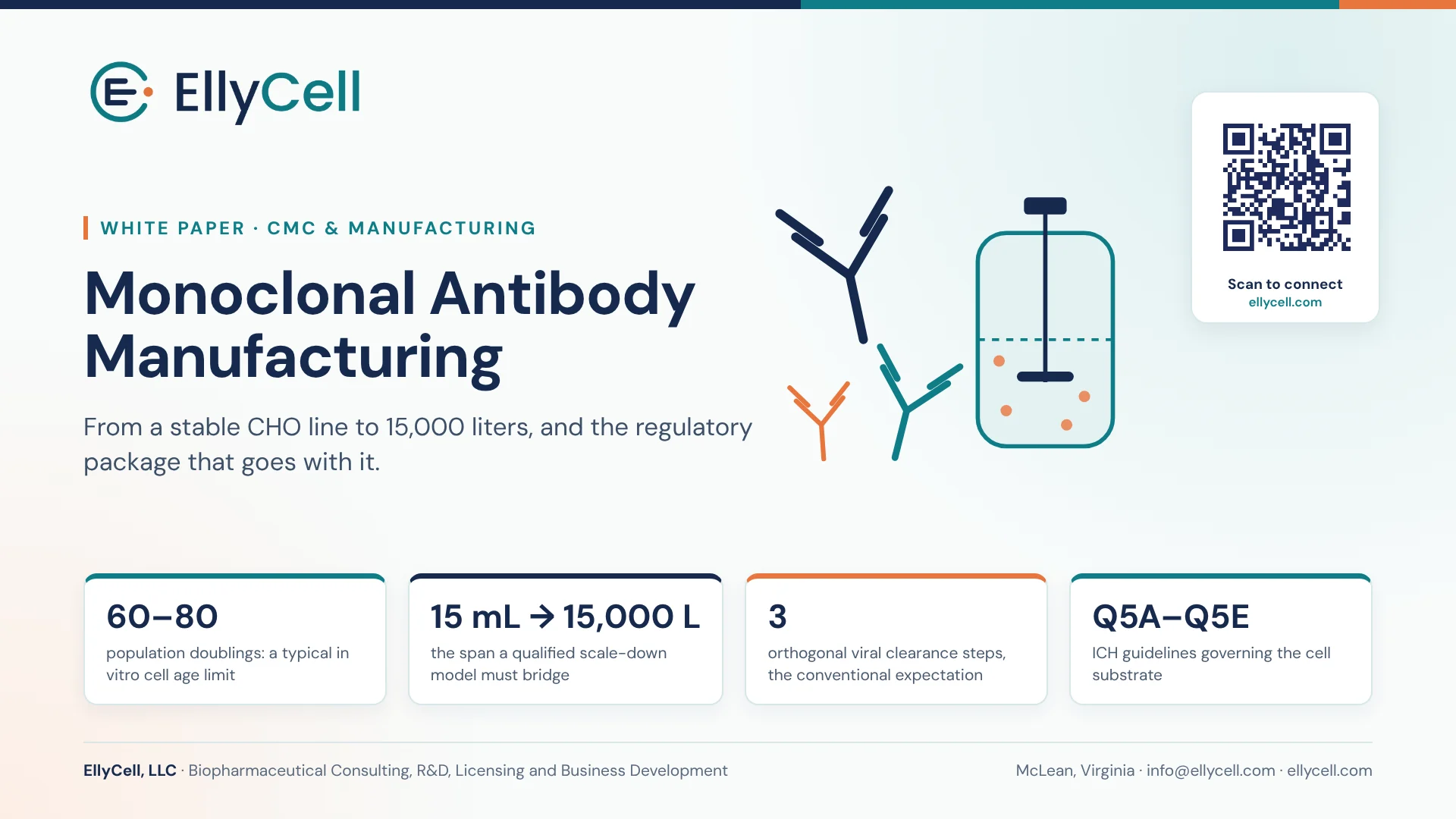
Monoclonal Antibody Manufacturing
From a stable CHO line to 15,000 liters, and the regulatory package that goes with it
Antibody manufacturing is a solved problem in the sense that the unit operations are known. It is not a solved problem for any individual sponsor, because the decisions are sequential, most of them are expensive to reverse, and the ones made in the first year set the ceiling for the next ten. This paper walks the path from transfection to commercial supply and names the decision at each step.
EllyCell, LLC
Biopharmaceutical Consulting, R&D, Licensing and Business Development
McLean, Virginia, USA
Email: info@ellycell.com
Website: https://ellycell.com/
Executive summary
A monoclonal antibody program is a chain of decisions in which each link constrains the next. The clone you pick in month six determines the titer you live with at 2,000 liters. The cell age limit you justify determines how many batches a working cell bank can support. The scale-down model you qualify determines whether a 15-milliliter experiment can defend a 15,000-liter decision to a reviewer.
None of this is novel science. It fails on execution: a clone selected on titer alone that proves unstable at passage 60, a process locked before the scale-down model was qualified, an analytical package built after the batches it was supposed to compare.
60 to 80
population doublings is a typical in vitro cell age limit to justify
15 mL to 15,000 L
the span a qualified scale-down model has to bridge
3
orthogonal viral clearance steps is the conventional expectation
Q5A to Q5E
the ICH guidelines that govern the cell substrate and the changes to it
Key messages
Screen clones in a vessel that behaves like the tank. Ambr 15 microbioreactor performance has been shown to track benchtop vessels and to mimic pilot and manufacturing scale, reported up to 15,000 liters [1].
Stability is a property of the clone, not of the process. ICH Q5D requires stability data to or beyond the proposed cell age limit, typically 60 to 80 population doublings from the master cell bank, and that limit is then locked into the process description [2, 3].
Choose the production mode from the molecule. Fed-batch is the platform default; intensified fed-batch and perfusion exist because some molecules will not tolerate fourteen days in a tank.
Build the analytics before you need them. Validated methods are expected before process performance qualification, and comparability after a scale change is an analytical exercise first [4, 5].
The development path
The shape of the program is consistent across sponsors. What differs is how much of it is planned and how much is discovered.

| Stage | What is produced | What is decided |
| Cell line development | Master cell bank from a single clone | The clone, the host, the selection system, and the productivity ceiling for the life of the product |
| Process development | A defined upstream and downstream process at bench scale | Fed-batch or perfusion, media and feed platform, the purification train, and the scale-down model that will defend later changes |
| Toxicology and Phase 1 supply | GMP material at 50 to 500 liters | First GMP batches, first release specifications, and the shape of the analytical package |
| Phase 2 and 3 supply | Clinical material at 500 to 2,000 liters | The commercial process, the commercial scale, and any comparability needed to get there |
| PPQ and BLA | Validation batches at commercial scale | Final specifications, shelf life, and the process description that becomes a regulatory commitment |
| Commercial supply | Routine batches at 2,000 to 15,000 liters | Lifecycle management under ICH Q12; every change now costs a filing |
Building a stable CHO cell line
CHO remains the workhorse because regulators know it, the glycosylation is human-compatible, and viral clearance for CHO-derived products is well characterized. The decisions inside cell line development are about the host, the integration strategy and the evidence trail.
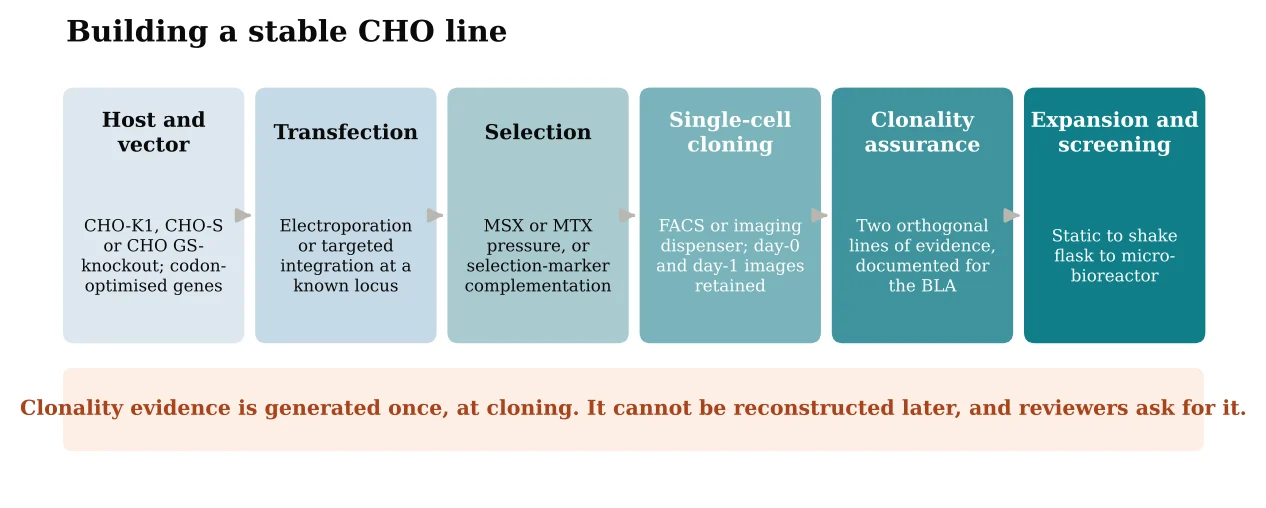
| Decision | Options | What it costs you later |
| Host line | CHO-K1, CHO-S, CHO DG44, or a glutamine synthetase knockout host | Licensing terms, the selection agent, and the host-cell protein profile your assay has to detect |
| Integration | Random integration with selection pressure, or targeted integration at a characterized locus | Random integration gives higher screening burden and more stability risk; targeted integration gives predictability at the cost of a lower ceiling |
| Selection system | MSX with a GS host, MTX amplification with DHFR, or marker complementation | Amplified lines are more prone to copy-number loss over passage |
| Cloning method | Limiting dilution, FACS, or a single-cell imaging dispenser | Clonality evidence. An imaging dispenser produces the day-0 and day-1 images that reviewers expect |
| Clonality evidence | Two orthogonal lines of evidence, retained | This cannot be generated retrospectively. Sponsors who skip it face a probability-of-clonality argument that is hard to win |
The one thing not to compromise
Clonality documentation is generated once, during cloning, and it is one of the few parts of the package that cannot be rebuilt later. If a contract organization is doing the cloning, the imaging and record-retention requirement belongs in the contract, not in a conversation afterwards.
Clone selection with Ambr 15
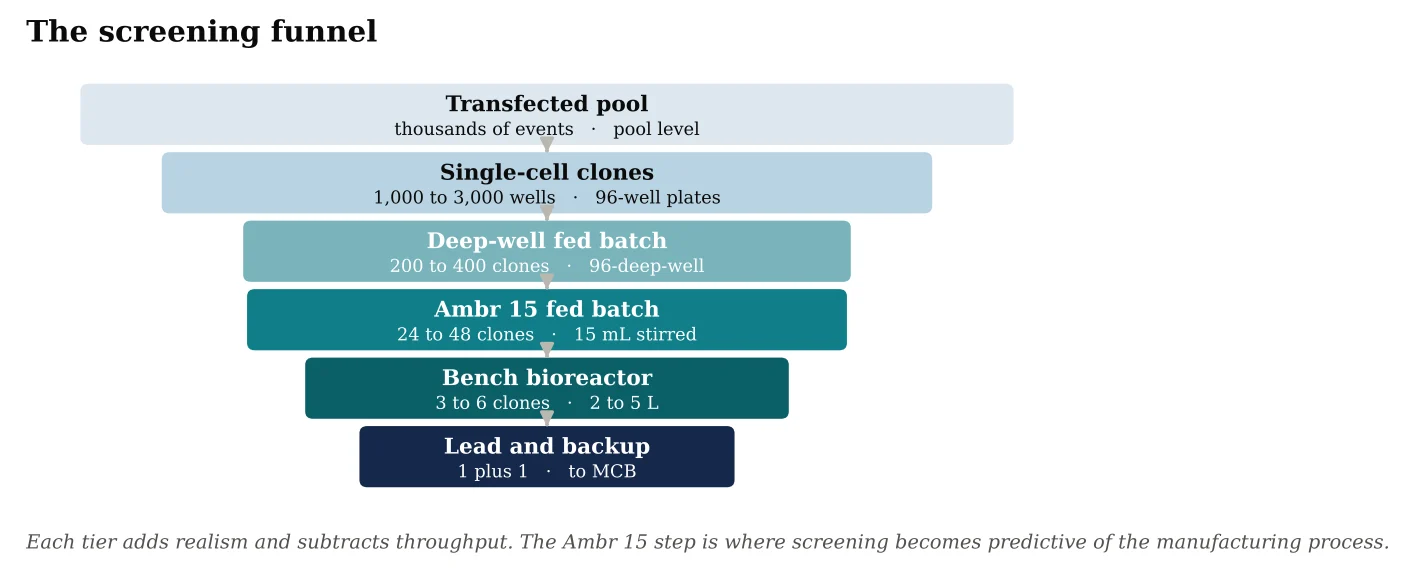
Thousands of transfected events have to become one production clone and one backup. The screening funnel exists because every tier that adds realism also subtracts throughput, so the population has to be cut before the expensive formats.
Why the microbioreactor titer matters
Shake flasks and deep-well plates rank clones by growth and titer, but they cannot reproduce controlled dissolved oxygen, pH control by gas and base addition, or the shear environment of a stirred tank. A clone that looks excellent in a flask can behave differently under real process control, and the deep-well fed batch is best understood as a pre-filter that feeds the microbioreactor tier rather than a substitute for it [6].
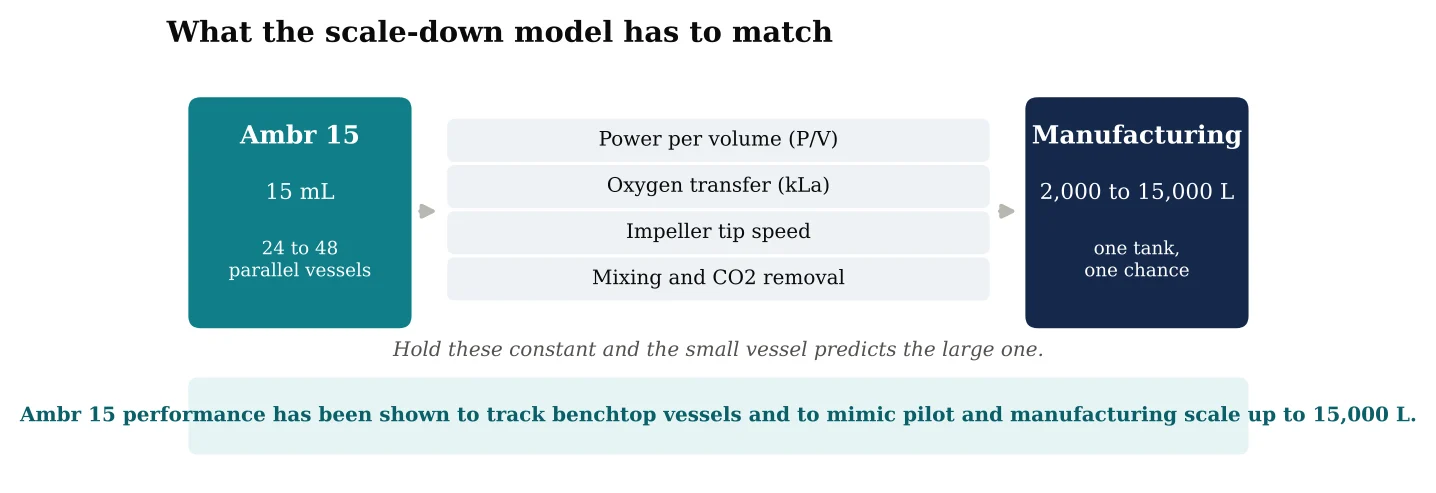
The Ambr 15 system, launched in 2010, runs 24 to 48 parallel 15 mL stirred vessels with individual control [1, 7]. It has been shown to perform comparably to 2, 3 and 5 liter benchtop bioreactors, and to mimic pilot scale at 15 and 200 liters and manufacturing scale reported up to 15,000 liters [1].
Selecting for the process you will actually run
A clone selected under standard fed-batch conditions is not automatically the right clone for an intensified or perfusion process. Scale-down tools now exist to screen directly for the intended mode: perfusion mimic in the Ambr 15, achieved by cell settling or by centrifugation with media exchange at around one vessel volume per day, and high-inoculation fed-batch formats that reproduce an intensified seed train [7, 8, 9].
Modelling is shortening this step. Machine-learning approaches have been used to predict high-inoculation-density performance from low-inoculation-density Ambr 15 attributes at harvest, and hybrid mechanistic and AI methods combining Ambr 15 fed-batch data with perfusion simulations have been reported to identify an optimal perfusion clone in one to two days rather than weeks [10, 11].
| Selection criterion | Why it earns its place |
| Volumetric titer | The headline number, and the one most likely to be over-weighted on its own |
| Specific productivity and growth | Separates a clone that grows well from one that produces well; the two trade off |
| Product quality attributes | Glycan profile, charge variants, aggregation and fragmentation. A high-titer clone with the wrong glycosylation is not a candidate |
| Metabolic profile | Lactate and ammonia accumulation predict behavior at scale, where CO2 removal and mixing are worse |
| Stability signal | Early passage data flags clones that will fail the cell age study months later |
| Fit to the intended mode | Fed-batch, intensified fed-batch or perfusion, screened as such rather than inferred |
Cell banking: MCB, WCB and EOPC
The two-tier bank system is the foundation of the regulatory file. ICH Q5D requires both the master and working cell banks to derive from a single-cell clone, to be filled uniformly into cryovials, to be tested for identity, purity and genetic stability, and to be stored under conditions that maintain viability [12]. For CHO-derived products, ICH Q5B, Q5D and Q5A(R2) are the primary global standards, supplemented by FDA and EMA regional guidance and WHO recommendations [13].

| Bank | What it is | Practical notes |
| Master cell bank (MCB) | A single fill from the expansion of one clone; typically, 100 to 300 vials | Fully characterized. This is the irreplaceable material. Split the inventory across two geographically separate storage sites |
| Working cell bank (WCB) | Expanded from a single MCB vial and refilled; the routine source for production | Abbreviated testing relative to the MCB, but identity, sterility, mycoplasma and adventitious agents are still expected |
| End-of-production cells (EOPC) | Cells harvested at or beyond the limit of in vitro cell age | Generated once per process to support the cell age limit; tested for adventitious agents and for genetic stability |
The testing panel
| Category | Tests | Applies to |
| Identity | Isoenzyme analysis or STR profiling, species confirmation, transgene identity | MCB and WCB |
| Sterility and mycoplasma | Compendial sterility, mycoplasma by culture and by PCR | MCB, WCB and EOPC |
| Adventitious agents | In vitro assays on multiple indicator cell lines, in vivo assays where still required, bovine and porcine agents traced to raw materials | MCB, and EOPC |
| Retrovirus | Transmission electron microscopy for particle counting, infectivity assays, reverse transcriptase | MCB and EOPC |
| Genetic characterization | Transgene copy number, sequence of the coding region, restriction map, integration site were known | MCB and EOPC, per ICH Q5B |
| Viability and recovery | Post-thaw viability, growth and productivity on a sampling of vials | MCB and WCB, ongoing |
A planning note
Cell bank testing is long-lead work. Adventitious agent and retrovirus panels run for weeks to months, and the results gate the first GMP production campaign. Booking the testing slots at the same time as the banking slot avoids a gap that no amount of urgency can close later.
Genetic stability and the cell age limit
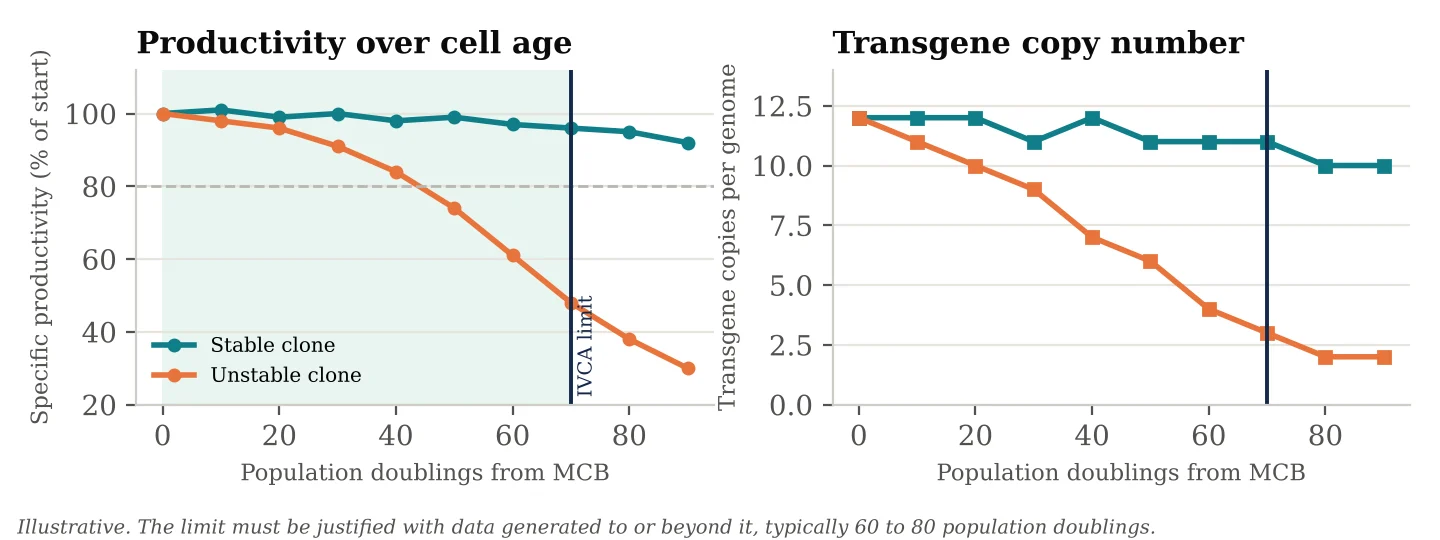
A production clone has to still be the same clone at the end of the last batch. ICH Q5D asks the applicant to define and justify a maximum in vitro cell age for production, and to support it with data generated to or beyond that limit, typically 60 to 80 population doublings from the master cell bank. Once set, the limit goes into the manufacturing process description and cannot be exceeded without further stability data [2, 3].
| What is measured | What a failure looks like |
| Specific productivity across passage | Gradual decline, often from loss of amplified copies under reduced selection pressure |
| Transgene copy number | Copy loss over generations; the most common mechanism of productivity decline in amplified lines |
| Coding sequence integrity | Point mutations or rearrangements in the heavy or light chain gene, verified by nucleic acid testing or by product analysis [14] |
| Product quality | Drift in glycan profile, charge variants or aggregation at late passage, even where titer holds |
| Karyotype | FDA practice under 21 CFR and ICH Q5D looks for no more than about 10 percent karyotypic abnormality in the MCB and no further drift in the WCB; EMA frames the expectation as no clinically relevant alterations [15] |
The design question is how much headroom to build in. A limit justified only to the number of doublings the current process needs leaves no room for a larger bioreactor, a longer seed train or an extended perfusion run later. Each of those is a supplement if the limit has to move.
Upstream process: fed-batch or perfusion

Fed-batch is the default for a stable IgG: one vessel, one harvest, a clean batch definition, and the validation path that regulators see most often. Perfusion holds a high viable cell density for weeks with continuous harvest, which shortens the time any molecule spends in the bioreactor environment. That matters for products that degrade, aggregate or clip during a long culture.
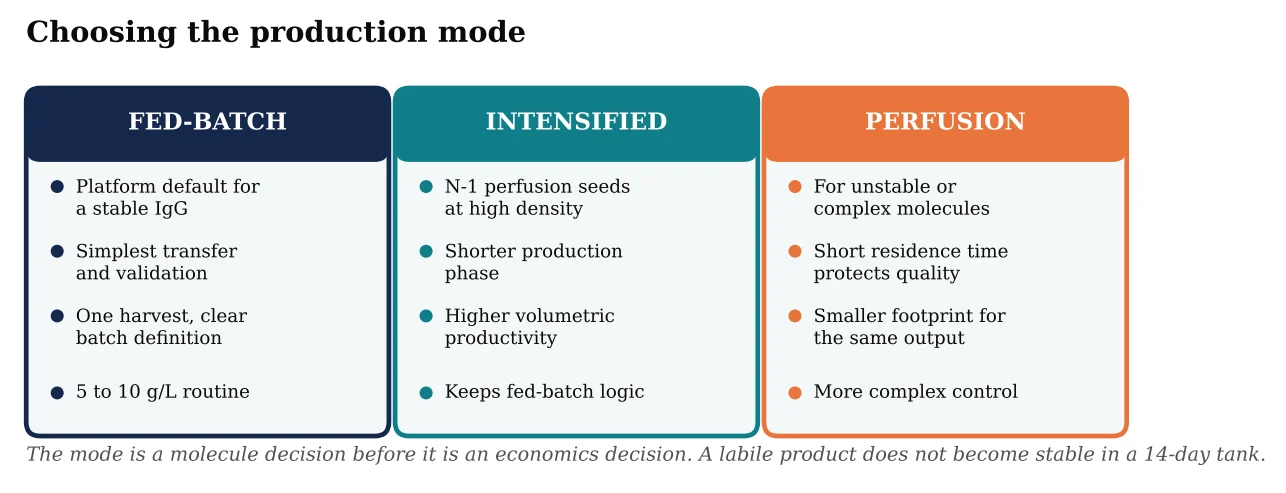
Intensified fed-batch, the middle path
The option for many programs land on is neither pure mode. An N-1 perfusion step grows the seed to high density, and the production bioreactor is inoculated at that density. This raises volumetric productivity and shortens the production phase while keeping the batch logic of fed-batch intact [16]. For a sponsor trying to avoid a 2,000-liter capital decision, it is often the cheapest way to buy capacity.
| Fed-batch | Intensified fed-batch | Perfusion | |
| Duration | 12 to 16 days | 8 to 12 days | 30 to 60 days or more |
| Peak cell density | 15 to 25 million/mL | 25 to 40 million/mL | 50 to 100 million/mL |
| Batch definition | Simple: one harvest | Simple: one harvest | Requires a defined harvest pooling strategy |
| Media consumption | Lowest | Moderate | Highest per batch |
| Facility footprint | Largest per gram | Moderate | Smallest per gram |
| Validation burden | Lowest | Moderate | Highest: continuous control, longer campaigns |
| Best fit | A stable IgG at any scale | Capacity relief without new tanks | Labile or complex molecules; high-value low-volume products |
Downstream purification and viral clearance
The antibody purification train is the most platform-like part of the process, which is an advantage: a sponsor can adopt a known sequence and spend its development effort on the parts that are molecule-specific.
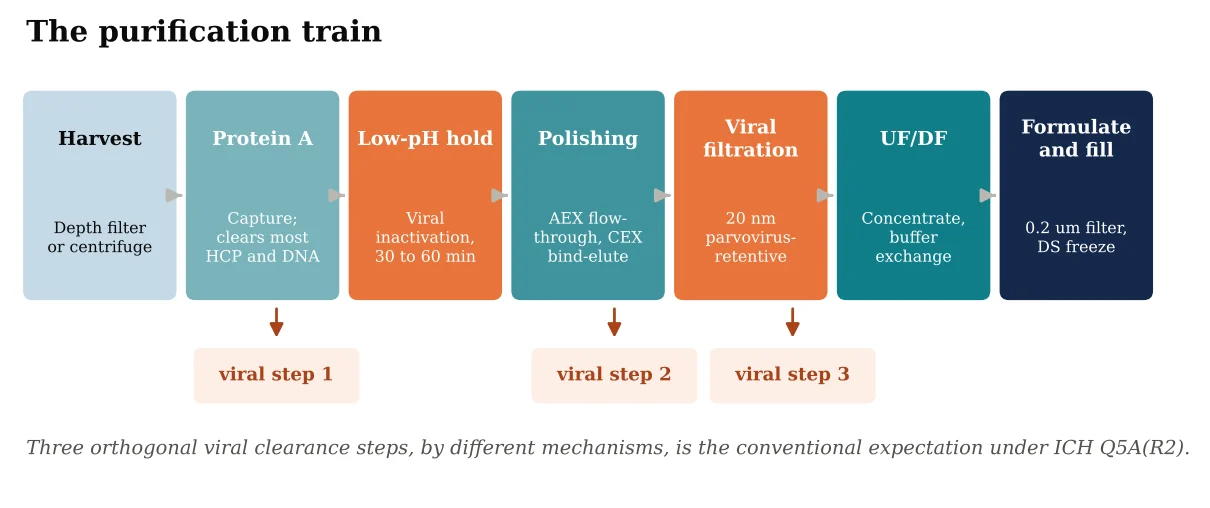
| Step | Purpose | What to watch |
| Harvest clarification | Remove cells and debris by depth filtration or centrifugation | Filter capacity falls as cell density rises; an intensified process can break a harvest train designed for standard fed-batch |
| Protein A capture | Affinity capture; clears the majority of host-cell protein and DNA in one step | Resin lifetime and carryover; leached protein A becomes a release test |
| Low-pH viral inactivation | Hold at pH 3.5 to 3.8 for 30 to 60 minutes | Hold time and pH are validated parameters; some molecules aggregate at low pH and need a narrower window |
| Polishing | Anion exchange in flow-through mode, cation exchange in bind-elute | Where aggregate, charge variants and residual DNA are controlled to specification |
| Viral filtration | 20 nanometers parvovirus-retentive filtration | Throughput is sensitive to aggregate load; a polishing step that underperforms shows up here |
| UF/DF and formulation | Concentrate and exchange into the final buffer | High-concentration formulations raise viscosity and aggregation risk; this is where a subcutaneous presentation is won or lost |
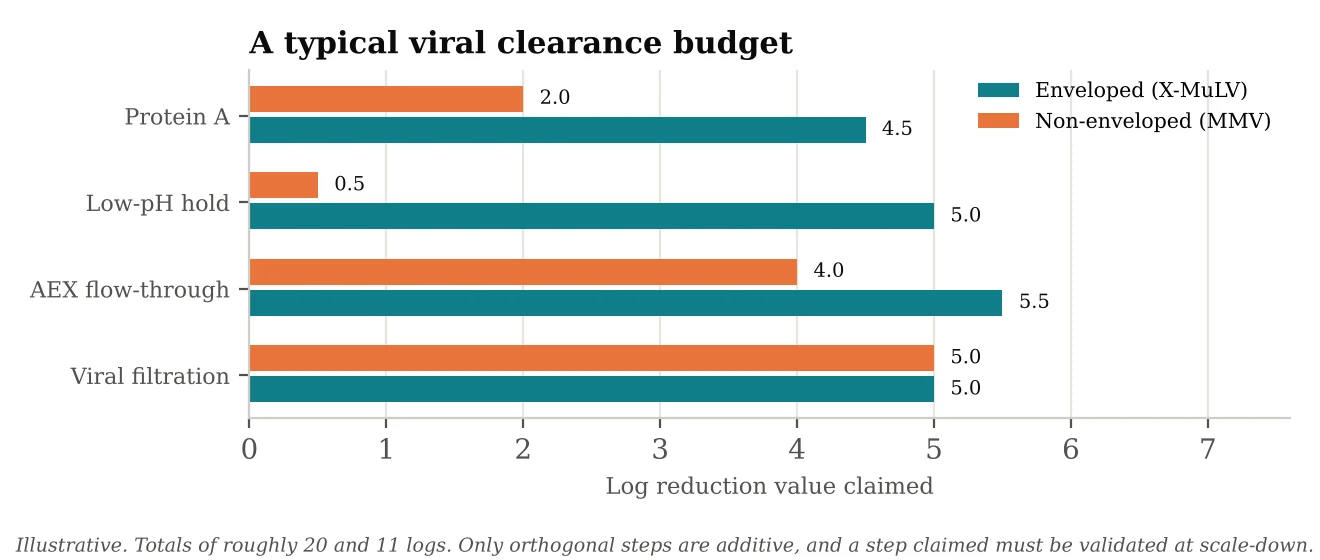
The viral clearance budget
ICH Q5A(R2), adopted on 1 November 2023, retains the scientific structure of the original guideline while modernizing it for new product types, new analytical methods, platform manufacturing knowledge and continuous manufacturing [17]. For a CHO-derived antibody the expectation remains orthogonal clearance: steps that work by different mechanisms, each validated in a qualified scale-down model, with claimed log reduction values summed only where the mechanisms genuinely differ.
Scale-up from 50 L to 15,000 L
Scale-up is not a single event. It is a series of transfers, each of which has to preserve the product while the physical environment of the vessel changes underneath it.

| Scale | Phase | Purpose and practical notes |
| Ambr 15, 15 mL | Development | Clone selection and design-of-experiment work. 24 to 48 parallel vessels; the only tier where real statistical designs are affordable |
| 2 to 5 L bench | Development | Process definition and the qualified scale-down model. This model will be used for years, including for viral clearance and for comparability after changes |
| 50 L | Preclinical | Toxicology material and engineering runs. The first time the process meets a real facility, and where most transfer problems surface |
| 200 to 500 L | Phase 1 and 2 | Clinical supply. Single-use bioreactors dominate here; for an IgG at 3 to 5 g/L a 500 L batch yields on the order of 1 to 2 kg before losses |
| 2,000 L | Phase 3 and PPQ | The commercial process should be in place before Phase 3 material is made, because changing it afterwards means bridging comparability against clinical material |
| 5,000 to 15,000 L | Commercial | Stainless steel at this scale. Justified by volume demand; for many modern antibodies, two to four 2,000 L single-use trains are the alternative |
What must not move

Geometric similarity cannot be maintained across three orders of magnitude, so engineering parameters are conserved instead. Power per unit volume and oxygen transfer rate are the usual anchors. What cannot be held constant is mixing time, which lengthens with vessel size and creates gradients in pH, dissolved oxygen and nutrient concentration that a 15 mL vessel never sees. Scale-down models that deliberately introduce those gradients are the way to test for it before the batch rather than after.
The timing decision that costs the most
Running Phase 3 at a scale you do not intend to commercialize at means a comparability exercise between the pivotal material and the commercial material, at the point in the program where there is least time to absorb a surprise. Locking the commercial scale before Phase 3 is more expensive up front and almost always cheaper overall.
Release testing for drug substance and drug product
Specifications under ICH Q6B are built from the quality attributes that matter for safety and efficacy, justified by manufacturing experience and by what the clinical material actually contained. Q6B has been in force since 1999 and is now itself under revision, with regulators arguing for a more patient-centric and risk-based basis for acceptance criteria than a limited number of batches can supply [18, 19].
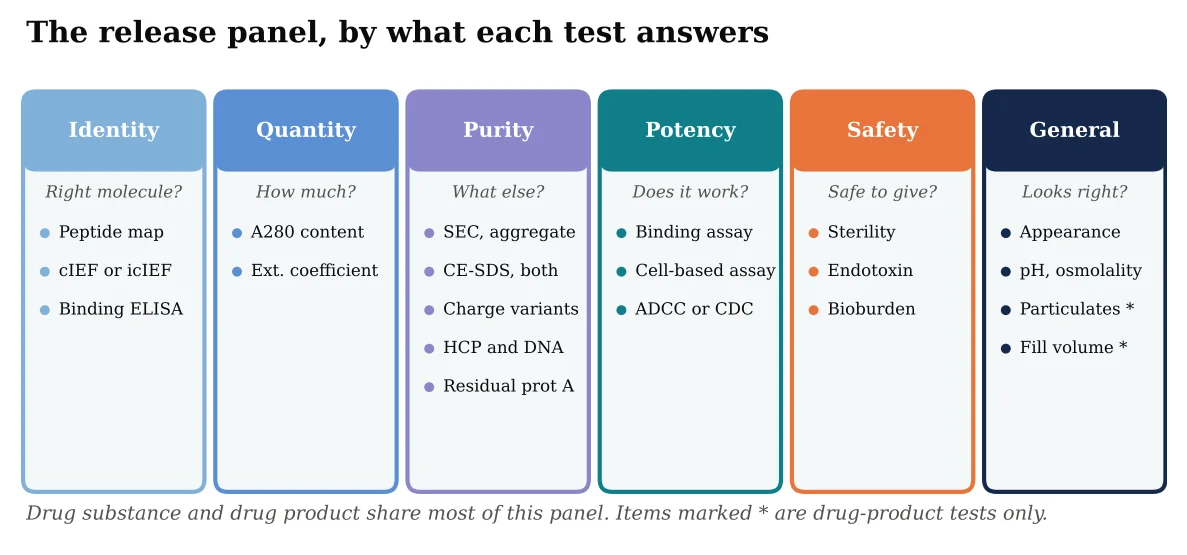
| Category | Drug substance | Drug product |
| Appearance | Color and clarity of the thawed solution | Color, clarity, visible particulates |
| Identity | Peptide map, icIEF, binding assay | Same, usually abbreviated |
| Quantity | Protein concentration by A280 | Concentration, plus fill volume or weight |
| Purity and impurities | SEC, CE-SDS reduced and non-reduced, charge variants, HCP, residual DNA, leached protein A | SEC, CE-SDS, charge variants; process impurities usually tested at DS only |
| Potency | Binding and a cell-based functional assay | Same assay, same reference standard |
| Safety | Bioburden, bacterial endotoxin | Sterility, bacterial endotoxin, sub-visible particulates |
| General | pH, osmolality, excipient content | pH, osmolality, extractable volume, container closure integrity |
Potency is the attribute to get right early
Potency is the quantitative measure of biological activity, and EMA expects a relevant potency assay in the specification for drug substance, drug product or both, reflecting the product’s mechanism of action [20]. FDA’s position in its monoclonal antibody potency guidance is that a binding assay is generally sufficient at the IND stage, but that a binding assay assesses only one aspect of potency, and that the methods used must be incorporated into both release testing and the stability protocol [21].
The practical consequence is that a binding ELISA carried from the IND into Phase 3 without a functional assay behind it becomes a problem late, when the reference standard, the assay qualification and the stability history all have to be rebuilt at once.
Reference standards
A two-tier reference standard system, a primary standard held in reserve and a working standard qualified against it, should be established before the first GMP batch. Every potency number the program ever reports is relative to that material, and a poorly characterized primary standard contaminates the whole data set.
Stability program
ICH Q5C governs stability for biotechnology products including monoclonal antibodies and asks for a detailed protocol covering both drug substance and drug product in support of the proposed storage conditions and expiration dating [22]. Its central principle is that no single assay is stability-indicating: the program has to be product-specific and able to detect changes in identity, purity and potency, with the methods validated at the time of submission [23].
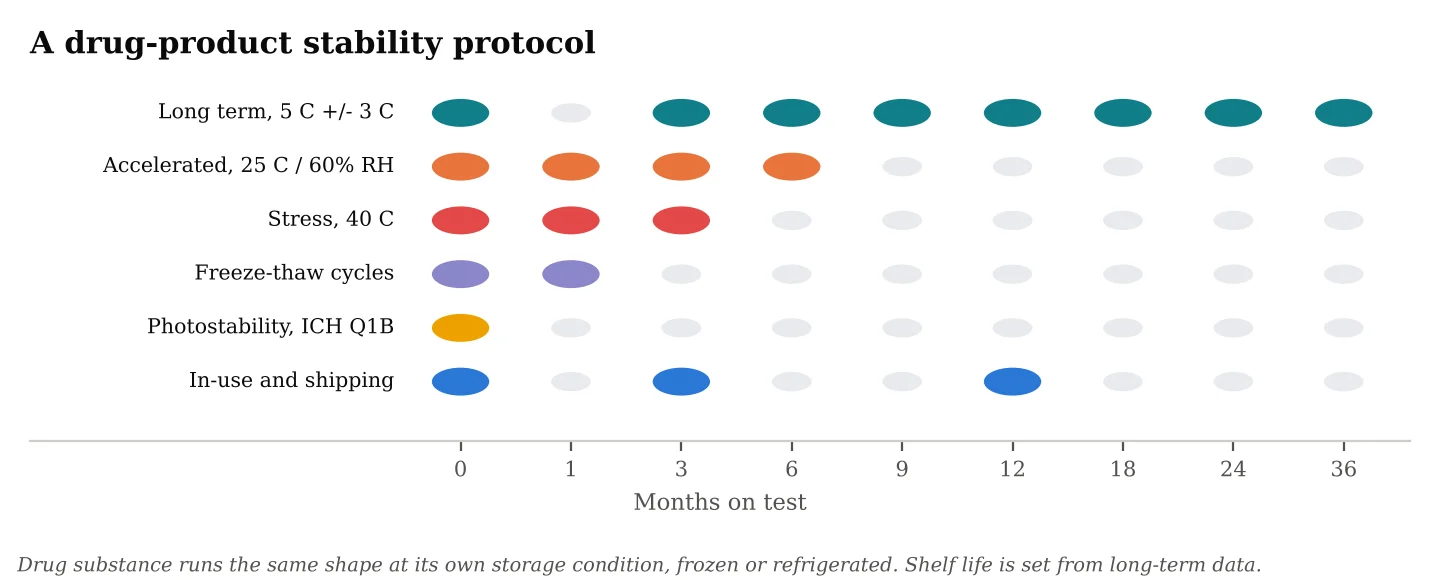
| Study | Purpose | Typical design |
| Long term | Sets the shelf life | 5 degrees plus or minus 3 for a refrigerated drug product; frozen for most drug substance. Tested at 0, 3, 6, 9, 12, 18, 24 and 36 months, on at least three batches |
| Accelerated | Supports excursions and gives early degradation signal | 25 degrees at 60 percent relative humidity, typically to 6 months |
| Stress and forced degradation | Demonstrates the methods are stability-indicating and maps degradation pathways | Thermal, oxidative, photolytic, pH and agitation stress. Not for shelf-life setting |
| Freeze-thaw | Supports drug substance handling and shipping | Multiple cycles at the intended rate; aggregation and particulates are the readouts |
| Photostability | ICH Q1B | One batch, confirmatory study |
| In-use | Supports the label | Dilution in the intended infusion bag or administration set, held for the stated period |
| Shipping and transport | Qualifies the cold chain | Simulated and actual shipping lanes, with temperature excursion modelling |
The stability guidance itself is moving. A consolidated revision of the ICH stability series reached Step 2b in April 2025, with the expert working group targeting resolution of public-consultation comments through 2026, and the new ICH Q1 is intended to combine guidance for synthetic and biological products in one document alongside a revised ICH Q6 [24, 25, 19]. Programs filing in the next few years should expect the framework to shift under them and should build protocols that do not depend on the current document numbering.
Comparability and the regulatory map
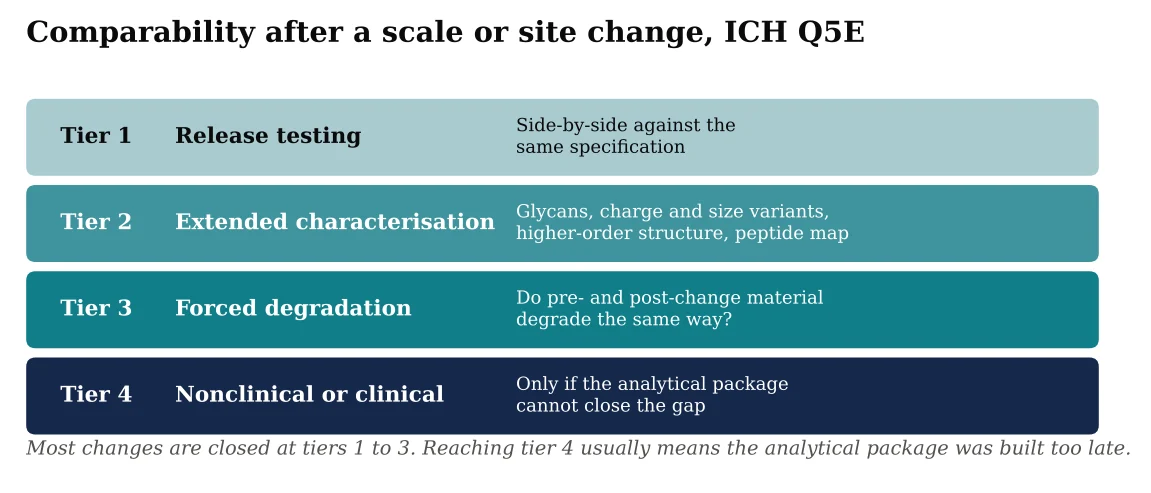
Every scale change, site change, resin change and formulation change raises the same question: is the product after the change the same product as before it? ICH Q5E sets the framework, and the answer is built analytically before it is built clinically.
| Study | Purpose | Typical design |
| Long term | Sets the shelf life | 5 degrees plus or minus 3 for a refrigerated drug product; frozen for most drug substance. Tested at 0, 3, 6, 9, 12, 18, 24 and 36 months, on at least three batches |
| Accelerated | Supports excursions and gives early degradation signal | 25 degrees at 60 percent relative humidity, typically to 6 months |
| Stress and forced degradation | Demonstrates the methods are stability-indicating and maps degradation pathways | Thermal, oxidative, photolytic, pH and agitation stress. Not for shelf-life setting |
| Freeze-thaw | Supports drug substance handling and shipping | Multiple cycles at the intended rate; aggregation and particulates are the readouts |
| Photostability | ICH Q1B | One batch, confirmatory study |
| In-use | Supports the label | Dilution in the intended infusion bag or administration set, held for the stated period |
| Shipping and transport | Qualifies the cold chain | Simulated and actual shipping lanes, with temperature excursion modelling |
Which guideline governs what
| Guideline | Scope | Where it bites |
| ICH Q5A(R2), Step 4, 1 November 2023 | Viral safety | Cell bank and unprocessed bulk testing; viral clearance validation. Updated for platform knowledge and continuous manufacturing [17, 4] |
| ICH Q5B | Genetic stability of the expression construct | Analysis of the coding sequence in the production cell at the cell age limit |
| ICH Q5C | Stability of biotechnological products | Drug substance and drug product stability protocols, shelf life and storage [22] |
| ICH Q5D | Cell substrates | Cell line history, the two-tier bank system, identity, purity and stability testing, and the in vitro cell age limit [12] |
| ICH Q5E | Comparability after manufacturing changes | Any scale, site or process change, during development or after approval |
| ICH Q6B | Specifications for biotechnological products | Release and shelf-life acceptance criteria. Adopted 1999 and under revision [18, 19] |
| ICH Q2(R2), Step 4, 1 November 2023 | Analytical procedure validation | Release and stability methods, validated before process performance qualification [4] |
| ICH Q12 | Lifecycle management | Post-approval change categorization and established conditions [4] |
How EllyCell helps
EllyCell’s consulting arm covers drug substance and drug product manufacturing, process development, assay development and qualification, CMC, cGMP and GLP audit, CAPA, and process characterization and performance qualification. For an antibody program that means we work alongside the sponsor and the contract organizations, on the sponsor’s side of the table.
| Service | What you get |
| CDMO selection and oversight | Scored evaluation against your molecule and timeline, technical scope and statement-of-work review, and ongoing oversight of the work you are paying for |
| Cell line and clone selection | Screening strategy, criteria weighting beyond titer, review of Ambr 15 and bench data, and clonality documentation requirements written into the contract |
| Cell banking strategy | Bank sizing, testing panel design, test-lab selection, and scheduling so that long-lead assays do not gate the first campaign |
| Process development and scale-up | Mode selection, scale-down model qualification, scale-up parameter strategy, and tech-transfer protocols and review |
| Analytical and specifications | Method development and qualification plans, validation to ICH Q2(R2), reference standard strategy, and specification setting with the justification a reviewer will read |
| Stability program design | Protocols for drug substance and drug product, forced degradation design, and shelf-life justification |
| Comparability | Protocols before the change rather than after it, with the analytical package sized to the risk |
| CMC regulatory | Module 3 authoring and review, pre-IND and pre-BLA briefing packages, PPQ strategy, and inspection readiness |
| Audit and CAPA | cGMP and GLP audits of your contract organizations, and CAPA design and closure support |
Start a conversation
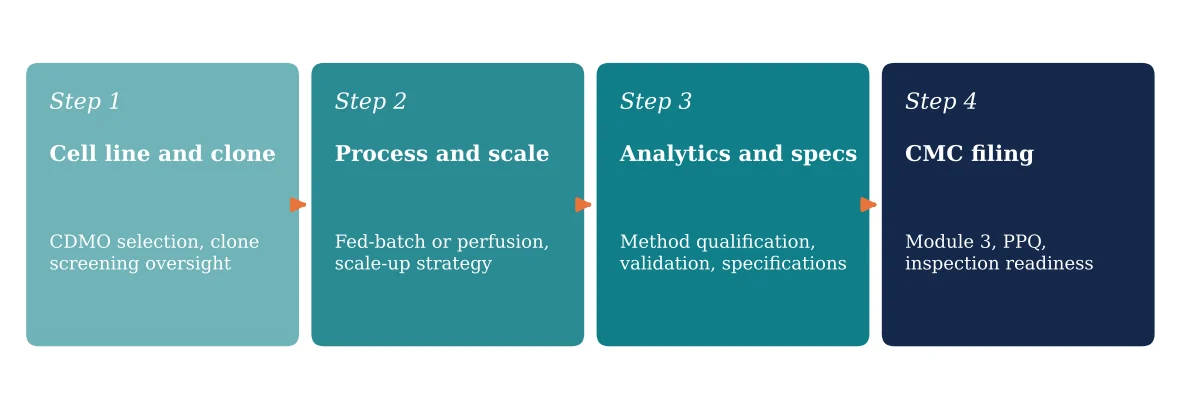
Tell us where you are on the path in Figure 1 and what the next decision is. We will tell you what it costs to get it right and what it costs to get it wrong.
EllyCell, LLC, McLean, Virginia, USA, https://ellycell.com, info@ellycell.com
References
[1] Velugula-Yellela SR, et al. High throughput automated microbial bioreactor system used for clone selection and rapid scale-down process optimization. Biotechnology Progress (PMC5836883).
[2] BioProcess Tools, “Cell line stability testing and clone selection: ICH Q5D best practices for CHO,” 2026.
[3] ICH Q5D, Derivation and Characterisation of Cell Substrates Used for Production of Biotechnological/Biological Products.
[4] EirGenix, “Biologics CMC regulatory compliance: the ICH guidelines and Module 3 map.”
[5] ICH Q5E, Comparability of Biotechnological/Biological Products Subject to Changes in Their Manufacturing Process.
[6] BioProcess International, “Building the next generation of cell-line-development platforms.”
[7] Genetic Engineering and Biotechnology News, “Evaluation of a small-scale perfusion mimic for intensified processes.”
[8] Sartorius, “Approaches for applying perfusion mimic in Ambr 15 for increased cell density” (poster).
[9] Sartorius, CHO cell line development services, Ambr 15 and Ambr 250 scale-down tools for perfusion and high-inoculation fed batch.
[10] Wolnick, et al. Machine learning-assisted clone selection for intensified cell culture processes. Biotechnology Progress, 2026.
[11] Sartorius, “How AI is transforming cell line development for protein production,” 2026.
[12] BioProcess Tools, “Master cell bank: storage, QC and WCB preparation,” 2026.
[13] Minaris, CHO cell line characterization: recommended testing panel for CHO cell banks (MCB, WCB, EOP/LIVCA).
[14] ICH Q5B, Analysis of the Expression Construct in Cells Used for Production of r-DNA Derived Protein Products.
[15] Cell bank system, establishment, and application in the virus research, diagnosis, and biopharmaceutical industries. PMC12409320, comparing FDA (21 CFR, ICH Q5D) and EMA (EMA/CHMP/BWP/532517/2008) genetic stability expectations.
[16] Development of an N-1 perfusion process and optimized scale-down models for implementation in a platform CHO cell culture manufacturing process. Engineering Conferences International.
[17] ICH Q5A(R2), Viral Safety Evaluation of Biotechnology Products Derived from Cell Lines of Human or Animal Origin, Step 4, 1 November 2023.
[18] ICH Q6B, Specifications: Test Procedures and Acceptance Criteria for Biotechnological/Biological Products, adopted September 1999.
[19] Regulatory Rapporteur, “ICH Q1 guideline revisions to promote innovation and enable global patient access to high-quality medicines,” 22(9); and RAPS, “EU official says ICH Q6B is outdated and needs revision.”
[20] EMA, Guideline on development, production, characterisation and specification for monoclonal antibodies and related products, revision 1.
[21] FDA, Potency Assay Considerations for Monoclonal Antibodies and Other Therapeutic Proteins Targeting Viral Pathogens, guidance for industry.
[22] ICH Q5C, Quality of Biotechnological Products: Stability Testing of Biotechnological/Biological Products.
[23] ICH Q5C training material, stability-indicating profile and protocol design.
[24] ICH, Q1 Expert Working Group work plan, 11 February 2026; topic adoption January 2026, Step 1 sign-off April 2025.
[25] Kivo, overview of ICH guidelines: consolidated Q1 revision in draft at Step 2b, April 2025.