01 · Consulting
Pre-IND Gap Analysis
for Oncology Antibodies
Finding and closing the gaps before FDA does: a practical guide for monoclonal, bispecific and multispecific antibodies, with cost-effective solutions.
EllyCell, LLC
Biopharmaceutical Consulting, R&D, Licensing and Business Development
McLean, Virginia, USA
Email: info@ellycell.com
Website: https://ellycell.com/
Executive summary
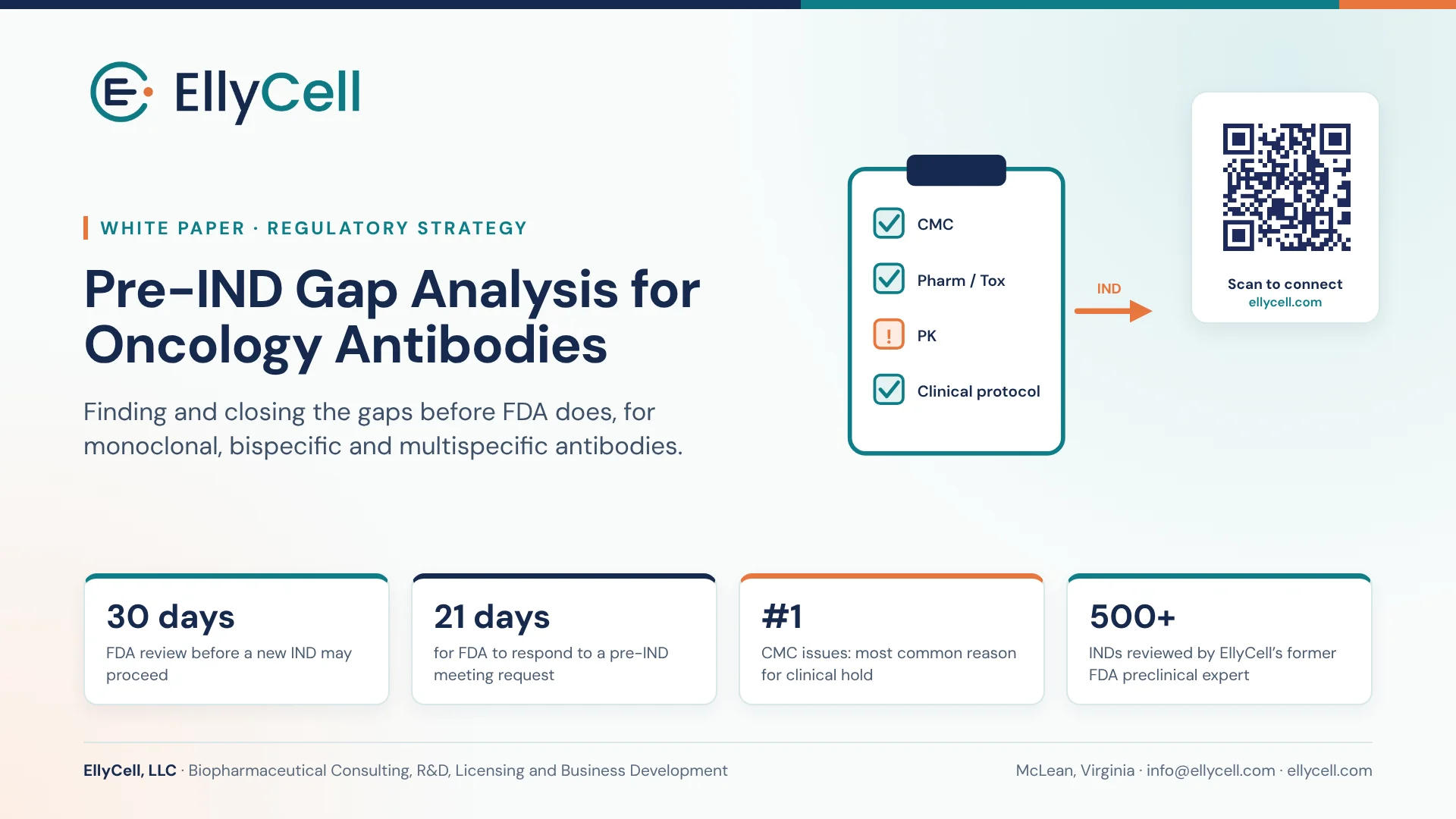
An Investigational New Drug (IND) application is the gate between the lab and the first patient. After submission, FDA has 30 days to decide whether the proposed study is safe to proceed; if it is not, the IND is placed on clinical hold. A hold can cost months of runway at the moment a young company can least afford it. Most holds are preventable, because they come from gaps that a careful review would have found earlier.
A pre-IND gap analysis is that careful review. It compares everything a sponsor has (manufacturing data, pharmacology and toxicology, pharmacokinetics and the draft clinical protocol) against what FDA will expect for the specific product and patient population. It then ranks each gap and proposes the fastest, least costly way to close it, ideally confirmed with FDA at a pre-IND meeting before money is spent.
30 days
FDA review before a new IND may proceed
21 days
for FDA to respond to a pre-IND meeting request
#1
CMC issues: most common reason for clinical hold in a CDER study
500+
INDs reviewed by EllyCell’s former FDA preclinical expert
Key messages
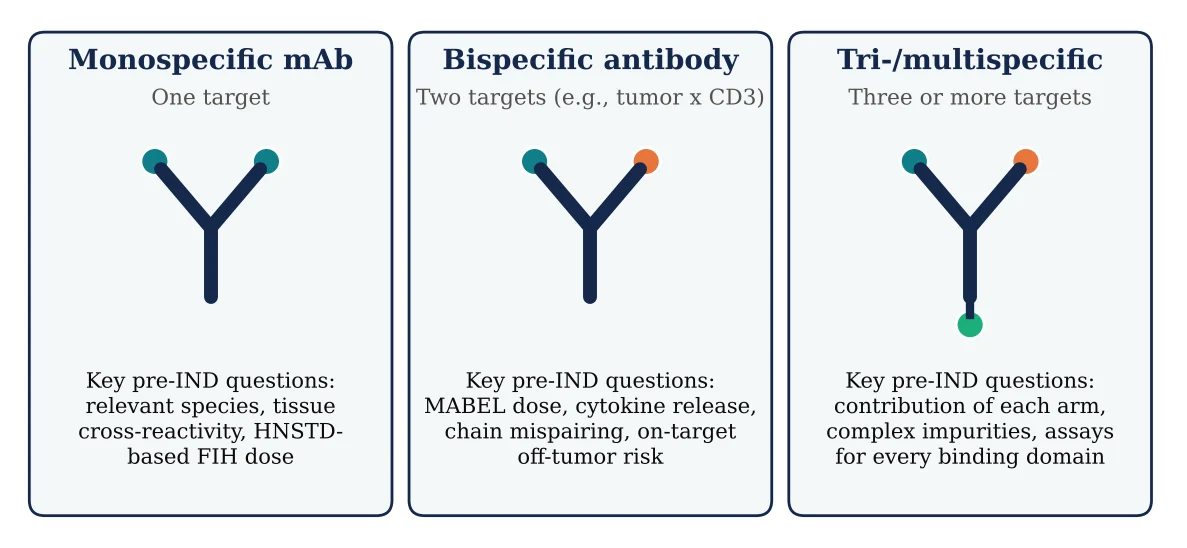
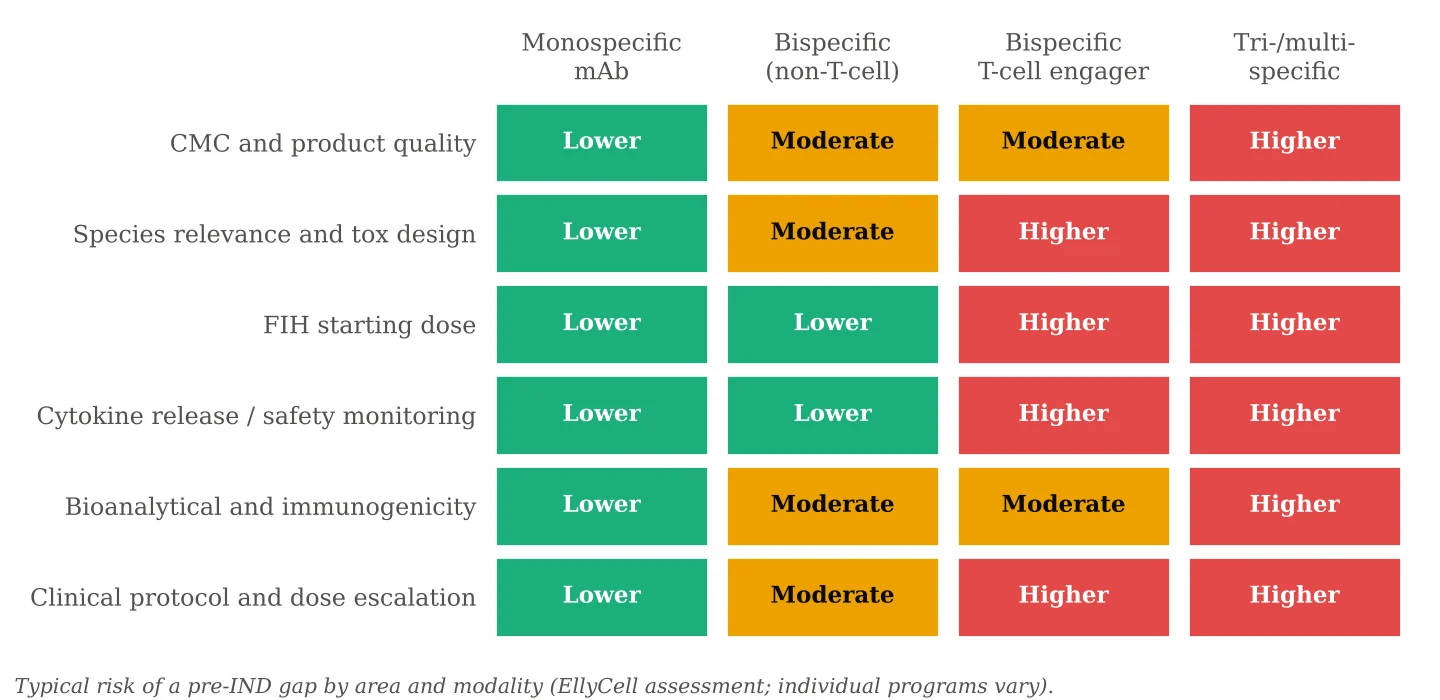
Antibody format changes the gap profile. Monospecific antibodies usually have well-trodden paths. Bispecific T-cell engagers and multispecific antibodies raise harder questions on starting dose, cytokine release, species relevance and product quality.
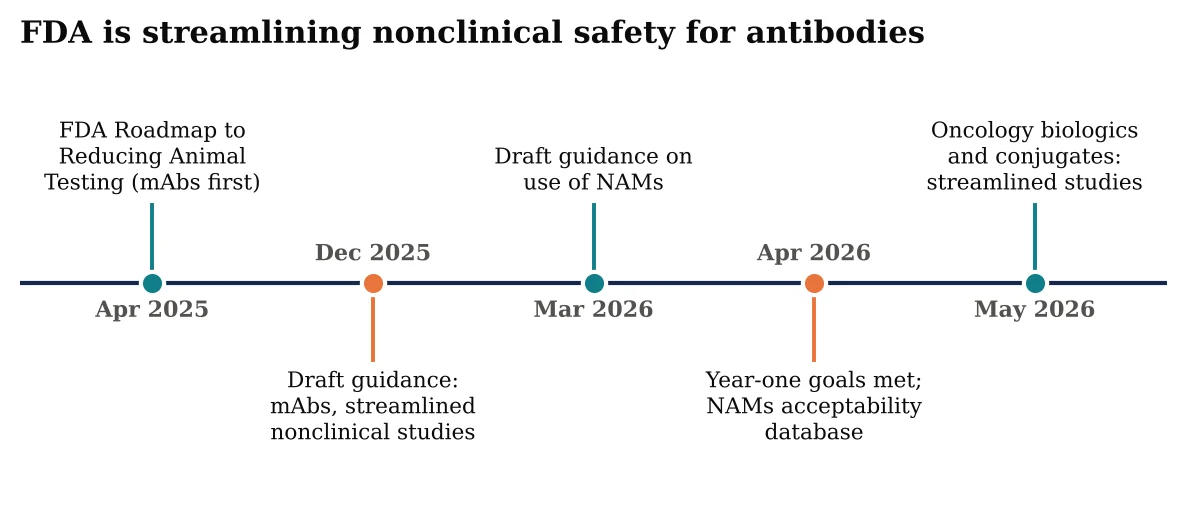
The rules are moving in sponsors’ favor. Since April 2025, FDA has issued a roadmap and several guidance that allow streamlined, lower-animal-use safety packages for antibodies, including oncology biologics (May 2026).
Close gaps by evidence, not by default studies. Weight-of-evidence arguments, human in vitro assays and phase-appropriate manufacturing can replace costly studies when justified and agreed with FDA.
Experience shortens the path. EllyCell pairs oncology development and manufacturing experience with a former FDA preclinical reviewer who spent more than 22 years at the agency and reviewed over 500 INDs.
What a Pre-IND gap analysis is, and what it matters now
FDA reviews three main areas in a new IND: chemistry, manufacturing and controls (CMC), nonclinical pharmacology and toxicology, and the clinical protocol. In a retrospective study of initial INDs submitted to FDA’s Center for Drug Evaluation and Research, CMC reasons were the most commonly cited cause of clinical hold, followed by clinical and then toxicology reasons. More than half of the INDs placed on hold became active within a year, which shows that the issues were fixable, but only after costly delay.
The pre-IND meeting is where gaps get resolved
A pre-IND meeting is a Type B meeting, and FDA must respond to the request within 21 days. FDA’s final guidance on formal meetings (August 2026) confirms that the agency may answer pre-IND questions with written responses only, regardless of the format requested, so questions must be precise and the briefing package must stand on its own. INTERACT meetings, designed for novel products that present unique early challenges, are available only before a pre-IND meeting or IND, so the timing of engagement should be planned deliberately.
FDA is streamlining nonclinical safety for antibodies
In April 2025, FDA published its Roadmap to Reducing Animal Testing in Preclinical Safety Studies, starting with monoclonal antibodies. It followed with draft guidance on streamlined nonclinical studies for monoclonal antibodies (December 2025) and, in May 2026, guidance for oncology biologics and conjugated products. The oncology guidance allows alternatives to three-month general toxicology studies when they adequately address safety, such as non-sacrificial study designs, designs that use fewer animals, or a weight-of-evidence risk assessment for well-understood targets, supplemented with new approach methodologies (NAMs). A gap analysis today should identify where these options apply.
The EllyCell gap analysis method
EllyCell’s gap analysis follows five steps and produces a scored gap register, a close-out plan with budget, and a draft list of pre-IND questions.

| Area | Questions we ask | Typical evidence reviewed |
| CMC and product quality | Is the cell line clonal and characterized? Is the process controlled? Are potency, purity and stability assays phase-appropriate? Is the tox lot representative of the clinical lot? | Cell bank reports, process flow, batch records, analytical methods, stability data, viral safety |
| Pharmacology | Is the mechanism shown in relevant human cells and models? Which species are pharmacologically relevant? | Binding and functional assays, cross-reactivity data, in vivo efficacy |
| Toxicology | Does the safety package fit ICH S6(R1) and ICH S9 for advanced cancer? Can streamlined options apply? | Tox protocols and reports, tissue cross-reactivity, safety pharmacology, NAM data |
| Clinical pharmacology | Is the first-in-human (FIH) starting dose justified? Are PK and immunogenicity assays ready? | PK/PD modeling, MABEL or HNSTD calculations, bioanalytical validation |
| Clinical protocol | Do dose escalation, monitoring and stopping rules match the risks? | Draft protocol, investigator brochure, risk mitigation plan |
Where the gaps are risk by antibody format
The more an antibody can do, the more it can do unexpectedly. Monospecific antibodies have clear precedents; bispecific T-cell engagers add potent immune activation; multispecific antibodies add complexity in every area at once.
Oncology examples
Monospecific monoclonal antibody
For a monospecific antibody in advanced cancer, ICH S9 generally allows a lean package, and the 2025 to 2026 FDA guidance make it leaner still. The most common gaps are not the toxicology studies themselves but the links between data sets: whether the toxicology species is truly pharmacologically relevant, whether the toxicology lot matches the clinical material, and whether the starting dose rationale is clearly documented.
| Typical gap | Cost-effective solution |
| No data showing the toxicology species is pharmacologically relevant | Short binding and functional cross-reactivity study before committing to GLP toxicology |
| Tissue cross-reactivity study planned late or missing | Schedule early on the representative lot; use results to support the risk assessment |
| Toxicology lot made by an earlier process | Analytical comparability package rather than repeating the study |
| Potency assay not yet qualified | Phase-appropriate qualification for Phase 1, with a plan to validate later |
Bispecific T-cel engager
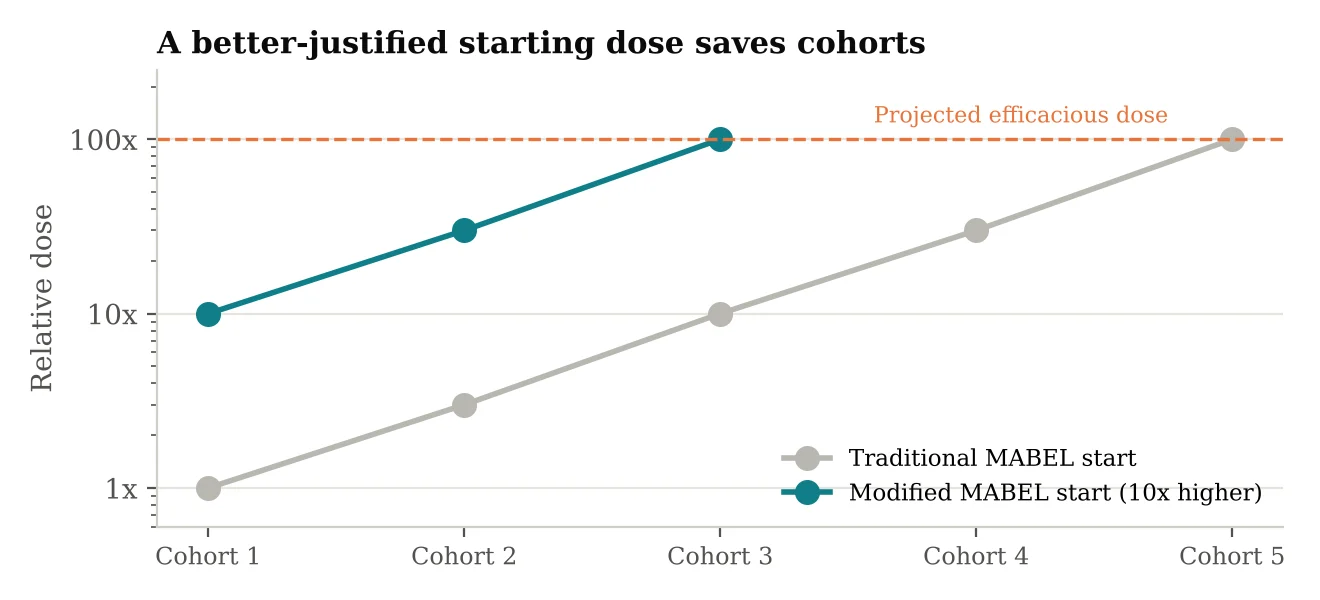
T-cell engagers redirect a patient’s T cells to tumor cells, usually by binding a tumor antigen and CD3. FDA has continued to clear such INDs in solid tumors; for example, NextPoint’s B7-H7 x CD3 engager NPX372 (February 2026) and Harbour BioMed’s B7H4 x CD3 bispecific HBM7004 (May 2026). The critical gaps are the starting dose and cytokine release. Starting doses are usually based on the minimal anticipated biological effect level (MABEL), but a traditional MABEL can lead to long dose escalations at sub-therapeutic doses. A published modified MABEL approach for a half-life-extended engager in gastric cancer allowed a 10-fold higher starting dose, was safe and well tolerated, saved at least two dose-escalation cohorts and was accepted by global regulators.
Example gap scorecard (illustrative T-cell engager). Each gap is scored by its risk to an on-time, hold-free IND.
| Area | Finding | Risk | Recommended close-out |
| FIH dose | MABEL based on high effector-to-target ratio only | High | Add tumor-relevant ratios and cytokine data; integrated PK/PD model |
| Cytokine release | Human whole-blood cytokine assay not done | High | Run human in vitro cytokine release assay; define step-up dosing |
| Species relevance | No cross-reactivity with non-human primate CD3 | Medium | Weight-of-evidence package, possibly a surrogate molecule |
| Product quality | Mispaired and homodimer species not quantified | Medium | Add an orthogonal purity method and set interim limits |
| Bioanalytical | Single PK assay for an intact molecule | Low | Confirm assay detects the active form; plan anti-drug antibody assay |
Trispecific and multispecific antibodies
Multispecific antibodies bind three or more targets in one molecule. FDA has cleared several in 2025 and 2026, including EvolveImmune’s trispecific T-cell engager EVOLVE104 (August 2025), CStone’s PD-1 x VEGF x CTLA-4 trispecific CS2009 for a global Phase 2 trial (February 2026), and HanchorBio’s trispecific HCB303 following pre-IND feedback from FDA in August 2026. For these molecules, a gap analysis must show what each binding arm contributes, which in turn supports the dose, the safety monitoring and the case for one molecule rather than a combination of separate drugs.
| Typical gap | Cost-effective solution |
| Contribution of each arm not shown | Single-arm-knockout or ‘silenced’ variants in in vitro assays; summarize in a clear mechanism table |
| No species cross-reacts with all three targets | Weight-of-evidence assessment, human in vitro systems and NAMs; targeted in vivo study only where needed |
| Complex product-related variants | Characterize early; set phase-appropriate interim specifications |
| Assays cover only one binding domain | Develop functional potency and PK assays that reflect all domains |
Closing gaps affordably
Closing a gap does not always mean adding a study. Nonclinical programs for antibodies can be expensive: one estimate puts a typical monoclonal antibody program at 144 non-human primates at up to $50,000 per animal. EllyCell looks first for the least costly way to answer each FDA question and then confirms it with the agency.
| Lever | How it saves time and money |
| Weight-of-evidence risk assessment | Uses published target biology, class data and existing results to replace or shorten studies where FDA guidance allows |
| Single relevant species | If activity is similar in rodents and non-rodents, oncology general toxicology may use one rodent species under the May 2026 guidance |
| Human in vitro assays and NAMs | Cytokine release, organoid and microphysiological systems give human-relevant data and support starting dose |
| Phase-appropriate CMC | Qualify rather than fully validate assays for Phase 1; use comparability instead of repeating studies |
| Integrated study designs | Combine dose-range finding, toxicokinetics and safety pharmacology endpoints where scientifically appropriate |
| Precise pre-IND questions | Well-framed questions get usable written answers and avoid a second meeting |
A realistic timeline
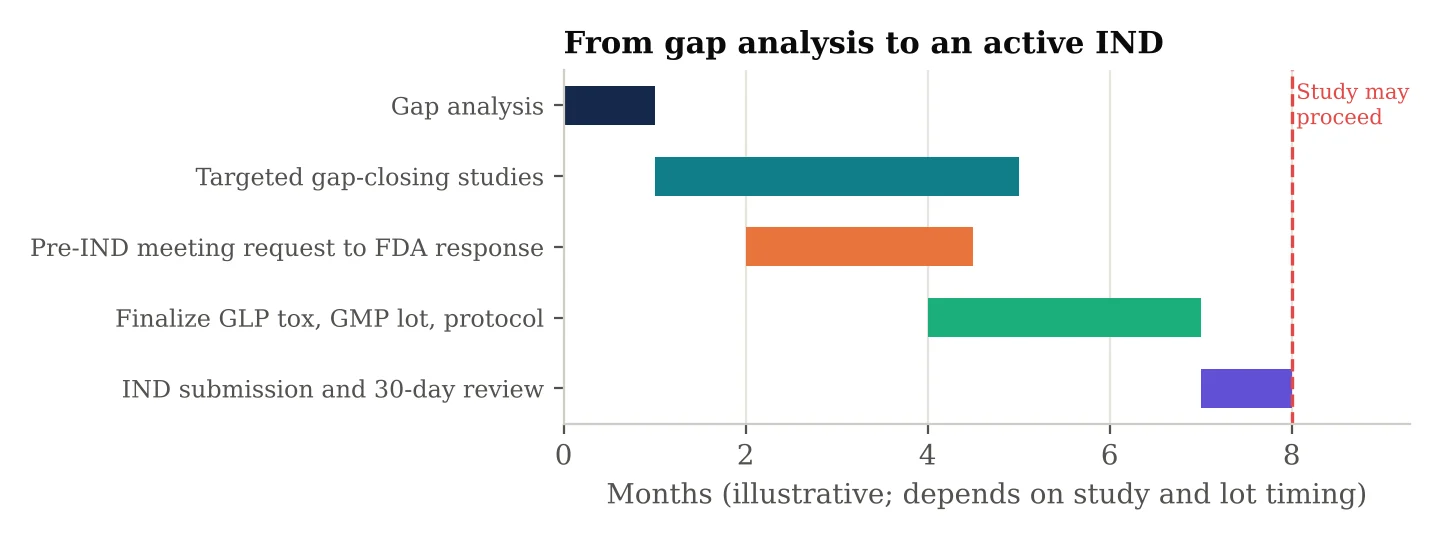
Starting the gap analysis early lets gap-closing work run in parallel with the pre-IND meeting, instead of in sequence after it.
The EllyCell Team
EllyCell (formerly Vertex BioPharm Consulting) brings together hands-on oncology development, manufacturing and regulatory experience, with team members in the United States, Belgium, France and China.
David Hawver, former FDA preclinical reviewer
David Hawver worked at the U.S. Food and Drug Administration for more than 22 years as an expert in preclinical (pharmacology and toxicology) review and handled more than 500 IND cases. He brings a reviewer’s perspective to every gap analysis: what FDA will ask, which gaps can lead to a clinical hold, and which solutions are most likely to be accepted. At EllyCell, he helps clients define the gaps, design effective and affordable close-out strategies, and prepare for productive interactions with regulatory agencies.

| Experience | What EllyCell contributed |
| Oncolytic virus, neuroendocrine tumors | Supported IND-enabling work and a Phase 1 trial with checkpoint inhibitors; helped raise $6M in 2025 |
| Trispecific T-cell engager platform | IND-enabling planning (efficacy, GLP toxicology, cGMP drug substance and product, CMC) and partnering support |
| Phase 2-complete solid-tumor asset | NewCo formation and licensing ahead of a global Phase 3 trial |
| Viral vaccines and gene therapy | Preclinical through Phase 1/2 development; process development and manufacturing |
How EllyCell can support you
| Service | What you receive |
| Pre-IND gap analysis | Scored gap register across CMC, nonclinical, clinical pharmacology and protocol, with a close-out plan and budget |
| Nonclinical strategy | Study designs aligned with ICH S6, ICH S9 and current FDA streamlining guidance; weight-of-evidence documents |
| FIH dose justification | MABEL or HNSTD rationale, PK/PD modeling support and dose escalation design |
| CMC readiness | Phase-appropriate assay, process and stability strategy; comparability plans |
| Pre-IND meeting support | Question drafting, briefing package, rehearsal and follow-up |
| IND assembly and response | Module review, clinical hold avoidance and, if needed, hold response strategy |
Start with a pre-IND readiness review
Share your current data package and development plan under a confidentiality agreement.
Our team, including our former FDA preclinical expert, reviews it against current FDA expectations.
You receive a prioritized list of gaps, recommended solutions and estimated costs.
References
Lapteva and Pariser: rates and reasons for clinical hold of initial INDs (J Investig Med, 2016)
RAPS: FDA finalizes guidance on formal meetings with sponsors (Aug 14, 2026)
JAMA: A Transformational Roadmap (FDA animal testing roadmap)
Spencer Fane: FDA reports meeting year-one goals for reducing animal drug testing (Jun 8, 2026)
NAVS: FDA progress report, April 2025 to June 2026
Zhou et al.: modified MABEL starting dose for a solid tumor T-cell engager (Clin Pharmacol Ther)
Targeted Oncology: NPX372 gains IND clearance (Feb 10, 2026)
BioPharm International: Harbour BioMed HBM7004 IND clearance (May 8, 2026)
BioSpace: EvolveImmune EVOLVE104 IND clearance (Aug 14, 2025)