03 · Licensing
A Comprehensive LNP Technology Platform
EllyCell and HanzBio: lipid nanoparticle delivery for RNA, gene editing and in vivo cell therapy
How a validated ionizable lipid library, organ-targeted lipids and formulations, integrated CMC and regulatory support shorten the path from payload to IND.
EllyCell, LLC
Biopharmaceutical Consulting, R&D, Licensing and Business Development
McLean, Virginia, USA
Email: info@ellycell.com
Website: https://ellycell.com/
Executive summary
Lipid nanoparticles (LNPs) are the only non-viral delivery system with multiple approved products, and they now carry the majority of RNA therapeutics in development. The science has moved quickly, but four problems still hold programs back: (1) almost all clinically validated lipids deliver to the liver, (2) low delivery efficiency has restricted the expansion of the new therapy, (3) the foundational patents are tightly held and actively enforced, and (4) building a new LNP in-house takes roughly two years and several million dollars before a single patient is dosed.
EllyCell and HanzBio together address all four. HanzBio contributes a huge screened ionizable lipid library with organs-targeted (liver, spleen, lung, pancreas, lymph nodes, etc.), conjugation chemistry (antibody-conjugation, peptide-conjugation, etc.) for cell-specific delivery, and formulation and in vivo screening capacity. EllyCell contributes the CMC, manufacturing, regulatory and licensing work that turns a promising formulation into an IND-ready program and a financeable asset.
75%
of RNA delivery pipelines use LNP
100,000+
lipids designed in HanzBio’s screening funnel
~18 months
saved vs. building an LNP in-house
$2.25B
largest LNP patent settlement to date
Key messages
What this partnership offers
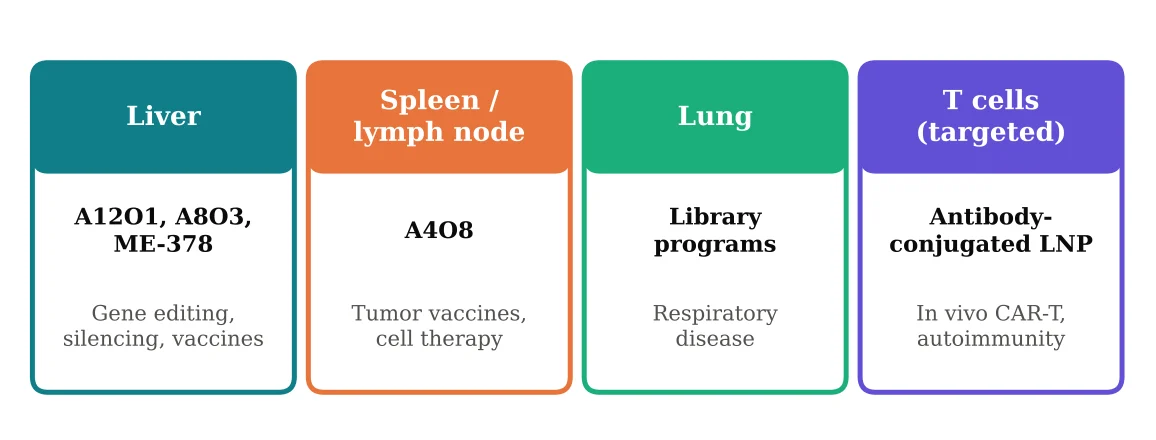
A validated lipid library, not a single lipid. Liver-targeted lipids (A12O1, A8O3, ME-378) and a spleen-targeted lipid (A4O8,A5O9), with lung (A73-2CO8, A73-2CON8) and T-cell programs in the library.
Targeting beyond the liver. Antibody-conjugated LNPs direct particles to chosen cell types, which is what in vivo cell therapy and extrahepatic programs require.
An alternative IP position. An independently developed lipid portfolio gives sponsors a route that does not depend on the most heavily litigated patent families.
One accountable team. Lipid selection, formulation, analytics, cGMP scale-up planning, IND-enabling strategy and licensing terms handled together rather than across four vendors.
Why LNP is the delivery platform of choice
An LNP is a small particle, typically 70 to 120 nanometers across, built from four lipid components that protect an RNA payload and release it inside a target cell. The ionizable lipid does most of the work: it binds the RNA during manufacture, stays neutral in the bloodstream, and becomes positively charged inside the cell’s acidic compartments, which lets the payload escape into the cytoplasm.

Among non-viral delivery systems, LNP is the only one with approved products. Liposomes, polymer nanoparticles, inorganic nanoparticles, exosomes and virus-like particles remain investigational for RNA delivery. LNP now carries about three quarters of RNA delivery programs.
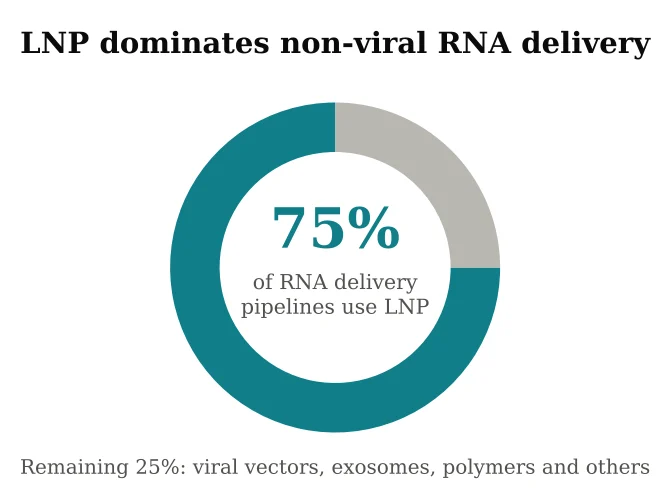
Clinical validation continues to broaden. In vivo CRISPR programs use LNP to deliver guide RNA and Cas9 mRNA to the liver, and the first regulatory filings for LNP-delivered in vivo gene editing are now with FDA. At the same time, capital has moved decisively toward in vivo cell therapy, where LNP is a leading delivery route: several billion dollars of acquisitions and partnerships were announced across 2025 and 2026, including Eli Lilly’s acquisition of Orna Therapeutics, built on a circular RNA and LNP platform, in a deal worth up to $2.4 billion; AbbVie’s acquisition of Capstan Therapeutics, built mRNA and tLNP platform, in a deal worth up to $2.1 billion.
What still limits LNP today
|
Limitation |
Why it matters |
How this platform responds |
|
Liver-dominant delivery |
The approved ionizable lipids (SM-102, ALC-0315, MC3) deliver predominantly to the liver, which closes off most extrahepatic indications |
A spleen-targeted lipid (A4O8), lung–targeted lipid (A73-2CO8), and antibody conjugation for cell-specific delivery |
|
High patent barriers |
Foundational LNP patents are tightly held and actively enforced; the Moderna settlement with Genevant and Arbutus reached up to $2.25 billion, and litigation against other developers continues |
An independently developed lipid portfolio and licensing terms negotiated directly with the owner |
|
Cost and time to build in-house |
New LNP development has been estimated at over $3 million and about two years before a program is delivery-ready |
High-throughput screening platform with One-pot synthesis and AI-driven, access to screened lipids and formulations that are already characterized in vitro and in vivo |
|
CMC complexity |
Particle size, polydispersity, encapsulation efficiency and stability all carry direct quality and potency implications, and regulators scrutinize them closely |
EllyCell’s CMC, analytical and cGMP audit experience applied from the first formulation run |
|
Cold chain and stability |
Many LNP products require demanding storage conditions, which constrains commercial reach |
Stability data generated during screening; formulation work aimed at practical storage profiles |
The HanzBio LNP platform
Hanz Biotechnology (Suzhou) was founded in March 2024 with LNP as its core technology. It was recognized as a leading technology enterprise in Suzhou Industrial Park in August 2024, as a technology-based small and medium enterprise in August 2025, and as a leading company in Suzhou in March 2026. Hanz’s co-founder, Prof. Xuexiang Han, holds a PhD from Tsinghua University and completed postdoctoral work at the University of Pennsylvania (cooperation Mentor: Prof. Michael Mitchell, and Prof. Drew Weissman), with first-author publications (30+) in Nature Chemistry, Nature Nanotechnology, Nature Materials and Nature Communications. The company operates about 1,850 square meters (close to 20,000 square feet) of laboratory space.
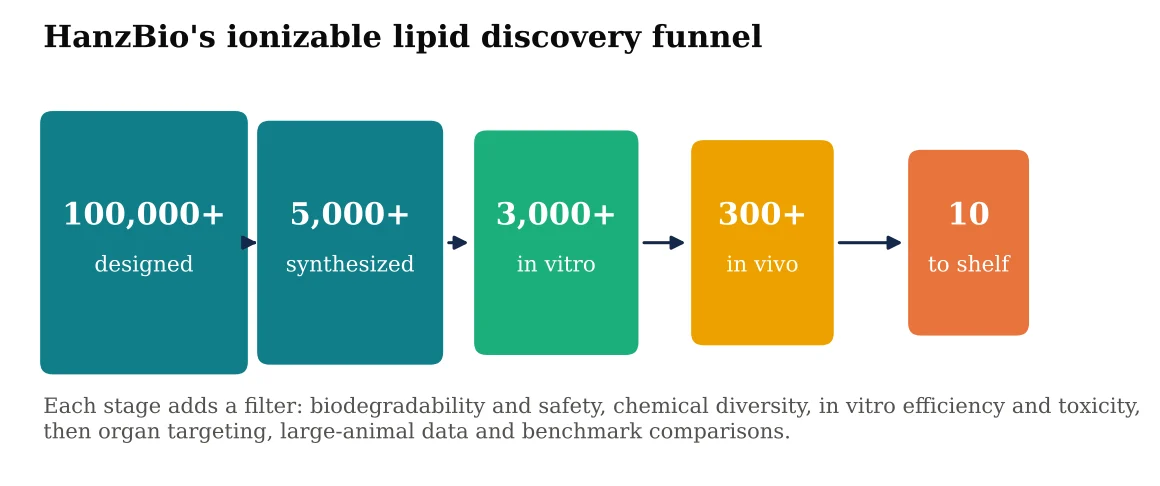
Lipid discovery at scale
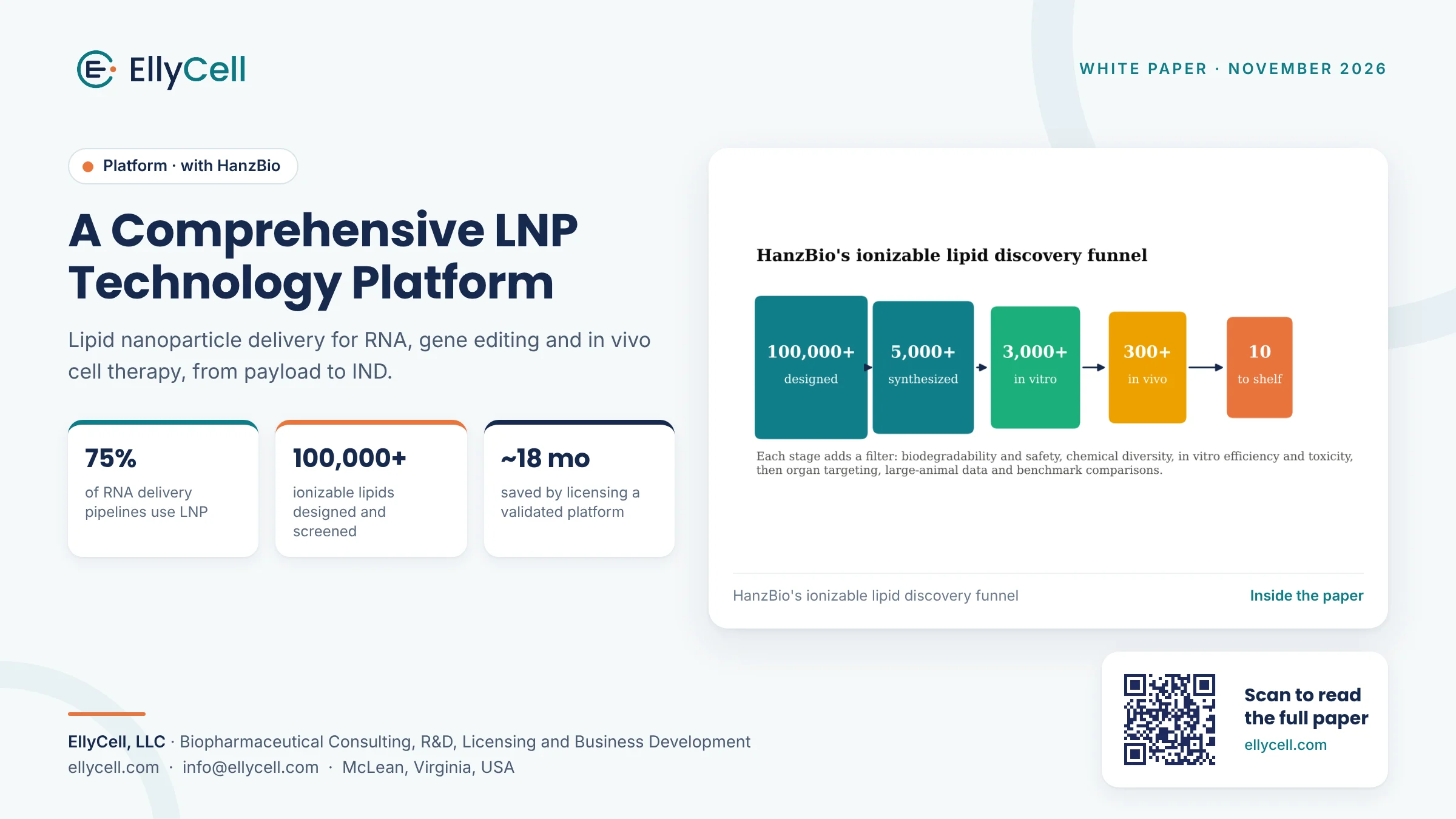
The platform is built on a screening funnel that narrows a very large design space down to a small number of development-ready lipids.
Organ and cell targeting
Different lipid chemistries direct particles to different tissues. The library is organized around that principle, with antibody conjugation layered on top when a specific cell type is the target.
Reported performance
The figures below are HanzBio’s own preclinical results, generated in-house and with partners. They have not been independently verified by EllyCell and should be confirmed under a confidentiality agreement before any program decision.

|
Application |
Reported result |
Comparator |
|
mRNA delivery, intravenous |
A12O1 approximately 1.5 to 2.5 times more efficient |
SM-102 (Moderna) |
|
mRNA delivery, intramuscular |
A12O1 approximately 2 times more efficient |
SM-102 |
|
CRISPR gene editing |
Significantly better than Lipid 5; no significant difference versus ALC-0315 |
Lipid 5 (Moderna); ALC-0315 (Pfizer/BioNTech) |
|
siRNA silencing |
99.9% gene silencing, well tolerated at 10 mg/kg siRNA |
Internal benchmark (GalNac) |
|
pDNA transfection (Jurkat cells) |
0% to 90% mRNA expression in Jurkat cells with conjugated LNP; 0% to 41% CAR-positive cells with conjugated LNP |
Unconjugated LNP |
|
In vivo CAR expression (mice) |
CAR-positive cells in blood, bone marrow, spleen and liver at 24 hours; ME 378 > A53O10 > A12O1 = SM-102 |
SM-102 |
|
Spleen targeting |
A4O8 at or above benchmark targeted LNP in spleen T cells |
L829 benchmark (Capstan) |
|
Lung targeting |
A73-2CO8 go to lung 90%, and with same delivery efficiency of SM 102 |
SM 102 |
|
Stability |
A12O1 LNP stable for more than six months at minus 80 degrees Celsius |
Not applicable |
|
Tolerability (mice, rats) |
Liver and kidney markers and IL-6 and TNF-alpha within expected ranges at doses tested |
SM-102, Lipid 5 |
Applications across modalities
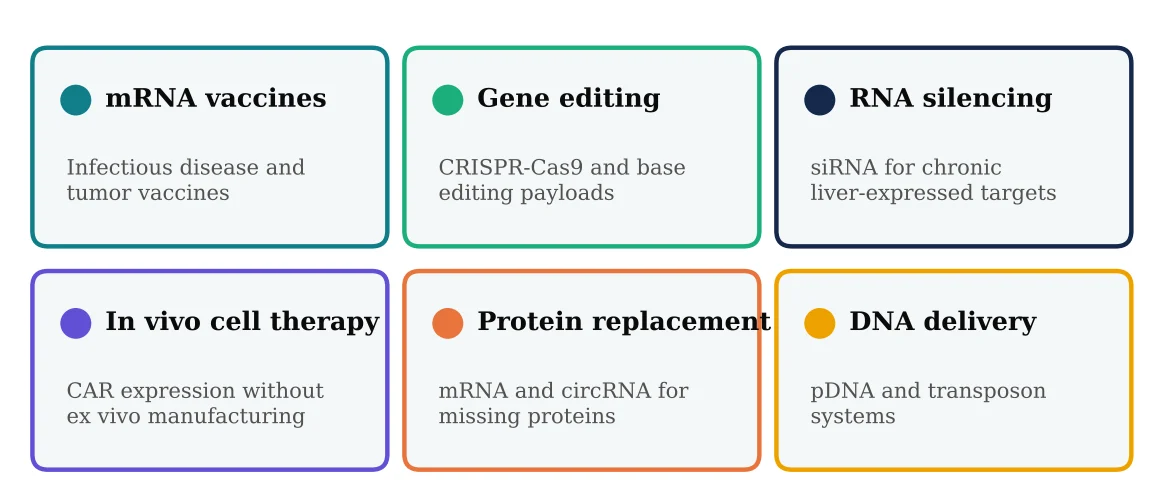
Because the delivery problem is shared across RNA modalities, one platform supports a wide set of programs. The payload changes; the particle engineering discipline does not.
|
Program type |
Payload |
Targeting approach |
Typical development question |
|
Infectious disease vaccine |
mRNA, saRNA |
Intramuscular, lymph node drainage |
Can we match or beat SM-102 potency at a lower dose? |
|
Tumor vaccine |
mRNA |
Spleen-targeted (A4O8) tLNP(antibody conjugation) |
Does antigen presentation improve with spleen targeting? |
|
Gene editing |
Cas9 mRNA plus guide RNA |
Liver-targeted (A12O1, ME 378) |
What editing efficiency is achievable at an acceptable dose? |
|
RNA silencing |
siRNA |
Liver-targeted (A12O1, ME 378) |
How durable is knockdown, and how often must we dose? |
|
In vivo cell therapy |
mRNA, circRNA, pDNA |
Antibody-conjugated, T-cell directed |
What fraction of T cells express the construct, and for how long? |
|
In vivo TCE therapy |
mRNA |
Liver-target |
How to achieve high delivery efficiency and low immune activation |
|
Protein replacement |
mRNA, circRNA |
Liver or tissue-specific |
Can expression be sustained with repeat dosing? |
From lipid to IND: the EllyCell contribution
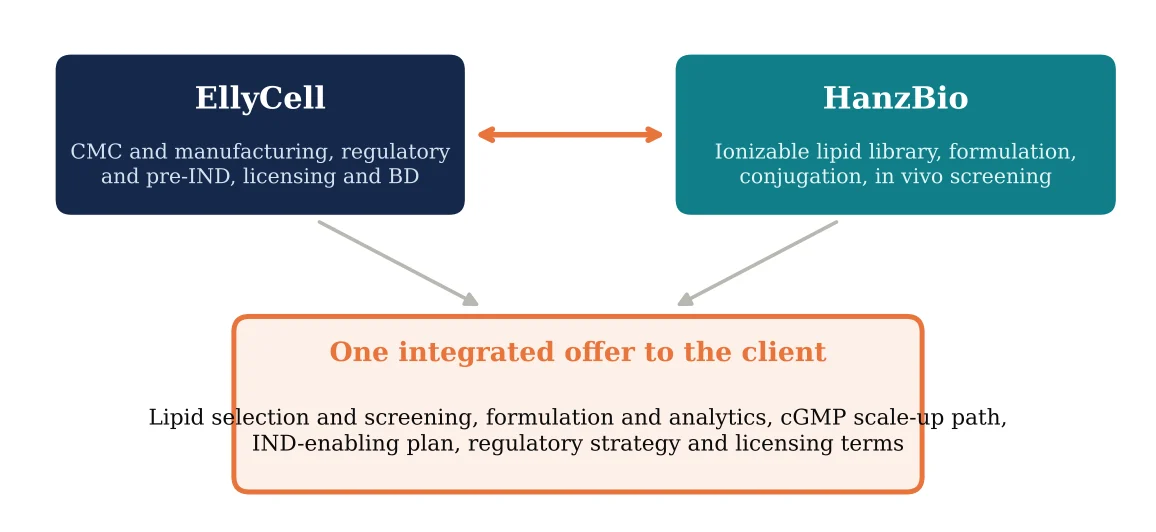
A good lipid is necessary but not sufficient. Between a promising formulation and a cleared IND sit manufacturing, analytics, nonclinical safety and regulatory strategy. This is where EllyCell works, and it is why the two companies are complementary rather than overlapping.
|
Stage |
HanzBio |
EllyCell |
|
Lipid and formulation selection |
Library screening, formulation optimization, conjugation chemistry |
Target product profile, benchmark selection, go/no-go criteria |
|
Characterization |
Size, polydispersity, zeta potential, encapsulation efficiency, in vitro and in vivo screening |
Assay development and qualification strategy, phase-appropriate specifications |
|
Nonclinical |
Efficacy and tolerability studies in rodents |
GLP toxicology design, pre-IND gap analysis, weight-of-evidence strategy |
|
CMC and manufacturing |
Lipid supply at gram scale |
Drug substance and drug product strategy, process development, CDMO selection, cGMP and GLP audit, CAPA |
|
Regulatory |
Technical data packages |
Pre-IND meeting preparation, IND assembly, agency interactions |
|
Business development |
Licensing terms for lipids and platform |
Partner mapping, valuation, data-room readiness, deal structuring |
Why the combination matters for CMC
For an LNP product, batch-to-batch consistency, particle size distribution and encapsulation efficiency carry direct implications for sterility assurance and potency. Regulators treat these as quality attributes, not formulation details. Planning them from the first screening run, rather than retrofitting them before an IND, is usually the difference between a smooth filing and a costly one.
Access model and economics
Not every program needs the same depth of access. The platform is offered in tiers, so a sponsor can start with materials and services and move to a license only when the data justify it.
|
Model |
What it includes |
Best suited to |
|
Materials and kits |
Lipids, off-the-shelf LNPs (MC3, SM-102), mRNA, and transfection kits that need no microfluidics equipment |
Early discovery teams testing a payload |
|
Technical services |
Formulation, quality control (size, polydispersity, encapsulation efficiency, zeta potential), cell screening (HeLa, Jurkat, 293T, PBMC) and in vivo testing by several routes |
Teams without in-house LNP capability |
|
Custom LNP development |
Screening and optimization against a defined target organ or cell type, including conjugation |
Programs needing extrahepatic or cell-specific delivery |
|
Platform license |
Rights to use HanzBio lipids and formulations for therapeutic development, scaled to the stage of the program |
Programs heading to IND and beyond |
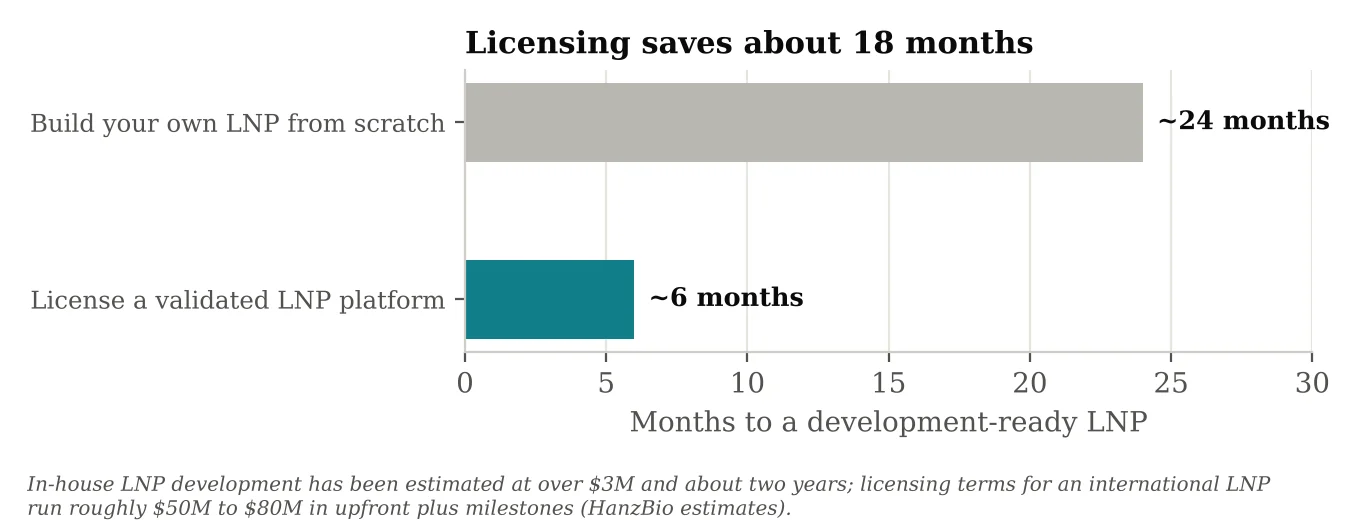
The economic argument is straightforward. Building a new LNP in-house has been estimated at more than $3 million and about two years. An international LNP license at a reasonable price has been estimated at roughly $50 million to $80 million in upfront and milestone payments. Starting from a validated library compresses the timeline and reduces the licensing cost, while the independent IP position lowers the risk of a dispute later.
Working with EllyCell and HanzBio
EllyCell supports biotechs and investors across oncology, CNS, rare disease and ophthalmology, with team members in the United States, Belgium, France and China. Its experience spans preclinical development through Phase 1/2 trials, gene therapy and oncology manufacturing, and licensing and NewCo formation. HanzBio brings the delivery science and the lipid portfolio.
|
If you need to… |
Start here |
|
Test whether LNP suits your payload |
Materials and kits, with a short in vitro and/or in vivo screening package |
|
Reach a tissue outside the liver |
Custom design and screening against the targeted library, including conjugation |
|
Replace a benchmark lipid for IP reasons |
Head-to-head comparison against your current lipid, then license discussion |
|
Move an LNP program toward IND |
Pre-IND gap analysis covering CMC, nonclinical and clinical protocol |
|
Partner or out-license an LNP asset |
Landscape, valuation and partner mapping, with a data room built to match |
Next step
Share a non-confidential summary of your payload, target tissue and development stage.
We will propose a screening or development plan, with timelines and costs, and identify the access model that fits.
Technical data from HanzBio can be reviewed in detail under a confidentiality agreement.
EllyCell, LLC, McLean, Virginia, USA https://ellycell.com, info@ellycell.com
Hanz Biotechnology (Suzhou) Co., Ltd., https://hanzbio.com
References
IPWatchdog: Moderna settles with Genevant and Arbutus, ending LNP patent dispute (Mar 4, 2026)
AllSci: Arbutus escalates LNP patent battle against Pfizer and BioNTech
Pharma Now: Roivant secures $2.25B LNP patent settlement with Moderna (May 20, 2026)
Pharmaceutical Technology: Eli Lilly acquires Orna Therapeutics for up to $2.4bn (Feb 9, 2026)
Labiotech via Pulse: CAR-T cell therapies going in vivo (Apr 29, 2026)
MarketsandMarkets: Lipid nanoparticles market, global forecast to 2031
The Business Research Company: Targeted LNPs for extrahepatic delivery, global market report 2026
PatSnap: Lipid nanoparticle drug delivery technology landscape 2026