03 · Licensing
Is Your Data Room Ready?
What pharma BD teams check before they take a meeting
A messy room reads as a messy company. A clean one tells a BD team that the science, IP and manufacturing will hold up and gets you to the second meeting faster.
EllyCell, LLC
Biopharmaceutical Consulting, R&D, Licensing and Business Development
McLean, Virginia, USA
Email: info@ellycell.com
Website: https://ellycell.com/
Executive summary
A business development team forms a view of your company in the first few minutes it spends in your data room, and that view is hard to reverse. The room is the only direct evidence a partner has of how you work: whether your claims are traceable, whether your intellectual property is clean, whether your manufacturing has been thought through, and whether your team answers questions straight.
None of that requires new science. It requires an index, a set of summaries linked to source reports, honest disclosure of what did not work, and staged access that protects your most sensitive material until a partner has earned it. Most companies can close the gap in about a month.
Up to 10
separate diligence reviews a seller may face for one deal
5,000-15,000
documents in a typical pharma licensing data room
4 tiers
of staged access protect your crown-jewel data
30 days
to take a first-draft room to deal-ready
Key messages
You are judged on traceability, not volume. Every claim in the deck needs a report behind it. A thousand unlabeled PDFs build less confidence than two hundred well-indexed ones.
Disclose the bad news yourself. Failed studies, clinical holds and tough FDA questions are found eventually. Found by the reviewer, they become a credibility problem as well as a technical one.
Stage your access. Raw datasets, batch records and contracts belong behind exclusivity, not in a pre-CDA deck.
Appoint one owner. One person should control the index, uploads, permissions and the question log, so answers stay fast and consistent.
The five-minute screen
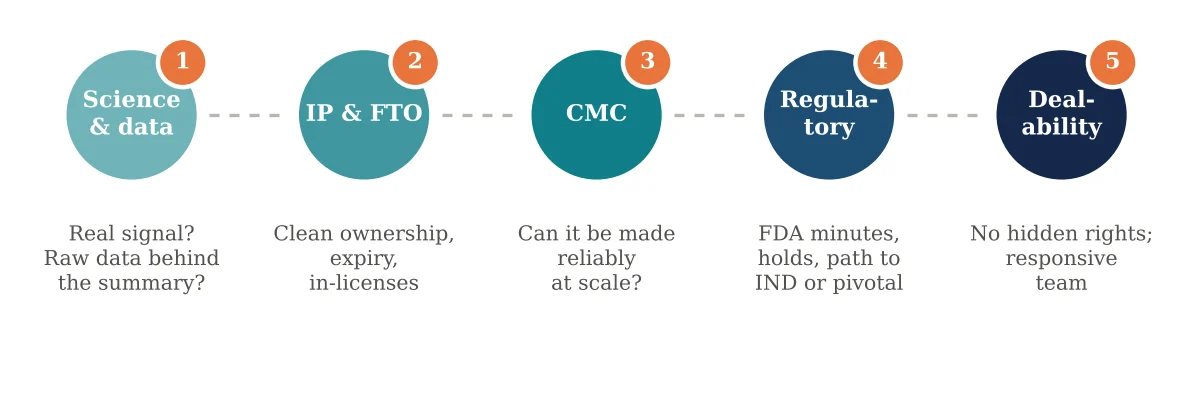
Before a first call, a BD analyst skims your deck and, after a confidentiality agreement, your data room. Five questions decide whether you get the meeting.
| Area | What they are really asking | What satisfies them |
| Science and data | Is there a real signal, and is there raw data behind the summary? | Figures linked to study reports, with n, model and statistics stated |
| IP and freedom to operate | Who owns this, for how long, and what is already licensed out? | A patent table with family, status, expiry, owner and encumbrances, plus an FTO memo |
| CMC | Can this be made reliably at scale, and at what cost? | Process and analytics summary, CDMO, batch history and a costed scale-up plan |
| Regulatory | What has the agency actually said? | All FDA correspondence and minutes posted, including the difficult exchanges |
| Dealability | Are there hidden rights, and is the team responsive? | A one-page rights map and a single, fast point of contact for questions |
Good room versus bad room
The difference is rarely the quality of the underlying science. It is whether a reviewer can find things, trust them, and move on.
| Builds confidence | Triggers more diligence, or a pass |
| A numbered index that mirrors the BD checklist | A folder dump of unlabeled PDFs, drafts and duplicates |
| File names with version and date (4.2_GLP-Tox_28d_Final_2026-03) | Files called scan001.pdf and Final_v7_REALLY_final |
| A one-page summary per section, linked to source reports | Claims in the deck with no report behind them |
| Failed and negative studies included, with context | Only the best experiments, with gaps left for the reviewer to find |
| A patent table: family, status, expiry, owner, encumbrances | IP still owned by a founder or university, with no executed license |
| FDA minutes posted, including the tough questions | A claim of positive FDA feedback, but no minutes |
| One question-and-answer owner; fast, consistent answers | Answers that contradict the deck, or take weeks |
Red flags, and how we defuse them
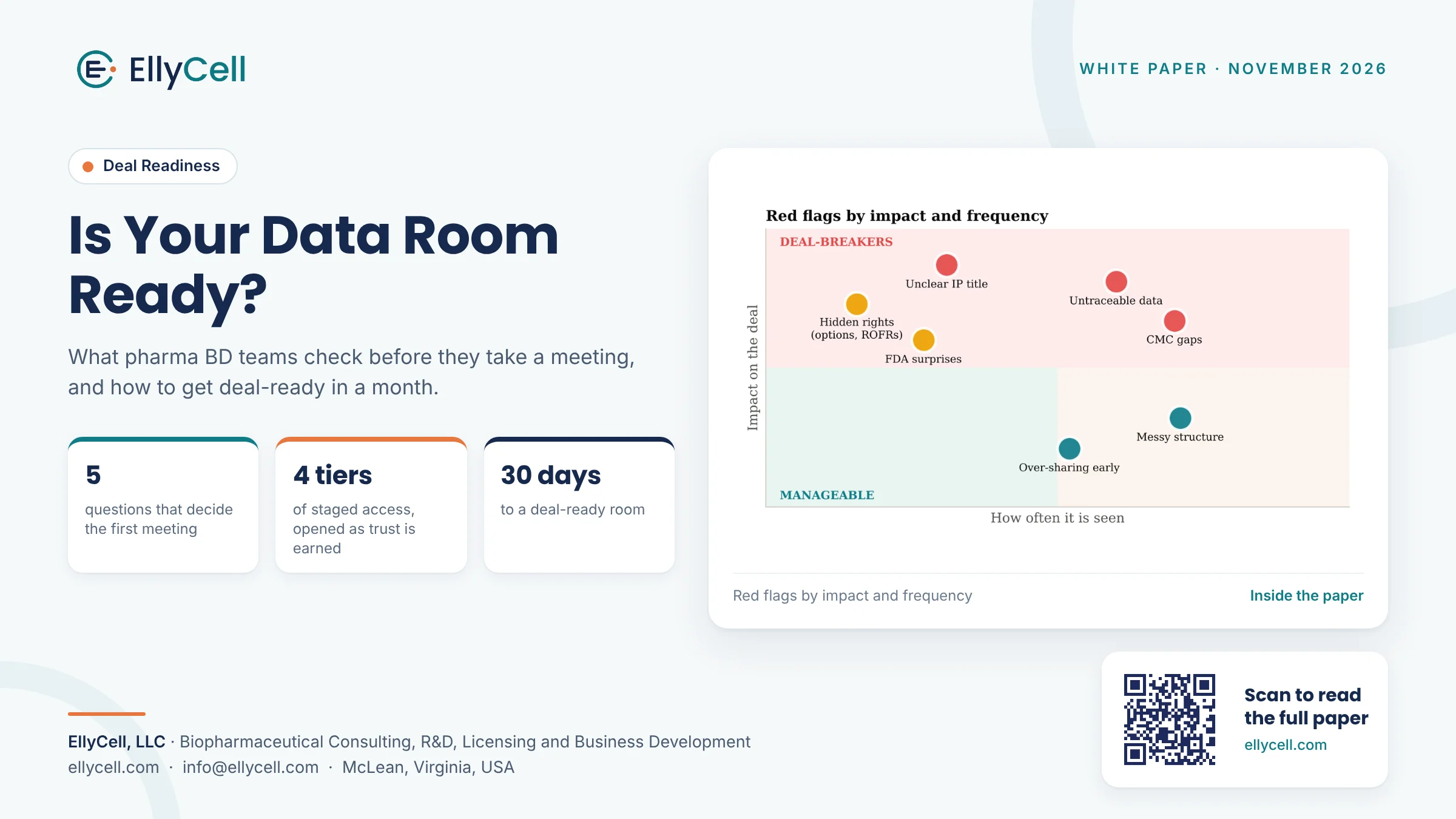
Not every problem is fatal. The ones that end deals sit high on impact and are common enough that reviewers look for them by habit.

| Red flag | How to defuse it |
| Untraceable data | Link every figure to its study report; state n, model and statistics; keep raw data ready for Tier 3 |
| Unclear IP title | Executed inventor assignments; a university license with field, territory and sublicense rights spelled out; an FTO memo |
| CMC gaps | Summarize process, analytics, CDMO, batch history and a costed scale-up plan |
| Hidden rights | Disclose options, rights of first refusal and co-ownership up front in a one-page rights map |
| FDA surprises | Post all agency correspondence; explain each issue and how it was resolved |
| Messy structure or over-sharing | Use a standard index and staged, watermarked, view-only access |
Do this week
Name one data-room owner. One person controls the index, uploads, permissions and the question log.
Run the five-minute screen yourself. Open your room as a BD analyst would. Can you answer all five questions in five minutes?
Pull crown jewels out of early tiers. Raw data, batch records and contracts belong in Tier 3, not in a pre-CDA deck.
Share in stages, not all at once
Open each tier only when the partner has earned it. Start with summaries and save full datasets for parties under a confidentiality agreement who are in genuine, detailed diligence.

| Tier | Trigger | What you open | What stays closed |
| Tier 0 | Before any CDA | Non-confidential deck, one-page asset summary, published data | Everything unpublished |
| Tier 1 | CDA signed | Data summaries, target product profile, IP list, development plan | Full reports, contracts, raw data |
| Tier 2 | Term-sheet discussions | Full study reports, CMC package, FDA minutes, FTO opinion | Raw datasets, batch records, notebooks |
| Tier 3 | Exclusivity or letter of intent | Raw datasets, batch records, contracts, notebooks | Nothing material |
Choosing a virtual data room
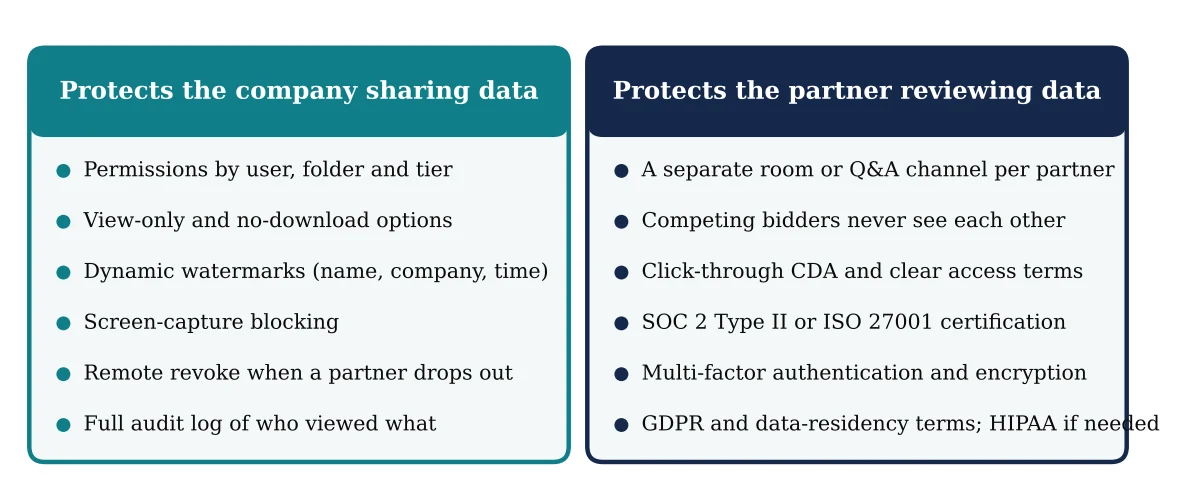
A virtual data room has two jobs at once: it protects what you are sharing, and it gives the partner enough assurance to put their own reviewers inside it.
Provider landscape
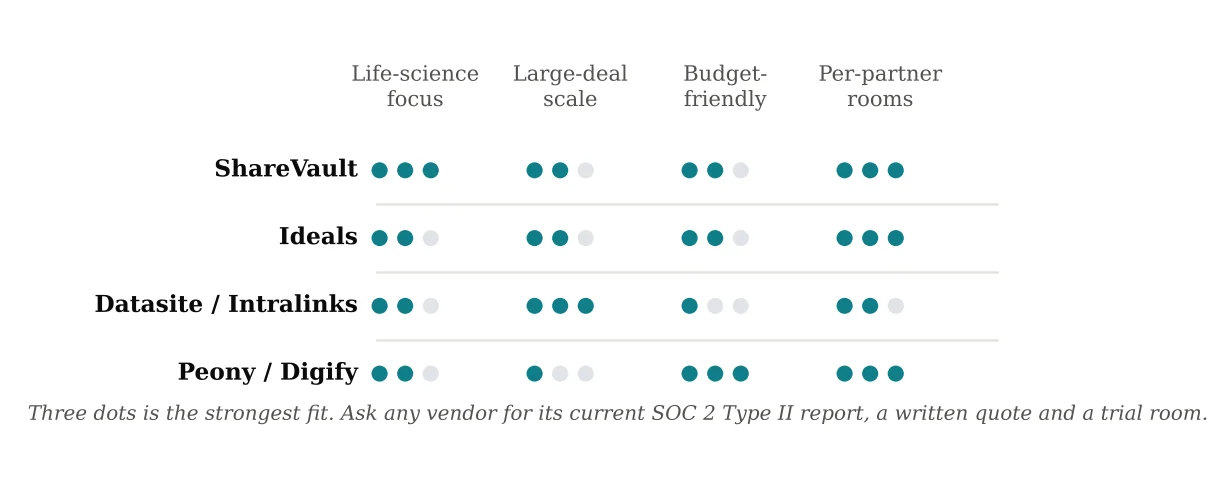
ShareVault is the life-science specialist. Datasite and Intralinks serve large, banker-run deals, where fees commonly exceed $50,000 per deal. Peony and Digify offer lower-cost flat plans. Ask any vendor for its current SOC 2 Type II report, a written quote and a trial room before committing.
Score your room
Rate each area from 1 to 5 before you start outreach. Anything under 4 is a gap worth closing first, because a reviewer will find it.
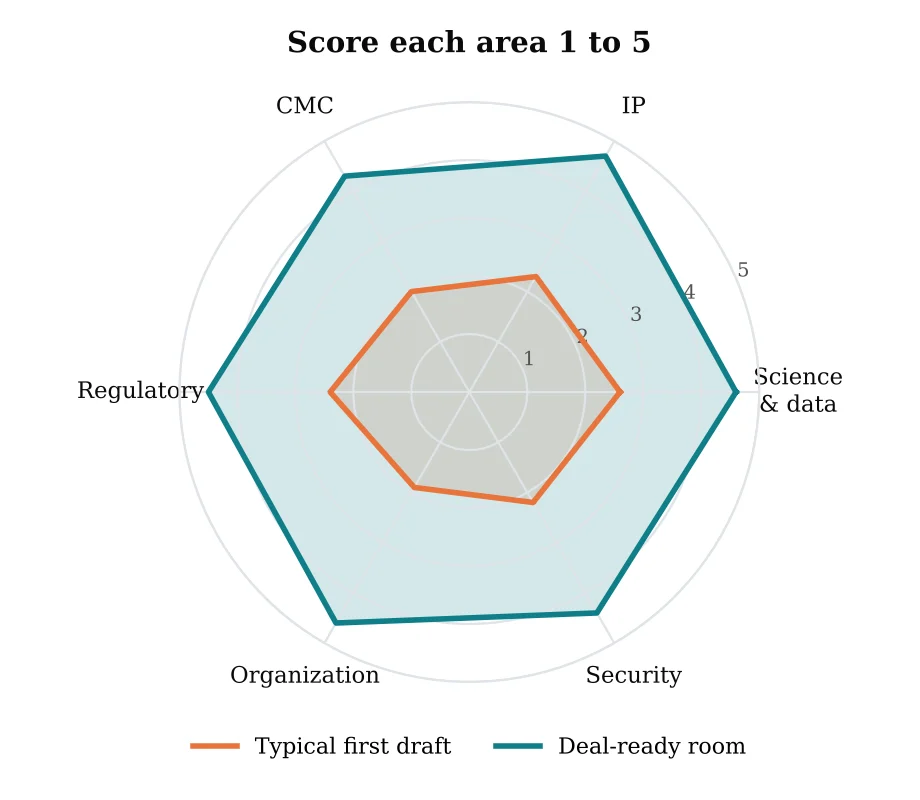
| Area | Score 5 looks like | Score 2 looks like |
| Science and data | Every claim traceable to a report; negative data included | Summary slides with no underlying reports |
| IP | Assignments executed, licenses in hand, FTO memo written | Title unresolved or university license unsigned |
| CMC | Process, analytics, CDMO and scale-up plan documented | A slide saying manufacturing is feasible |
| Regulatory | All correspondence posted with context | Selected highlights and no minutes |
| Organization | Numbered index, consistent file naming, one owner | A folder dump with duplicates |
| Security | Tiered permissions, watermarks, audit log, certified provider | A shared cloud drive link |
Thirty days to deal-ready
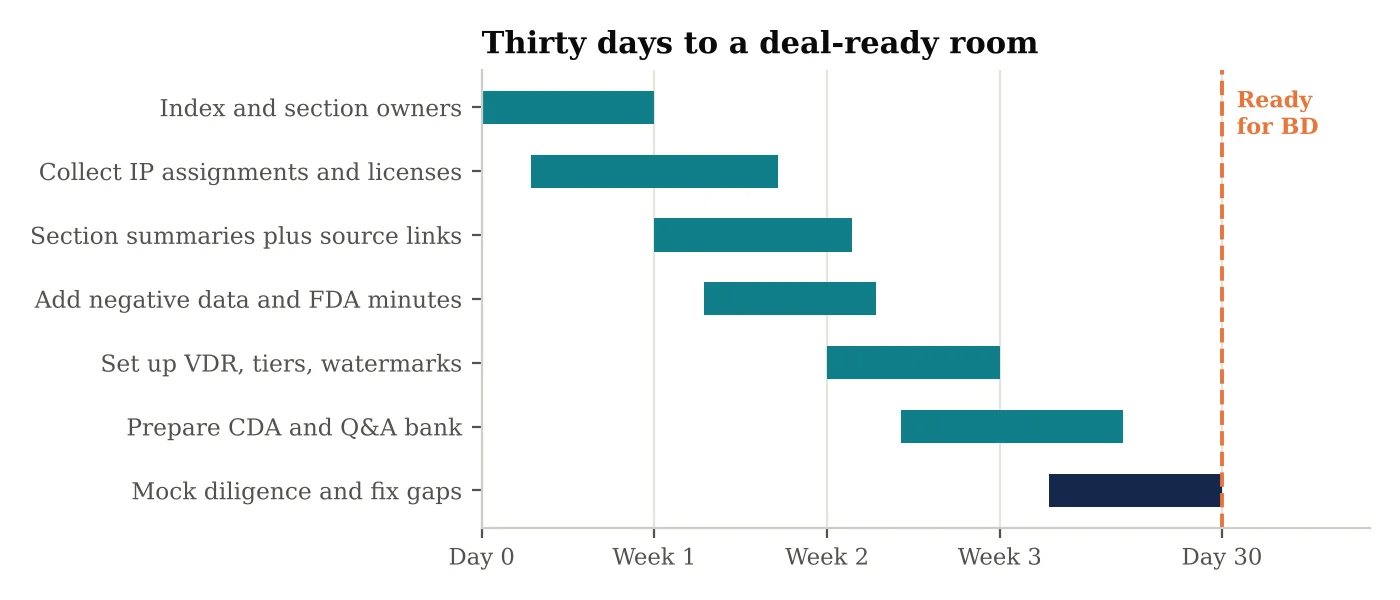
Most of this work is organization rather than new science, so it can run in parallel with ordinary operations. The sequence matters more than the speed: fix ownership and traceability before you build the room and run a mock diligence before any partner sees it.
How EllyCell can help you
EllyCell runs data-room readiness reviews and mock pharma diligence for biotech teams preparing for licensing, partnering and financing. We review your room the way a partner’s BD and technical teams will, and we tell you what they will find.
| Service | What you get |
| Readiness review | Your room scored across the six areas above, with a prioritized gap list |
| Mock diligence | A simulated pharma review, including the questions we would ask and the documents we would request |
| Index and structure | A numbered index that mirrors the BD checklist, with file-naming conventions and section owners |
| Technical gap closure | Help assembling the science, CMC, IP and regulatory sections, including summaries linked to source reports |
| Tiering and access design | A staged access plan, CDA template and question-and-answer process |
| Partner preparation | Partner mapping, outreach materials and support through the diligence process |
Need a second pair of eyes?
Send us access to your current room, or a description of what you have assembled so far.
We will review it as a partner’s BD team would and return a prioritized list of gaps with recommended fixes.
EllyCell, LLC, McLean, Virginia, USA https://ellycell.com, info@ellycell.com