03 · Licensing
Licensing vs. NewCo
A practical guide for Asian asset owners and Western buyers
Asia, led by China, is now the largest external source of new drug candidates for global pharma. Most asset owners still default to a classic license, but the NewCo model has gained significant traction.
EllyCell, LLC
Biopharmaceutical Consulting, R&D, Licensing and Business Development
McLean, Virginia, USA
Email: info@ellycell.com
Website: https://ellycell.com/
Executive summary
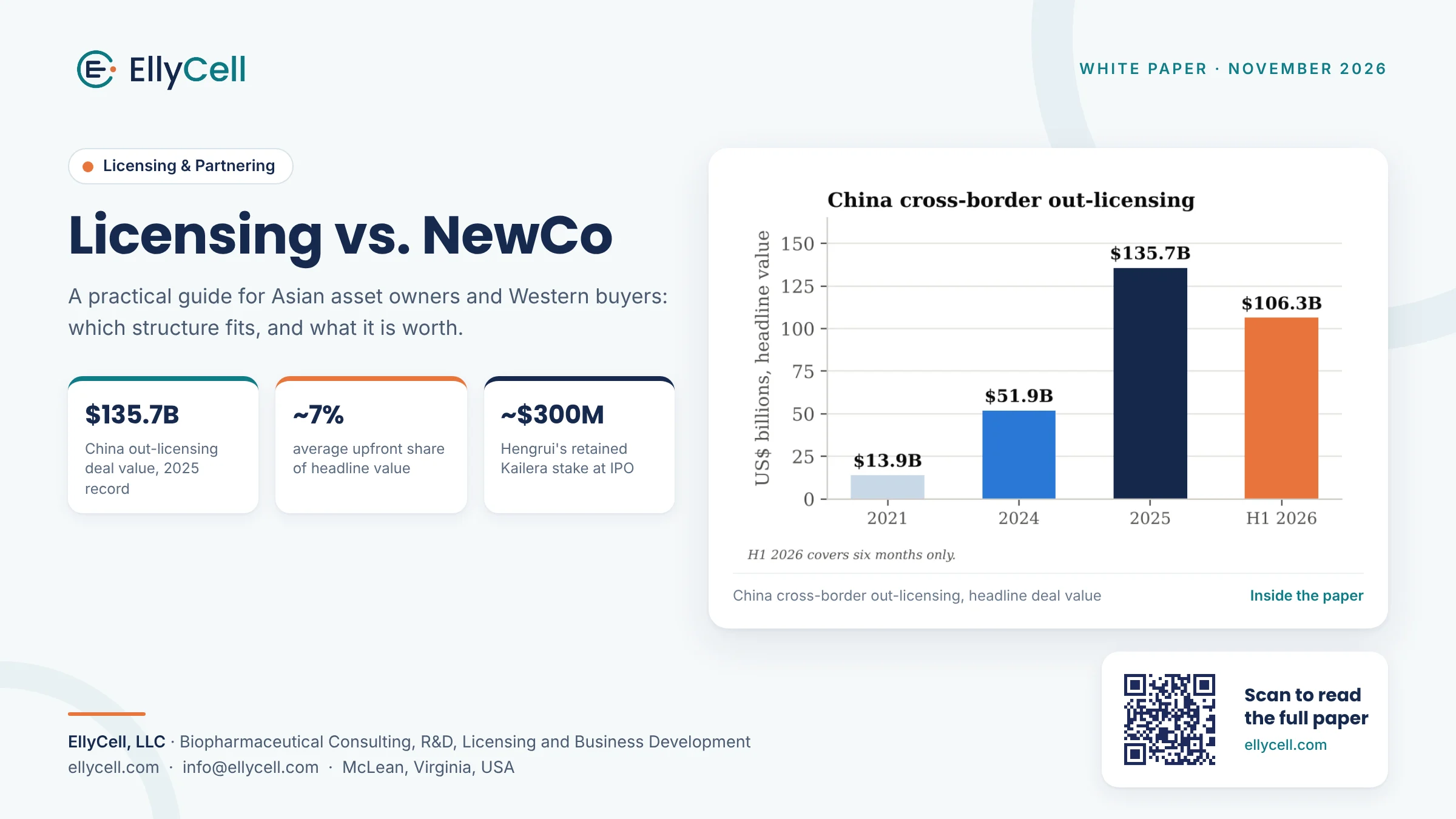
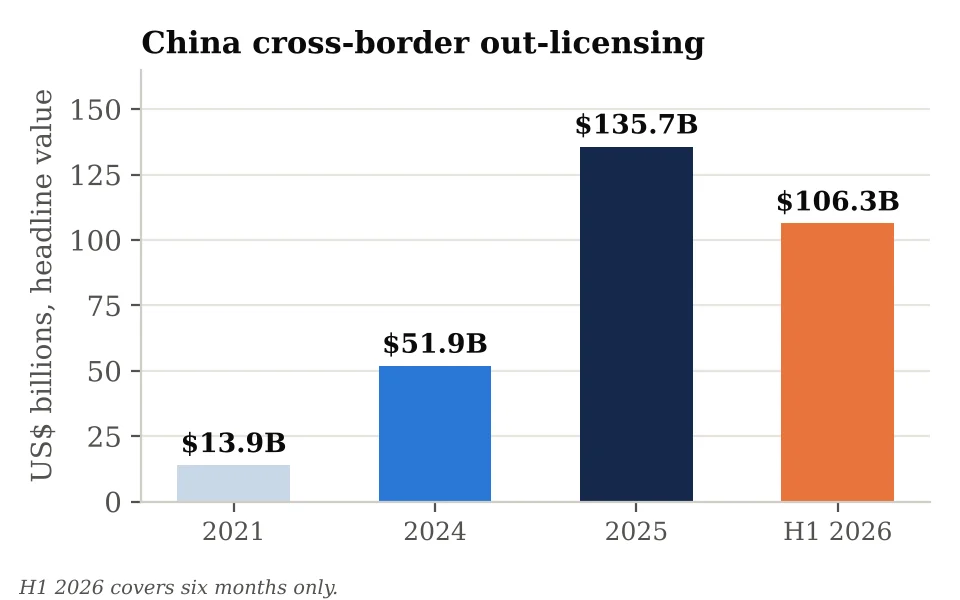
In 2025, Chinese drugmakers signed a record $135.7B of cross-border out-licensing deals, and 2026 is running even faster. The question for an asset owner is no longer whether a Western partner can be found, but which structure to use when one is.
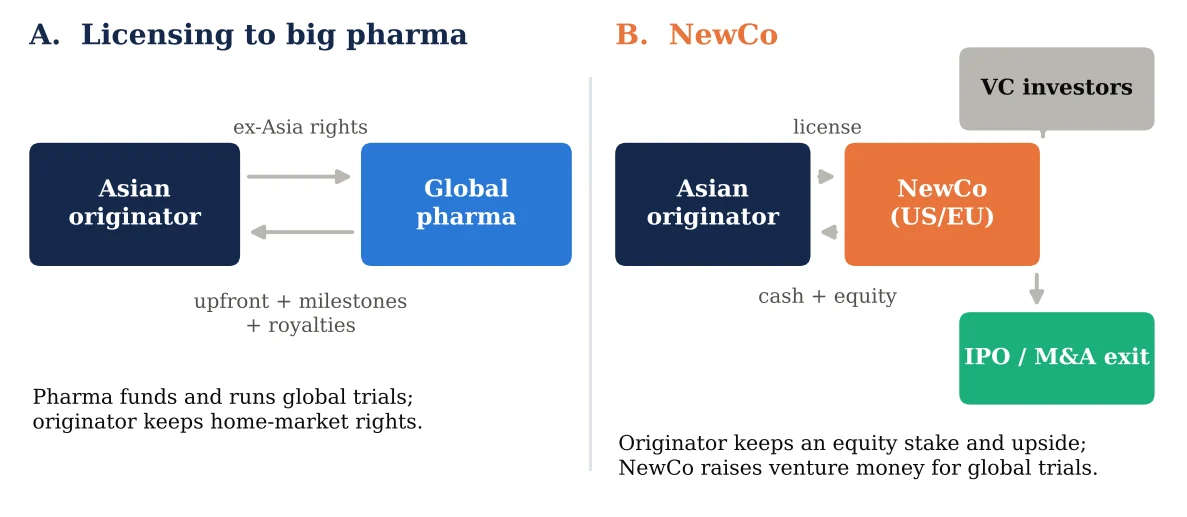
A classic license converts the asset into cash and capped upside. A NewCo, in which a US or EU company is created around licensed assets with venture funding, converts it into less cash and an equity stake that can re-rate. The right choice depends on data maturity, how hot the target class is, and how much upside the originator wants to keep.
$135.7B
China out-licensing value, 2025, across 157 deals
$106.3B
H1 2026 alone; 8 of the top 10 global deals were Chinese
About 7%
upfront as a share of headline value, 2025
9
China NewCo deals in 2025; the model is gaining traction
Key messages
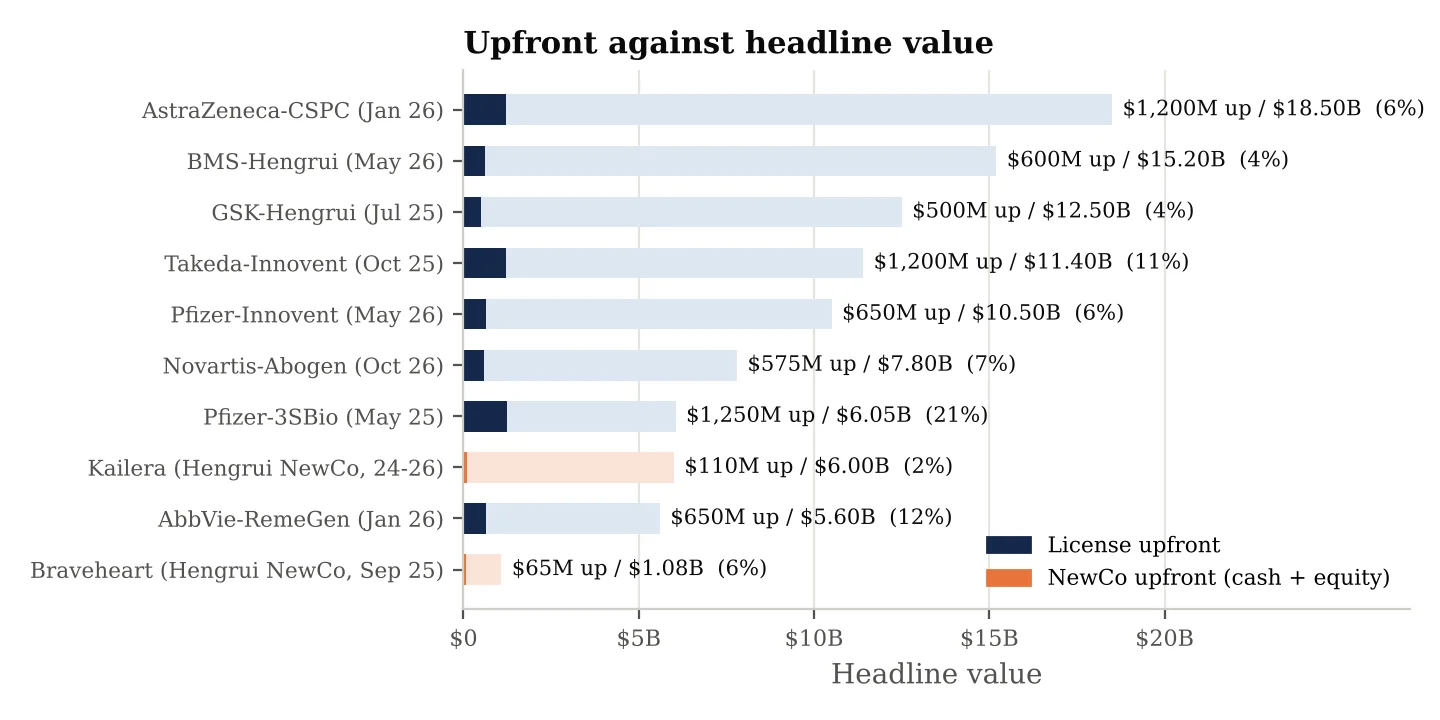
Read headlines with care. Headline value assumes every milestone is hit. Upfront cash averaged only about 7 percent of headline value in 2025.
Upfronts are rising. Average upfronts roughly doubled, from $38.8M in 2025 to $77.7M in early 2026.
Portfolio deals now dominate the top of the table. Multi-program transactions have displaced single-asset licenses among the largest deals.
The NewCo stake is the point. Hengrui’s Kailera stake fell from 19.9 percent to about 9.8 percent through dilution yet was worth roughly $300M at the April 2026 IPO.
The market at a glance, 2025 to 2026
Cross-border out-licensing from China has grown roughly tenfold in four years, and the first half of 2026 alone approached the whole of 2025.
The headline numbers are not what changes hands at signing. Upfront cash averaged only about 7 percent of headline value in 2025 [1, 4], although average upfronts roughly doubled from $38.8M in 2025 to $77.7M in early 2026 [5].
Compare like with like
Data sources differ. NMPA and PharmCube count $135.7B across 157 deals; PharmCube’s alternative count is $137.7B across 186. Check which basis a figure uses before you benchmark against it.
Major licensing deals
Ranked by headline value, 2025 to 2026.
| Date | Licensor to buyer | Asset or scope | Upfront | Headline |
| Jan 2026 | CSPC to AstraZeneca | 8 obesity / type 2 diabetes programs | $1.2B | $18.5B |
| May 2026 | Hengrui to BMS | 13 programs | $600M | $15.2B |
| Jul 2025 | Hengrui to GSK | HRS-9821 plus 11 programs | $500M | $12.5B |
| Oct 2025 | Innovent to Takeda | IBI363, IBI343; 40/60 US cost and profit share | $1.2B | $11.4B |
| May 2026 | Innovent to Pfizer | 12 early oncology programs | $650M | $10.5B |
| Feb 2026 | Innovent to Lilly | Preclinical asset | $350M | $8.85B |
| Oct 2026 | Abogen to Novartis | ABO2203 mRNA CD19xCD3 T-cell engager | $575M | $7.8B |
| May 2025 | 3SBio to Pfizer | SSGJ-707 PD-1/VEGF bispecific, plus $100M equity | $1.25B | About $6.0B |
| Jan 2026 | RemeGen to AbbVie | RC148 PD-1/VEGF bispecific | $650M | $5.6B |
| Jun 2025 | CSPC to AstraZeneca | AI-enabled discovery collaboration | $110M | $5.3B |
| Jun 2025 | BioNTech to BMS | BNT327, born at Biotheus, Suzhou | $1.5B | Co-development |
Four patterns
| Pattern | What it means for an asset owner |
| Multi-program portfolio deals dominate the top | A single strong asset may be worth more inside a package; Hengrui-GSK, Hengrui-BMS and Innovent-Pfizer were all portfolio transactions |
| Hot classes drive premiums | PD-1/VEGF bispecifics, obesity and incretins, and T-cell engagers are where buyers are competing |
| Buyers increasingly pay for preclinical assets | Innovent-Lilly reached $8.85B headline on a preclinical asset, so early data is no longer disqualifying |
| Profit sharing is returning | Innovent-Takeda split US cost and profit 40/60, which keeps more upside with the originator than a royalty would |
Two structures, side by side
| License to pharma | NewCo | |
| Cash today | Large upfront ($0.3B to $1.5B for top assets) | Smaller ($40M to $110M) cash plus equity |
| Upside | Milestones and royalties; capped | Equity stake can re-rate at IPO or M&A (Kailera: 19.9 percent to about 9.8 percent, about $300M at IPO) |
| Control | Buyer owns global strategy | Board seats; shared steering |
| Who funds trials | Big pharma balance sheet | VC rounds (Kailera more than $1B; Braveheart $382.5M IPO) |
| Process | Pharma diligence and internal approvals | Needs a VC syndicate, a US team build, and a China ODI filing |
| Key risks | Returned rights; portfolio reprioritization | Financing risk; dilution; US-China policy (BINSA) |
| Best fit | Validated clinical data; a crowded hot class | An early asset, a platform, or a class pharma is not yet buying |
The NewCo path in practice
The argument for a NewCo is not the day-one cheque. It is what the retained stake becomes if the asset progresses and the company lists or sells.
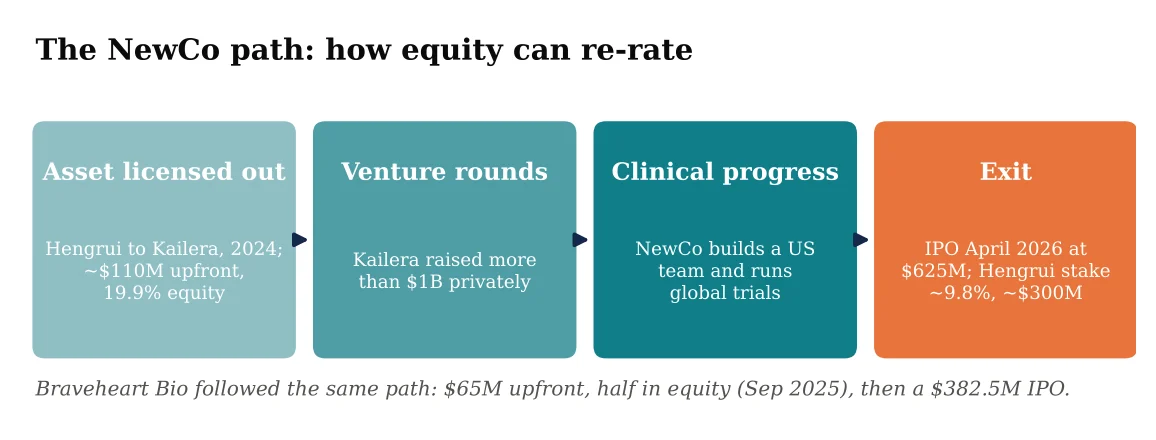
Hengrui spun GLP-1 assets into Kailera in 2024 for about $110M upfront, 19.9 percent equity and up to $6B in milestones. Kailera raised more than $1B privately and listed for $625M in April 2026; Hengrui’s diluted stake of about 9.8 percent was worth roughly $300M [11].
Hengrui’s Braveheart Bio followed in September 2025 with $65M upfront, half of it in equity, backed by Forbion and OrbiMed, and then a $382.5M IPO [11]. Allist and ArriVent, structured in 2021, listed in 2024, and a Keymed NewCo was bought by Gilead in March 2026 [6, 7].
Decision guide
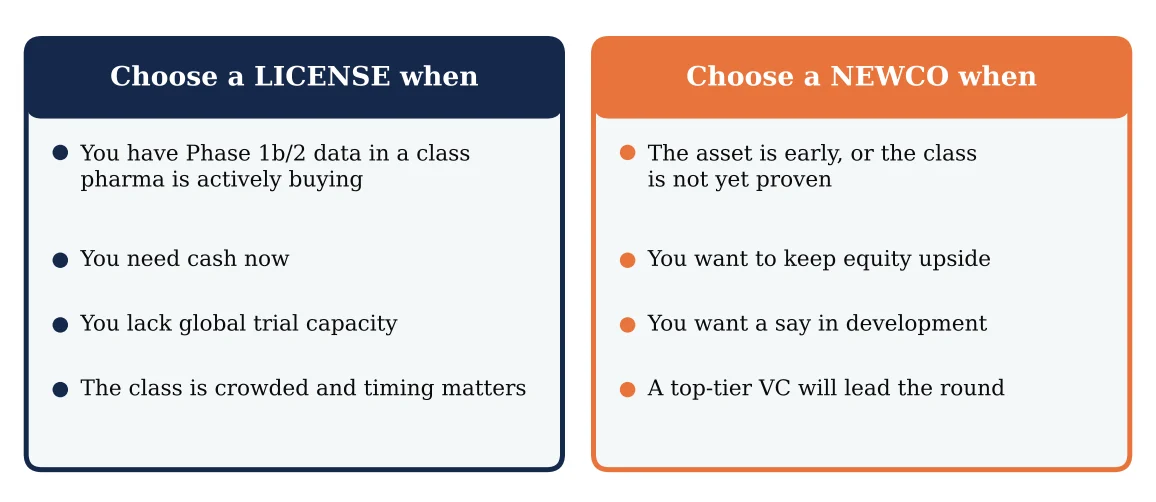
| If you are… | Choose a license when | Choose a NewCo when |
| An Asian asset owner | You have Phase 1b/2 data in a class pharma is actively buying, you need cash now, and you lack global trial capacity | The asset is early or the class is unproven; you want to keep equity upside and help steer development; a top-tier VC will lead |
| A Western buyer or investor | You are a pharma filling a pipeline gap and can underwrite diligence on China-generated data quickly | You are a VC or mid-cap seeking discounted, de-risked assets, and you can build a US team and an FDA-ready data package |
Watch-out before you sign
| Area | What to check |
| China outbound rules | ODI filings are required for a licensor to hold NewCo equity, and technology-export controls may apply. Start the filings early [7, 8] |
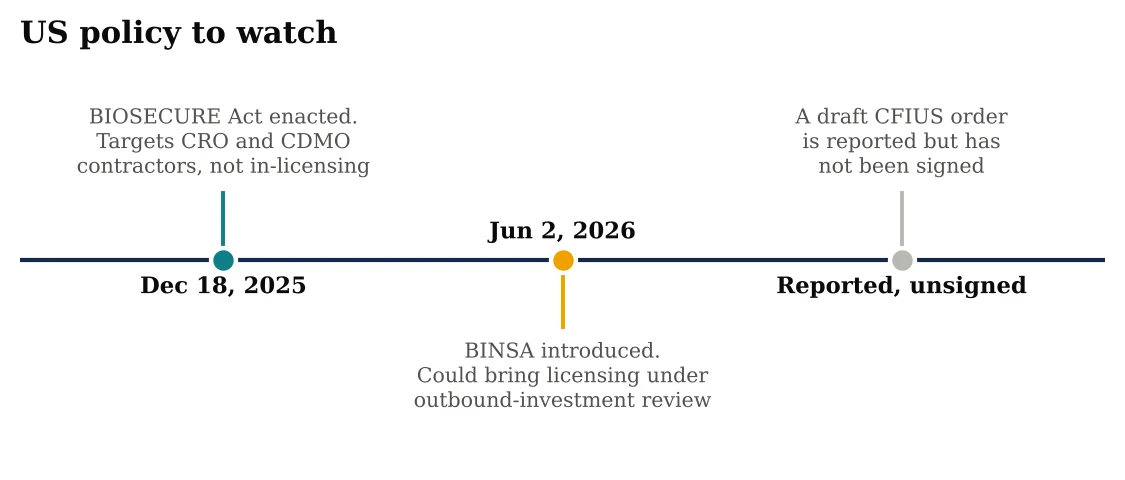
| US policy | BIOSECURE, enacted 18 December 2025, targets CRO and CDMO contractors, not in-licensing. BINSA, introduced 2 June 2026, could bring licensing deals under outbound-investment review. A draft CFIUS order is reported but unsigned [12] |
| Data acceptability | Plan multiregional or US bridging trials. FDA has pushed back on applications built mainly on China-only data |
| Deal hygiene | Negotiate on upfront and near-term milestones; define territory (is Greater China retained?); agree CMC and tech-transfer support, diligence obligations, and rights reversion |
How EllyCell helps
EllyCell works on both sides of these transactions: asset screening and positioning, buyer and VC mapping, structure modeling, and diligence support.
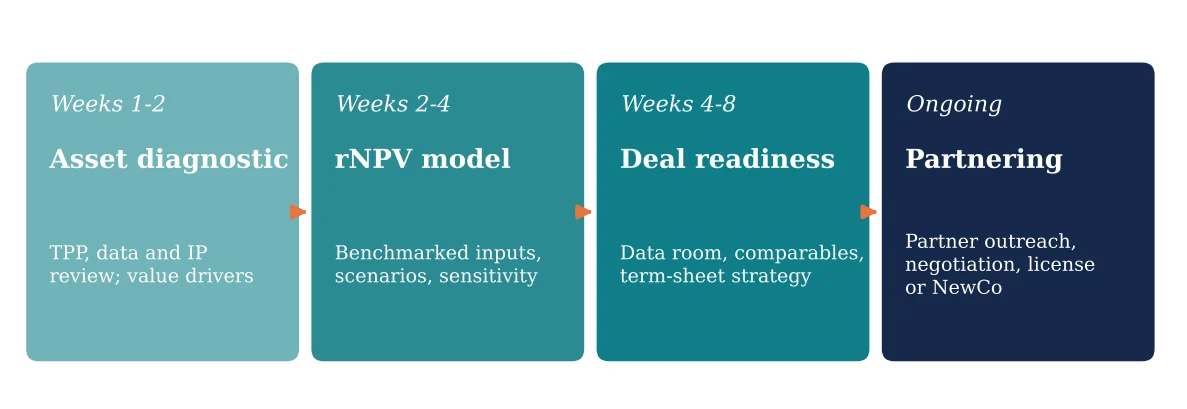
| Service | What you get |
| Asset screening and positioning | An honest read of where your asset sits against the classes buyers are actually paying for |
| Structure modeling | License against NewCo, modeled on your asset, your cash needs and your appetite for retained upside |
| Buyer and VC mapping | Tiered target lists of pharma licensees and venture investors, matched to your modality and stage, with warm outreach |
| Diligence support | Data-room preparation and response handling for a seller, or technical and commercial diligence for a buyer |
| Deal structuring | Term-sheet strategy and negotiation support, including territory, reversion and tech-transfer terms |
Start a conversation
Whether you are weighing a license against a NewCo, or evaluating an Asian asset from the buyer’s side, we can model the structures and map the counterparties.
EllyCell, LLC, McLean, Virginia, USA https://ellycell.com, info@ellycell.com
References
[1] Caixin Global, “Chinese drugmakers strike record $136 billion in overseas licensing deals,” 14 January 2026 (NMPA / PharmCube data).
[2] South China Morning Post, China biotech out-licensing 2025 totals, article 3339011, 2026.
[3] BioSpectrum Asia, “Asia as source” analysis (VBData H1 2026), 2026.
[4] Fierce Biotech, coverage of China deal upfronts, 2025.
[5] DIA Global Forum, PharmCube review of China 2025 licensing and NewCo deals, 2026.
[6] Cooley, “Key trends in China biopharma cross-border deals,” 17 March 2026.
[7] Morgan Lewis, “A strategic playbook for China out-licensing and NewCo structures,” April 2026.
[8] A&O Shearman (Mondaq), China outbound deal structures: ODI and technology-export rules, 2025.
[9] Innovent / Takeda press release (BioSpace), October 2025; AstraZeneca / CSPC (Pharma Focus Asia), January 2026.
[10] BioCentury article 658044, AbbVie and RemeGen, January 2026; BioSpectrum Asia news 26/28484, Novartis and Abogen, October 2026.
[11] PharmiWeb, Hengrui and Braveheart Bio, September 2025; The Bamboo Works, Kailera IPO, April 2026.
[12] DCAT Value Chain Insights, “China: the innovation factor,” 2026; BIOSECURE Act (enacted 18 December 2025); BINSA (introduced 2 June 2026).